

Memphis blogger Vance Lauderdale sees this practice as a business conflict: “This is just so wrong. It would be like morticians sitting in the emergency rooms, with an embalming kit in their laps.” Among the Memphis undertakers to whom he was referring was Spencer Company. Its scalloped glass weight advertised “Superior Ambulance Service.” The stained glass windows at the rear would indicate that their vehicle also doubled as a hearse.
 A fancier ambulance with a longer body and front mounted spare tire graced thescalloped paperweight from John V. May. May, a lifelong resident of Chicago, opened his undertaking business in 1914 on Milwaukee Avenue. As was often the case he and his family lived on the premises. Many other morticians were completing with May for customers and his ambulance service was a way of setting himself apart and gaining a business advantage.
 Like May, John A. Gentleman was an undertaker, opening his Omaha, Nebraska, funeral home in 1906. In the 1920s the firm moved to the “Gold Coast” area of Omaha at 34th and Farnam Street and issued a paperweight featuring his ambulance. Gentleman worked 50 years as an undertaker, before retiring in 1956 and selling his business to new owners who kept his name on the funeral home, one still in operation.
 An acclaimed African-American business in Memphis was T. H. Hayes and Sons Funeral Home, run by Thomas Henry Hayes, his wife, and two sons. The father founded it in 1902. It is said that his range of services were affordable to the working class as well as to the elite. In addition to his ambulance Hayes had ten rigs, five hearses, carriages, and 12 horses in his stables. When the funeral home closed in the early 1970s it was acclaimed Memphis oldest African- American owned business.
One of the few vehicles whose make was identified on an advertising artifact was this Holmes Sedan from the Ludlow Ambulance Service. The Holmes was a popular air-cooled American automobile built from 1918 to 1923 in Canton, Ohio. The car was famous for its louvered front grill that included a series of horizontal slits bringing in air any. An embezzlement by a top company executive in 1921 sealed the fate of the company founded by Engineer Arthur Holmes and it failed in 1923.

Perhaps the King Ambulance weight does not belong in this list. It was truly a doctor and hospital-based service, unaffiliated with any funeral home. Founded in 1886 and one of the first physicians exchanges and nurses registries in San Francisco, it was housed in a renovated Victorian mansion in the center city. In 1954 King merged with American Ambulance. The resulting King-American Ambulance Company has established itself as the longest operating private ambulance service in San Francisco and the West Coast.
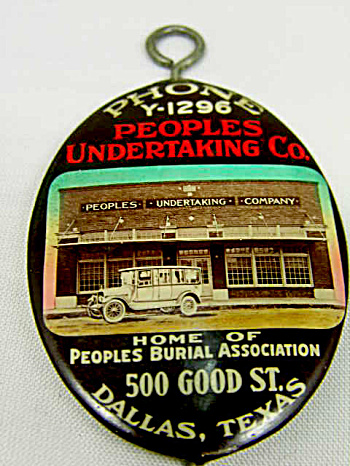 The Peoples Undertaking Company, a Dallas, Texas, business that advertised as the home of the “Peoples Burial Association,” issued this celluloid item that is described as a “paper clip and hook.” It occurs to me that It also might have been hung on a Christmas tree as an ornament, although it lacks a certain festive flavor. I have been unable to find any information on this establishment. The building shown here for 500 South Good Street appears to have been replaced.
With this celluloid pocket mirror we appear to return to an ambulance clearly being part of a funeral home business, this one in Norfolk, Virginia. It is from L. R. Cromer and Company that appears to be the forerunner of a still extant funeral business in the that city.

 Often in small town America, even into mid-20th Century, the undertaker also was a furniture dealer. Makes sense. The funeral director was buying caskets, a kind of furniture, why not add tables and chairs? Bayermann & Krug of Racine, Wisconsin, combined those businesses and added an ambulance service. They issued a clothes brush for their clients that up close reveals a vehicle with a red cross in the window motoring along.
Last month I did a post on paperweights that were issued by coffin makers to advertise their works. One outfit particularly known and collected for their casket and animal form weights has been Crane & Breed. At that time I was unaware that this Cincinnati company also built hearses — hearses that could double as ambulances, as in the photo here. This model was described thus: “The body is painted bronze green and the running gear carmine. The interior is finished in solid mahogany with an elevated cot on rollers. The vehicle is fitted with the best rubber tires and in winter will be heated with carbon stoves.” That elevated cot, of course, could accommodate a patient on the way to the hospital or a body going to the graveyard.

The hearse/ambulance automobile hybrid lasted some 70 years. Until as late as 1979 hearses in the U.S. could be combination coaches that also served as ambulances. In the late 1970s, however, stricter Federal standards were decreed for ambulances. The hybrids were unable to meet them and manufacturing was discontinued. In many smaller communities even today ambulances in vehicles distinct from hearses continue to be the business of the local undertaker.
Note: My first article on this subject, “Where to Buddy? Hospital or Graveyard?” was posted during July 2009. It presented six paperweights and two pocket mirrors. A second, called “Chasing the Ambulance: But Wait…Is It a Hearse?” followed in May 2013. That one displayed ten weights.


