Friday, July 22, 2011

"Comin' Thro' the Rye" - Whiskey, That Is


In 1782, the Scottish poet Robert Burns (1759-1796) wrote a poem that spoke of the sweetness of young love. It is the inquiry of a young swain of his girl friend that if they should happen to meet while walking through a field of grain, and he should kiss her, would her eyes well up in tears? The scene and the verse is shown on a Victorian-era trade card. Ironically, this image was issued by a company selling a laxative called “Sanative Pills.”

Through the years I have collected a number of pre-Prohibition postcards that use the same mantra -- “Comin’ Thro'’ the Rye” -- referring to liquor. Rye whiskey themes show up frequently citing Burn’s lyric and in related guises. The first example is of a well-dressed gentleman with plaid trousers strolling through bottles, flagons and one barrel, all marked “rye.” From the plaid we can assume, I suppose, that he is a Scot.

A very similar image follows. This time the gent is smoking a cigar and from the cut of his jaw the individual is Irish and, under the circumstances, clearly someone who imbibes. The lineup of rye containers he is negotiating includes bottles, flagons and, in this case, two barrels.

In the next card, the barrels have taken the spotlight and the bottles are small. We apparently are looking at a distillery worker who has filled them and is taking them off for sale -- or something. A very similar image was provided by a leather postcard. For a time in the early 1900s leather was a very popular medium for sending images through the mails.

The subsequent card continues the theme. Here the barrels are open and the worker, or a very thirsty person, has by chance or luck fallen into one. In the following card a gent with a top hat has emerged from a barrel of rye whiskey proclaiming that he “arrived here in good spirits.” This card also was tooled on leather.

In the final example, a gent in a vest is resting on a cushion, back to a barrel and sucking from it on a nursing nipple. The container is marked “Fine Old Rye.” Next to him is another cushion and “reserved” nipple. The message is: “I’m saving some for you -- Come on around.”

Rye whiskey cards were fairly common prior to Prohibition. Their frequency was indicative of the strong popularity of that form of spirits for much of the Nation’s history. The fall of rye in popularity with the drinking public since Repeal and the ascendancy of bourbon has been laid to many causes. My own view is that it was not so much the changing taste of the American drinking public as the identification of “rye” with an inferior kind of liquor sold in speakeasies during Prohibition.

Thursday, July 7, 2011

The Tile Club: Hi-Jinks and High Art


In keeping with my strong interest in art tiles, demonstrated in prior posts, I have been fascinated with a decade-long movement of American artists in the 19lth Century to paint on ceramic tiles, a movement that included one of our Nation’s foremost painters, Winslow Homer, pictured here.

The Tile Club was founded in the fall of 1877 in New York by a group of young artists and journalists who had been meeting informally from time to time to discuss art. Homer, an established artist at this point, was a charter member. As it evolved, the Club membership was held to twelve. When members left new ones were admitted by unanimous vote.

The Club was a highly fraternal and cordial type. There were no bylaws, officers, rituals, initiation or other fees. Initially the group met weekly at a member’s studio to, as the name implies, paint on tiles -- something none of them had done before. As detailed in a book by Ronald G. Pisano entitled “The Tile Club and the Aesthetic Movement in America,” the Club jointly agreed to undertake tile decoration and were pleased with the results of the experiment.

Over its life, membership in the Club included such American art luminaries as William Merritt Chase, Robert Swain Gifford, Earl Shinn, John Henry Twachtman, and Julien Alden Weir. Less well known, but charter members, were Arthur Quartly and Charles Reinhart.

In addition to their studio work, the Tile Club took summer outings to the beach, both for camaraderie and to paint. Their hi-jinks and excursions soon caught the fancy of the American press. Scribner’s Monthly of February 1879 featured a story of a Club outing to Long Island that had occurred in June of the previous year. It was captured in a ink drawing entitled “Ye Tilers in Procession.”

Homer (1836-1910) is accounted the most adventurous tile painter of the group. In addition to his use of bright colors on ceramics, he was prolific. Among Homer’s works are six known single tiles, one plaque and two fireplace murals. The first three examples shown here are from the master.

Chase, a young colleague of Homer, would make his reputation as an outstanding American Impressionist. He produced several tiles, including one of an old man in a flat hat, done in 1879, Chase (1849-1916) added his own name into the image before firing it. Today it is in the collection of the Hecksher Museum in Huntington, New York.

Quartly (1839-1886) was an American painter best known for his seascapes. Two of his tiles are shown here, a single tile entitled “Girl on the Beach” and a door panel depicting a fishing boat. Both were done with a limited pallet and indicate Quartly’s fascination with the marine environment.

The final tile is from Reinhart (1844-1896). Born in Pittsburgh, he later operated a studio in Paris. His reputation was largely for his pen and ink drawings many of which illustrated books and other publications of the times. For the Tile Club he created a door panel that included a heroic head and his initials.

With the publication in 1887 of an elegant “A Book of the Tile Club” by its members and the concurrent loss of its meeting place in a New York brownstone, the organization effectively came to an end. In terms of American art history the Club must be seen as a blip on the screen. At the same time the art works members left behind, including a number of tiles, demonstrate that good art can be achieved while having a good time.

Saturday, June 18, 2011

Kids Selling Beer


This post continues my series of images of children employed to advertise unlikely products. In March 2010 I dealt with kids selling whiskey and in October 2010, tobacco. This time the subject is beer.

Although the product being merchandised is different, the rationale behind the use of childhood innocence is the same: The attraction of consumers to a picture of a winsome youngster or two. All the illustrations shown here are pre-Prohibition, i.e., pre-1920. After Repeal in 1934 American mores had changed to the point where no brewery would have felt comfortable using children in advertising. (The Japanese still do.)

A theme that runs through many of these ads touts beer as a health food, safe even for children. Note the Schlitz ad. It shows a tyke of about 5 or 6, carrying a bottle of beer on a tray. In addition to its well-recognized mantra that Schlitz is “The beer that made Milwaukee famous,” the trade card states: “Mama says: It keeps us all well.” The clear inference is that this kid not only serves the beer but drinks it.

Schlitz cross-town Milwaukee rival, Blatz, similarly was pushing the health button. Its trade card features a cartoon tot, popping from a stein and chirping “Here’s good health.” Is the assumption that he has been imbibing in the flagon? The ad also assures us that “Blatz is certainly the finest beer ever brewed.”

The Virginia Brewing Company not only gives us a winsome little lady, but piles on the cute and cuddly by having her push a wheelbarrow holding two puppies. Virginia Brewing was a major beer-making operation, founded in Roanoke VA in 1890. Its Wurzburger Beer was touted as “a family tonic,” again an indication that it could be given to children. The company was shut down by state prohibition in 1916, reopened upon Repeal, struggled, and finally closed in the 1950s.

Vying for the “cute” title is a 1910 Easter greeting card from Buckeye Beer, located in my home town of Toledo, Ohio. If two puppies are fetching, how about four baby chicks surrounding a curly headed urchin? The flip side assured the reader that by drinking two pint bottles of Buckeye beer each day, “you will remain strictly temperate....” Buckeye traced its origins back to 1838. In 1886 the Buckeye name was adopted. The brewery survived Prohibition, for a time produced my favorite home town brew, and then in 1972 went out of business.

The Dallas Beer boys, shown with violin and flute, is more subtle. It has no health claims attached, just that “Mama and Papa” drink it. Demonstrating the value of some of these brewery ephemera to collectors, this card sold his year on eBay for $370. Even more pricey was the winsome, golden haired lassie on a tip tray issued by the Fredericksburg Brewery of San Jose, California. The tray recently sold at auction for $1,000. Founded in 1867 brewery survived until 1918 when closed by Prohibition.

Not all the children are having a good time with their beer. Christian Moerlein of Cincinnati, who often favored hordes of cherubs in his ads, shows a young lady who will never grow up to be a waitress. She has dropped one bottle of Moerlein beer and a glass to the floor and seems in danger of losing a second. Moerlein began by brewing beer in the back of his blacksmith’s shop during the 1840’s and saw the business become one of the Midwest’s largest. Under different ownership, the brand is still sold today.

Not only breweries exploited childhood images as a merchandising gimmick, local saloons did as well. Fred Pfalzgraf featured this trade card of a quartet of juveniles romping amidst the waves, apparently in Baltimore harbor. Just why two of them are wearing stocking caps in the surf is not apparent.

The final image in this series of kids selling beer is perhaps the most perplexing. It shows a scantily clad, evidently post-pubescent young girl fishing in a pond with what appears to be a butterfly for bait. It is an ad for the Adams Ale House of Concord, New Hampshire. Unfortunately one must assume that all involved in creating and distributing this image have long since left mortal life. Otherwise a question: “What exactly were you thinking of?”

Friday, June 3, 2011

The Vernacular Art of Cast Iron Bottle Openers


American vernacular art, according to experts Frank Maresca and Roger Ricco, often has a utilitarian purpose or origin that serves as a springboard for individual imaginations. Their book, American Vernacular: New Discoveries in Folk, Self-Taught and Outsider Sculpture,
includes a number of machine-made objects in order to drive home that point.

In that vein I have been fascinated by the variety and creativity embodied in cast iron bottle openers. They are far from being antiques. Most were manufactured in the ‘40s, ‘50s and ‘60s. Although the openers were cast from standardized molds, they were hand-painted by workers who often gave them individualized “personalities.”

The first group of castings shown here depict openers that were meant to be attached by nails or screws through holes in the ears to a wooden shelf or other surface. Maresca and Ricco mark the particular importance of sculptured faces in a contemporary times when most facial representations are two-dimension photographs. They believe three dimensional visages provide an important “presence” that photos cannot.

That may be the reason why the three faces shown here are so compelling. The four-eyed man, for example, shows up in a number of shapes and sizes with his teeth the hook for bottle caps. Seeing double he is a warning against overindulgence in alcohol. The Goofus face, another popular bottle opener, by contrast seems to be encouraging us with a wink to “let the good times roll.”

The top-hatted man with the sour look generally is known as “Mr. Dry” and comes in a variety of shapes, sizes and coloration. He is a Prohibitionist advocate and his frown greets anyone uncapping a beer bottle on his face. While the origins of many of these cast iron objects are unknown, “Mr. Dry” was created by Wilton Products, Inc., of Wrightsville, Pennsylvania.

The Wilton family began casting metal along the Susquehanna River in 1893. It was not until about 1935, however, that the company, presided over by a Wilton heir, began producing hand-painted cast iron objects, including bottle openers, trivets, candle holders and a wide variety of novelty items. These were most popular during and after World War Two.

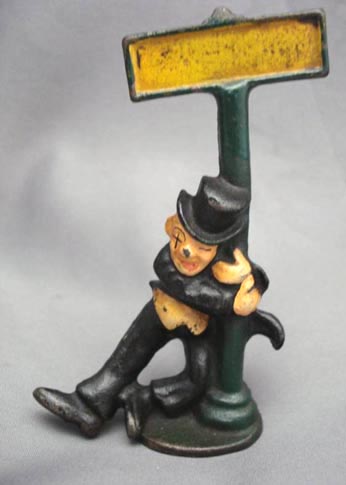
Another popular sculptured opener is a figure at a sign and/or lamp post. Often he is a drunk as indicated by his posture -- clinging to the post for dear life -- and an “x” over his eye. Less common is an item depicting a New Orleans hooker, provocatively showing a suggestive amount of ankle and thigh. The woman with the rolling pin obviously is waiting for her drunken husband to show up. Note that the hook of the opener is located at various points on the posts.

Mermaids are another popular cast iron format. Two are shown here but the variety is substantial. My hunch is that mermaids give an excuse for crafting a figure with bare breasts. After all it is largely men who are looking for a way to pop the top on their brewskies.

The black boy with the alligator nipping at his pants also comes in several variations. This bottle opener has an action quality that makes it particularly appealing. Using the Maresca/Ricco criteria, this object, like others shown here, would qualify as a vernacular American art. Moreover, all are eminently collectible at reasonable prices.

As can be seen on several of the openers shown here the original paint over time and with wear often tends to flake off, leaving the bare metal below. In fact, if an casting is too perfect in its appearance, it may be a reproduction or a repainted item. In the case of American vernacular, a la Maresca and Ricco, some damage or flaws would seem to enhance the artistic value.

Friday, May 20, 2011

John Lobmiller and the Whiskey Shakes


John Lobmiller was a glassmaker and inventor from Wellsburg, West Virginia, whose most memorable contribution to mankind may well have been a paperweight that contained shakable bar dice.

In 1885, together with other Wellsburg investors, Lobmiller founded the Venture Glass Works in that Ohio River town. According to an 1886 newspaper account. the glassworks specialties were brown flint glassware and private mold work. The article praised the operation: “These works are operated with natural gas, and while the establishment is not quite so large as some others, the work turned out is equal to those of more metropolitan pretensions.” The enterprise apparently succeeded to the extent that Lobmiller would marry Cora Nelson of Wellsburg in 1898.

As an inventor, Lobmiller had a number of ideas to improve existing tools and artifacts. In 1901 he filed with the U.S. Patent and Trademark Office an application to make a new kind of paperweight. Most weights of the time were solid glass with an image pasted or sealed in the base. Lobmiller created a paperweight of glass and metal with a cavity. His application noted that “moveable devices of circular or other form can be confined in the cavity....” Such devices, he noted, would add “novelty and attractiveness” to weights.

Two years later, on August 18, 1903, the U.S, Government issued Lobmiller his patent. There was an immediate interest in the invention from a source that Lobmiller may or may not have had in mind. Although his illustrations show small marbles in the cavity, whiskey dealers and saloonkeepers saw the open space as perfect for holding bar dice.

Shaking for drinks at the bar is an American tradition almost as old as the Republic. Patrons gamble against the bartender or against each other on who picks up the drink tab. Bar dice games typically are played with a set of five six-sided dice. Each player takes a turn rolling the dice either to outdo opponents or to accrue points.

Pre-Prohibition whiskey distributors like Harald Schmidt in Indianapolis (1903-1918) were quick to see the advantages of Lobmiller’s invention. The paperweight with dice would advertise Schmidt’s Fairmont Whiskey, reminding patrons of its availability behind the bar. In Memphis, Tennessee, Italian immigrant Dominic Canale had the same idea. He distributed five-dice paperweights to those saloons carrying his “Old Dominick” whiskey. Canale’s company (1885-1915) also featured brands, “B-Wise” and “Dominick Special Rye.”

On Milwaukee’s South Side, George Frank ordered up Lobmiller paperweights for his drinking establishment on National Avenue. His “sample room,” a high flown name for a saloon, is now the site of an apartment building. The base of all three of these weights bear the Lobmiller patent date. It is unclear but likely that they were fabricated at his Wellsburg glassworks.

In addition to the artifacts featuring a round cavity inside a square glass, a second Lobmiller patent variety was a broader, round paperweight. This is exemplified by the Clingstone Rye weight, shown here, one that also bears the 1909 patent date. This item was distributed by the Shiff, Mayer Co. of Cincinnati, in business from 1906 until 1911. Clingstone Rye was its flagship brand.

Lobmiller’s success almost inevitably drew copycats. Shown here are three whiskey weights, all probably from the same manufacturer and all bearing a “patent applied for “ designation. No evidence exists of a patent actually being granted, not surprising given how close the concept was to Lobmiller’s. Among the whiskey merchants making use of this “knockoff” were the Old Kentucky Fine Whiskey Co. of Kansas City, Missouri (1900-1902) and Winner Rye, the product of Wm. Mulherin & Sons, Philadelphia (1887-1918). A third was a weight advertising Pennsylvania Pure Rye. It is unusual because it features only three dice. This weight was distributed by Buffalo, New York, whiskey rectifiers known as C. Person’s Sons Company (1850-1920).

Despite the interesting legacy of whiskey memorabilia that John Lobmiller made possible, his own life apparently was plagued with difficulties. He committed suicide in Wellsburg in 1913. An obituary in a glassworkers trade paper cited “business troubles” as the cause.

Friday, May 6, 2011

Jug Bands


As the Marty Python crowd used to say, “Now for something completely different.” Well, not quite. This blog is mostly about bottles and booze and a post about jug bands fits both. For example, the Old Grand-Dad Jug Band, shown here on a early 1900s post card, was an advertisement for whiskey.

The names of this ensemble are lost in history but the brand they were merchandising lives on. Old-Grand-Dad bourbon was the product of a Marion County, Kentucky, distillery founded by the Hayden family about 1785. A grandson, Raymond Hayden, took the operation into full-scale commercial production when in 1882 he built a distillery at Hobbs Station in Nelson County.

When Raymond died without heirs the distillery was sold. Over the years it went through several ownerships until Prohibition in 1920 shut the plant down for good. The brand name has continued to be perpetuated to this day, reputedly using the original Hayden formula. By employing a jug band to merchandise Old Grand-Dad in the pre-Prohibition era, the distillers were clearly appealing to an African-American audience. Early jug bands typically were black.

Their instruments were a mix of traditional: fiddle and guitar -- and homemade: washboards, tubs, and, of course, jugs. The last was essential. Its swooping sounds filled a musical niche somewhere between a trombone and a tuba. Usually stoneware and sometimes glass, a jug is played by buzzing the lips into the mouth to play low and mid-range harmonies in rhythm. Experts could achieve two octaves, controlling changes in pitch by altering lip tension.

Jug bands clearly had a certain commercial appeal. Schlitz, a nationally known Milwaukee beer of German heritage, issued a trade card for its five-man jug band. The brewery clearly saw this ensemble as a good marketing image for its sales of Schlitz in Africa-American communities. Like the Old Grand-Dad band, this one was left anonymous. A recent CD release uses the same picture on the cover, however, and identifies the group as the Memphis Jug Band, one the most famous of the genre.

This ensemble was organized by singer-guitarist Will Shade. Born in Memphis, Tennessee, he lived there virtually all his life until he died in 1966. Other members of the band over the years included Ben Ramey, Charles Polk and Will Weldon. Between 1927 and 1934 the group recorded nearly 75 musical numbers whose up-tempo rhythms continue to delight. The Memphis Jug Band also is shown here in a later photo and in a color illustration by the famous American illustrator, R. Crumb, himself a passionate fan of blues, jazz and early country music.

Not just alcohol fueled the use of jug bands in commercials. Here are shown five musicians, with a prominent jug, called the Ballard Chefs Jug Band. They were regulars on Louisville radio station WHAS-AM. It broadcast their weekly program from the 1920s through the early 1930s over the Eastern half of the United States, sponsored by the Ballard Flour Company Fiddler Henry Miles was the leader. The legendary Earl McDonald for three years (1929-1932) did vocals and extraordinary jug-blowing.

After a period of neglect, during the folk music fever of the late 50s and early 60s jug bands revived. Most of them featured white musicians. Shown here is the Jolly Joe’s Jug Band. It was founded by record collector and music impresario Joe Bussard. The jug being used by Joe’s band, a 20th Century cylinder of stoneware, seems mighty puny compared to the earlier bands.