
Friday, November 19, 2010

Looking at Label Under Glass


During two years as a curator/cataloguer for the Stabler-Leadbeater Apothecary Museum in Alexandria, Virginia, I was able to see and handle some of the museum’s large collection of “Label Under Glass” bottles, similar to those shown here. I found them an interesting artifact of a bygone era.

Label Under Glass bottles were most common from the mid 1800s to the early 1900s. They were used for storage of many medicinal solutions employed by pharmacists of the time. The bottles featured an ornate, often gold leafed, label that was covered by a thin layer of glass to prevent damage. Then the glass-covered label was pasted to a bottle with an appropriate indentation to permit a smooth front. As objects they were attractive as well as functional and they dressed up a pharmacy.

Hair products and barber bottles also made use of Label Under Glass as shown in this Wildroot Dandruff and Eczema bottle from the Wildroot Co., Inc. This company was founded in the Buffalo New York in 1911. It registered the trademark “Wildroot” with the government in 1932. Who can forget its catchy jingle: “Get Wildroot Cream Oil, Charlieeee.” The company was sold to Colgate-Palmolive in 1959.

The contents of the Wildroot bottle shown here could have been drunk as well as slathered on the head. The label announces that it contained not more than 40% grain alcohol. That is 80 proof, about the same as some gin. That note takes us to another industry that made use of Label Under Glass to merchandise its products -- whiskey distilling.

The first example are three winsome lasses advertising Galaxy Whiskey. They appear on a back of the bar bottle, a finely lithographed image covered in clear glass. This whiskey was the product of the Peter McQuade organization of Brooklyn, New York. It registered the brand name with the government in 1905. McQuade also merchandised another alcohol-laced beverage under the name “Amazon Bitters.”

Kit Carson Whiskey featured a Label Under Glass bar bottle that featured the American explorer and Indian fighter with his horse. It was the product of Wood, Pollard & Co. of Boston. Founded in 1881, the company was supplied with whiskey product from the warehouses of the Mayfield Distillery in Kentucky. Kit Carson was only one among more than a dozen Wood, Pollard brands. They included “Very Old Cabinet 1873,” “Oxford Rye,” “Snowdrop Gin” and “White Wheat Whiskey.”

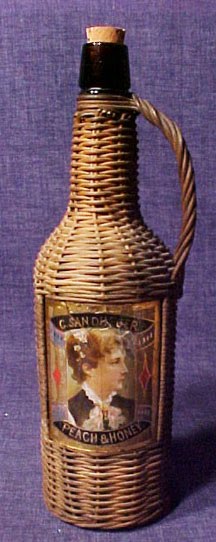
Chris Sandheger emigrated from Germany to the United States about 1853 when he was 21 and settled in Cincinnati, Ohio. After serving as an accountant in a liquor store, in 1857 Sandheger established his own liquor business. Under his management the firm grew steadily and his alcoholic brands found a wide local and regional trade. His “Peach and Honey” shown here was a cordial. He gave its bar bottle not only a distinctive Label Under Glass, but also wrapped it in wicker.

Sandheger was a rectifier, not a distiller, obtaining his whiskey from Kayser Distillery and other Kentucky producers. Following his death in 1906 family members continued the business until shut down by Prohibition. Among their brands were “Old Sandheger Club,” “Old Still,” and “Stone Lick.”

Prohibition brought an end to fancy bar bottles. Too many of them had been filled by saloon keepers with phony liquor after their initial pouring. Federal laws now prohibited them. Thus bar bottles with Labels Under Glass can easily be identified as pre-Prohibition.

Label Under Glass also was frequently used for whiskey flasks, often provided for special occasions. Among them were the National Encampments of the Grand Army of the Republic (GAR), the Union soldier veterans organization. In 1895 I.W. Harper, a brand of the Bernheim Bros. issued a special Label Under Glass flask to mark the event, held in Louisville, Kentucky, home town of the whiskey makers.

Another flask honored the veterans of the Spanish American War. The label depicted a soldier and a sailor in full combat gear of the times. The bottle gives no evidence of where or by whom it originated. The final example is among the most intriguing. The glass-fronted label shows a young woman in an abbreviated costume and high heels who is striking a provocative pose. The flask was issued by the Emrich Hotel on Pennsylvania Avenue in Washington, D.C., which might have been signaling the nature of its clientele. Like the two prior flasks it also is pre-Prohibition.

Label Under Glass bar bottles and flasks are avidly collected. The Emrich Hotel bottle, for example, recently sold at auction for $190. Condition is often an issue with these items. As seen on some bottles here, the glass cracks or the glue holding the label to the glass surfaces discolors. It is virtually impossible to find one in perfect preservation. Nonetheless, even damaged bottles are pricey. By contrast, Label Under Glass apothecary bottles and jars, although frequently collected, seldom fetch more than $50 and often less.

Friday, November 5, 2010

Who the Heck Was Irvin S. Cobb?


Once he was among America’s top celebrities: author of 60 books, he was America’s highest paid journalist, a star of radio, motion pictures and the lecture circuit. More celebrated in his time than Jay Leno or David Letterman in ours, he hosted the Academy Awards in 1935, received the French Legion of Honor, and two honorary doctorates. A bridge over the Ohio river, parks, a major hotel, and a brand of cigars were named after him.

Yet today, little more than 60 years after his death almost no one knows who Irvin S. Cobb was or what he did. If for nothing else he should be celebrated for his role in repealing the Prohibition amendment to the Constitution.

Irwin Shrewsbury Cobb was born in his grandfather’s house in Paducah, Kentucky, in 1876, shown here in postcard view. At the age of 16 he was forced to quit school to support his mother and siblings. By the age of 19 he was the youngest newspaper editor in the country, working for the Paducah Evening News. Moving to the Louisville Evening News, he gained attention for a humor column entitled “Kentucky Sour Mash.”

Encouraged by the success of his column and encouraged by his wife, he headed to New York City to make his mark. In the Big Apple he eventually landed a job with the New York World and within months was writing a nationally syndicated column, one that eventually boasted readership in the millions. H.L. Mencken, who came to regret it, once compared him to Mark Twain.

As native Kentuckian, Cobb was steeped in the taste and lore of whiskey. As shown here in a movie still, drinking often was a feature of his film roles. At the height of Cobb’s popularity in 1920 National Prohibition was enacted. At first he dealt with it humorously, writing that: “Since Prohibition came in and a hiccup became a mark of affluence instead of a social error as formally, and a loaded flank is a sign of hospitality rather than of menace, things may have changed.”

That jocular attitude had vanished by 1929 when Cobb wrote the only American novel devoted to the American whiskey industry. Entitled “Red Likker” and featuring a map of Kentucky on the cover, the book tells the story of an family that founded a distillery called Bird and Son right after the Civil War. It traces the history of the business to Prohibition when, like most distilleries, it was forced to close. Ultimately the distillery is destroyed by fire and the family is reduced to to running a crossroads grocery store.

Not only did Cobb inveigh against Prohibition in his literary works, he made it a personal crusade. Joining a national organization called the Association Against the Prohibition Amendment, he became its chairman of the Authors and Artists Committee. Under his vigorous leadership the committee ultimately boasted 361 members, including some of the nation’s best known figures. As chairman, he blamed Prohibition for increased crime, alcoholism, and disrespect for law. “If Prohibition is a a noble experiment,” he said, “then the San Francisco fire and the Galveston flood should be listed among the noble experiments of our national history.”

When Prohibition finally ended in 1934, Cobb was recognized for his contribution. The first night liquor became legal, he reportedly went to a hotel bar that once again had begun pouring, pulled out a $20 bill and hollered: “Drinks for everyone.”

Immediately after Repeal the whiskey industry feared that the buying public no longer knew how to make mixed drinks. The result was a plethora of drink recipe books. When newly revived Frankfort Distillery wanted one to plug its brands, it turned to Cobb. He obliged with a pamphlet in which he claimed, somewhat fancifully that one of his ancestors, Dean Henry Cobb, an immigrant from Ireland, in 1636 was the first publican licensed to draw spirits in the New World. He also described a great-grandfather who went west to Kentucky and founded “Squire Cobb’s Tavern” along the Cumberland River, a business Cobb claimed the “squire” abandoned one step ahead of the sheriff.

During the late 1930s and early 1940s, Cobb’s reputation plummeted as racist themes came to the fore in his writing. In 1941 his national column was canceled. Increasingly in ill health, Cobb died at age 68 in 1944. He was buried with a simple headstone in a Paducah cemetery. The inscription reads “Back Home.” The memory of Cobb’s life and fame quickly faded. The products to which he gave his name are no longer sold.

Perhaps the most enduring monument to a man who helped rid the Nation of Prohibition is the Irvin S. Cobb bridge. It is a two-lane span that carries U.S. Route 45 over the Ohio River from Brookport, Illinois, to Paducah. Motorists complain that it is a bumpy ride.

Friday, October 22, 2010

Seeing Whiskey Through a Reverse Glass


Reverse painting on glass consists of applying paint to the back of a piece of glass and then viewing the image by turning the glass over and seeing it through the glass. This art form has been around for centuries. It was used for sacral paintings in the Middle Ages and frequently was used for gilded images.

“Verre eglomise,” as the French call it, had something of a renaissance during the 1800s and early 1900s, used by both artists and by the fledging advertising community in Europe and the United States. Quick to see its commercial value in merchandising were American whiskey distillers and dealers. An attractive reverse glass sign in a saloon might entice more customers to imbibe their product.

I find these signs among the most attractive artifacts that the pre-Prohibition whiskey-makers have left to posterity. My favorite is the elegant “art nouveau” sign from John A. Dougherty’s Sons of Philadelphia. The elaborate “W” in “whiskey” is particularly decorative.

This distillery was founded by John Alexander Dougherty, a native of Ireland who arrived as a youth in Philly in 1814 by way of Halifax, Nova Scotia. Originally a baker, Dougherty eventually moved to making whiskey and in 1849 founded the distillery that bore his name. He had several sons who, upon his death in 1866, continued the business until Prohibition.

Pennsylvania was a state that seems to have fostered elegant glass signage. The second example, also from Philadelphia, is redolent with gold. It advertised a distillery founded in 1874 by Angelo Myers. Framed in gold, the sign also features two medallions that commemorate gold medals the whiskey had won at national expositions. This firm, with Myers father and son as presidents, survived 44 years before Prohibition closed its door. Quite unusually, two of four Myers’ one time corporate officers were women.

A third Philadelphia sign advertised the “Army and Navy Whiskey” from the James Moroney Co. A wholesalers and importer, Moroney founded his firm in 1875. Other brands he featured were “Moroney Pure Rye,” “Old Navy,” and “Round the World Scotch.” The company closed in 1918.

In Pittsburgh, the Joseph S. Finch & Co. was founded in 1873 to great success and made its “Golden Wedding Rye” into one of America’s best known brands of whiskey. It was responsible for two elegant reverse glass signs, one that screamed gold and a second that replicated its Golden Wedding logo. In this case, we know the identity of the creator of at least one of the signs. The back of the first, faint but visible, is written: John Golding Glass Sign, 240 Pearl Street, New York.

Although Hill Side Rye is advertised as being Pennsylvania whiskey, the brand actually was distributed by a New York City based outfit (1880-1918) known as Steinhardt Bros. There were four of them - Lewis, Henry, Morris and David. Together they forged a highly successful whiskey business. Not distillers, they collected whiskey from a variety of sources, “rectified” (mixed it) and sold it nationally and from outlets in New York under a number of brand names, including “White Lily Pure Rye,” “Emerald,” and “Lafayette Club.” This sign bears the signature of artist Thomas G. Jones of New York.

Unlike most of the distillers and wholesalers above, Pfieffer Bros. were relatively latecomers to the whiskey business, first opening their doors in 1902. Rectifiers and wholesalers, their glass sign features the firm’s flagship brand, “Silas Moore.” Pfieffer Bros. also sold their whiskey under brands names such as “Dixie Belle,” “Old Cornelius,” and “Tom Hudson.”

Pfieffer Bros. and the other whiskey companies cited above successfully were in business from the time of their founding until National Prohibition. This time spread makes it virtually impossible to date exactly any of these signs. Not so with the company that produced the final example shown here. “Royalty Club” was a brand name of the Anton Friedmann company in Cincinnati, Ohio. City directories first show Friedmann’s organization in 1870. By 1874 it had disappeared.

Although reverse glass advertising signs are still being made, many of them attractive, our legacy from the pre-Prohibition whiskey makers set an artistic standard that will be difficult to match--ever.

Friday, October 8, 2010

Kids Selling Tobacco


Last March my blog concerned the dubious use of children in order to sell whiskey through trade cards and ads. More recently I have become interested in the frequent use of youngsters, up until a few years ago, to sell tobacco products. The interest was kicked off by a 1890 ad for Mail Pouch chewing tobacco, shown here, that featured a laughing baby in diapers and the double entendre caption, “He just found his mail pouch.”

Perhaps West Virginia’ most famous consumer product -- one whose faded ads can still be found on thousands of barns across rural America -- the company began with brothers Aaron and Samuel Bloch, who ran a small grocery and dry goods store in Wheeling on the Ohio River. They also had a small cigar factory on the second floor. They conceived the idea of flavoring the scrap cuttings that were left over from the cigars and selling them in paper bags as chewing tobacco. Thus an industry was born.

The brothers had excellent marketing sense and built the company to national fame. Aaron was succeeded as president in 1902 by brother Samuel, who in turn passed the company along to his son, Jesse Bloch, in 1937. Jesse’s son, Thomas took over in 1947 until the firm was sold in 1969. Mail Pouch chewing tobacco is still being sold.

By using a baby to advertise their chew tobacco the Blochs were only emulating a wide range of tobacco manufacturers who used the images of children to sell their products. In a blog in June 2009, I related how Richard Outcault, the creator of Buster Brown, franchised several cigar makers to use his child cartoon character in their merchandising. One colorful label showed a man blowing cigar smoke from his ears, to the clear delight of Buster and his dog, Tige.

Subsequently I have found four more cigar makers using kids to flog their products. The most interesting are Nabob Cigars. Their box lid features a pair of boys, one white, one black, both in tattered or ill-fitting clothes. The white lad is smoking a cigar and clearly enjoying the experience. The black youngster seems to be wishing too he had a cigar.

Three other lids feature little girls and were sold under childish names. “Toto” seems to have sprouted butterfly wings. “ Lulu” is an preschooler with a shawl and heavy coat. “Elsie” is hatless and leaning on a well. Neither of the latter two looks particularly happy. Were these the children or perhaps grandchildren of the cigar makers? My research has found no answer.

A happier tobacco-selling tike was featured in a trade card by the G. W. Schreiber Co. of Philadelphia, a dealer in tobacco and “segars.” Why a tike catching an eel in a net should be considered an apt selling point for tobacco products escapes me, other than the general idea that images of children catch the attention of consumers.

These images, however, pale before a 1951 series of ads for Marlboro Cigarettes that ran in a number of national magazines. In them a series of super cute infants relate messages for both Mom and Dad. To Mom, the toddler had a question: “Can you afford not to smoke Marlboro?” And a second baby admonishes: “Before you scold me, Mom, maybe you better light up a Marlboro.” Dad got no questions, just approval for always smoking the infant’s choice.

Given what we know today about the dangers of smoking, these ads, particularly the Marlboro campaign of almost a half-century ago, may seem like something out of the Dark Ages. Today it would be unthinkable to merchandise tobacco using kids. But not so long ago....

Friday, September 24, 2010

Snakes in Clay


Right now somewhere in the Carolinas, I believe a potter lovingly is molding a snake onto a ceramic jug or pot. Although he assumes a ready sale for this work of his hands, the artist may be unaware that he is following a tradition almost 500 years old. In fact, this year is the 500th anniversary of the birth of the artisan who early conceived the idea of creating snakes in clay.

His name was Bernard Palissy, French, born in 1510. Shown here, Palissy was a early biologist during a period of great interest in the natural world. Also a potter, he made casts of actual specimens of animals and sea life and reproduced the forms on ceramic platters. Rampant on his dishware are fish, frogs, lizards, crayfish, shellfish, and -- most prominent -- snakes.

Palissy’s pottery developed a cult following in Europe and America during the 1800s. Many potters copied his plates and created ceramics in his “rustic” style. Two Americans were among them. In 1859 Cornwall Kirkpatrick (1814-1890) and his brother Wallace (1828-1896) founded the Anna Pottery in the southern Illinois town of Anna. Although their production included a wide range of ceramic items they have become best known for their snake jugs. Two shown here are among several dozen known specimens.

The traditional view of the Anna Pottery snake jugs has been that they were a temperance artifact and a warning against strong drink. More recent interpretations, with which I am in accord, have a different view. They point out grotesque, sexual and scatological aspects of the jugs, their humor and satirical “over the top” style. Moreover, the Kirkpatricks regularly supplied ceramic jugs and other containers for the whiskey trade. The conclusion is that the Anna snake jugs really are an attack on Victorian values and that the brothers were, like their contemporary Mark Twain, misanthropic humanists.

Whatever their motivation, the Kirkpatricks created snake jugs that fetch tens of thousands of dollars in the rare instances when the ceramics come up for sale. They also inspired generations of future potters to create serpent-featuring jugs, right up to our own time. Shown here are three contemporary examples.

The first is the product of W.A. “Bill” Flowers. Flowers, a North Carolina resident, specializes in ash glazes that impart a “tobacco spit” look to his ceramics. His jug shown here features a single large, smiling snake that seems to be guarding the contents of the jug.
The originator of the second ceramic is Marvin Bailey, a folk potter and artist from South Carolina. He works with salt glazes and often uses color to “dress up” his reptiles. His jug appears to bear the replica of a coral snake.

The third contemporary jug shown here is by a Kansas City artist, who signs his work, “W. Painter.” Known particularly for his mini-jugs, Mr. Painter is a student of earlier potters like the Kirkpatricks and tries to recreate their techniques and motifs. He has given his jug a surface approximating tree bark and looped a thin snake around it that eventually becomes its handle.

The tradition Bernard Palissy began a half millennium ago still is being carried on in small ceramic studios throughout America. For a long time to come we can be assured of viewing snakes in clay. Of Palissy himself, after a lengthy career as a favored potter to royalty, an intemperate outburst led to his being thrown into the Bastille. Although the French king offered Palissy freedom if he would recant, he refused and died in a dungeon cell in 1889 at the age of 80.

Thursday, September 9, 2010

H. L. Mencken and Monticello Rye


Known widely as the “Sage of Baltimore”, H.L. Mencken was the most influential American commentator of the first third of the 20th Century and a man of strong opinions, pro and con, about almost everything. One of his strongly positive views was of Maryland rye whiskey. Of those, the brand name that most often came first to his mind -- it was his father’s favorite -- was Monticello Rye.

This brand was the original product of Malcolm Crichton, who was born in Illinois, the son of a Scottish-born wholesale grocer, about 1840. Moving to Baltimore, Crichton took over a defunct distillery, rebuilt the facility and began producing a whiskey he called “Monticello Rye.”
The 1880s was one of rapid growth as Monticello Rye rapidly became a popular national brand. Under the slogan, “Its All Whiskey,” ads trumpeted the purity and medicinal value of Crichton’s rye whiskey. Distributors like Loeb-Lion-Felix in New Orleans and Peter Welty in West Virginia featured the brand.”

Mencken contended that a friend “always ate rye bread instead of wheat because rye was the bone and sinew of Maryland whiskey -- the most healthful appetizer yet discovered by man.” This was clear to the Mencken family physician, Dr. Z. K. Wylie. According to Mencken, the good doctor “believed and taught that a shot of Maryland whiskey was the best preventive of pneumonia in the R months.” Mencken’s father Augustus, a cigar manufacturer, was entirely convinced. Moreover, when the senior Mencken sent out for whiskey, he wanted Monticello Pure Rye. His famous son recounted:

“His...bill file shows that on December 27, 1893, he paid Courtney, Fairall & Company, then the favorite fancy grocery fancy grocers of Baltimore, $4 dollars for a gallon of Monticello whiskey...Before every meal, including breakfast, he ducked into the cupboard in the dining-room and poured out a substantial hooker of rye, and when he emerged he was always sucking in a great whiff of air to cool off his tonsils. He regarded this appetizer as necessary to his well-being. He said it was the best medicine he had ever found for toning up the stomach.”

When Malcolm Crichton died in 1890, it appears that none of his four sons were interested or equipped to take on the business. By 1892 M. Crichton & Co. had disappeared from Baltimore city directories. But as often was the case with popular brands, the Monticello name lived on. Thomas G. Carroll & Sons of Baltimore (1872-1919) added “Monticello Whiskey” to its own brands. By 1903 the rye brand was being produced by a new Baltimore-based firm called The Monticello Distilling Co.

Baltimore distilling came to a screeching halt with the coming of Prohibition in 1920. Mencken abhorred it. “The chief argument against Prohibition is that it doesn’t prohibit” he commented. “This is also the chief argument in favor of it.” The author personally responded to the “Great Experiment” by selling his car and using the proceeds to purchase a large stock of “the best wines and liquors I could find.” We can guess Monticello rye was among them. Mencken stored them in a basement vault in his home whose door bore a custom-painted sign emblazoned with a skull and crossbones. The sign said: “This vault is protected by a device releasing chorine gas under 200 pound pressure. Enter at your own risk.”

No one celebrated the end of Prohibition with more gusto than Mencken. A photograph on the front page of the Baltimore Sun showed him downing the first beer to be poured at Baltimore’s Rennert’s Hotel bar in 13 years. “Pretty good. Not bad at all,” the paper quoted him saying. But he complained about paying higher prices for liquor after Repeal. Now, he contended, Monticello Rye cost $3 to $3.50 a quart -- not the $4 a gallon his father had paid.

After Repeal, the brand survived, at least into the 1940’s, the vintage of the Monticello mini-bottle shown here. In 1967, after the deaths of Mencken and his brother left their Hollins Street house empty, Baltimore citizens interested in turning it into a museum found in the cellar numerous full bottles of whiskey and wine, as well as a few empties. There is no written record to reveal if Monticello Rye was among them, but we may be excused for believing so.

Friday, August 27, 2010

Hunting for Hugo Thuemler


In the early 1980s as a collector of ceramic whiskey jugs, I bought a canteen-shaped porcelain bottle advertising Puritan Rye, a whiskey from D. Sachs Company of Louisville, Kentucky. On the base was a round pottery mark for the Thuemler Manufacturing Company. It took me more than 20 years to research this firm and its founder, Hugo Thuemler.

During the hunt I discovered something quite unexpected. Thuemler made only a limited number of whiskey jugs -- perhaps as few as four -- but designed and produced scores of different beer steins and mugs for the American brewing industry. He also created them for root beer makers, fraternal groups, tourist attractions, and conventions. Because the company ceased with Thuemler’s death in 1908, every one of these ceramic drinking vessels legitimately can claim the status of antiques.

Hugo Thuemler was born in 1847, almost certainly in Germany. During his youth German manufacturers had developed a process of transfer printing that allowed more mass production of decorated steins. Exactly when Thuemler arrived in the U.S. is unclear, but he brought with him the Old World knowledge of decorating both pottery and glass.

In 1894 when he was 45 years old, he is recorded as living in Rochester, Pennsylvania, a town not far from Pittsburgh. His occupation then was listed as “salesman.” Four years later an area directory carried a notice for the Thuemler Manufacturing Co., a business that described itself as a “manufacturer of novelties, decorators of china and glassware,” This theme was repeated in its billhead. A number of early Thuemler items carry a Rochester mark.

By 1901 Hugo had relocated his operations to the Pittsburgh suburb of Sewickley where he employed a number of skilled decorators. He also maintained a second address, probably a sales office, in Pittsburgh. Subsequently his wares bore a “Pittsburg” (the official spelling for a short time) pottery mark.

Thuemler’s firm filled an evident need for American breweries. In the past decorated advertising mugs and steins had to be ordered from German suppliers with added cost and delay. Hugo’s ceramics, some of them shown here, solved that problem. I am particularly fond of the blue and white stein produced for the Fred Sehring Brewery of Joliet, Illiniois, and the patriotic themes created for Pabst of Milwaukee and the American Brewery of St. Louis. The handle of many steins, like the one from Sprenger Brewing, featured a ceramic portrait of King Gambrinus, the mythical German king who is the unofficial patron of beer and brewing.

Although earlier it appeared that Hugo Thuemler appears to have lived a bachelor’s life, information has come to light in 2015 indicating that he may have had a wife and daughter.  Further, there is some evidence that he kept a residence in Berlin.  In Sewickley, we know he lived at the Elmhurst Inn, a boarding house that originally was a private mansion. According to a newspaper obituary Thuemler died there on September 1, 1908, at the age of 61. Cause of death was listed as “acute indigestion.” After Hugo’s demise, production ceased and all references to the firm disappeared. More than a century later, however, Thuemler items are being avidly collected and prices have risen steadily.

For a decade or more I have kept an ever-growing list of Thuemler products that have come to my attention. It now numbers some 90 marked items and an additional few that are unmarked but may be attributed to Thuemler. The list does not contain prices. Anyone wishing a copy may write me enclosing a self-addressed stamped envelope: Jack Sullivan, 4300 Ivanhoe Place, Alexandria VA, 22304.