
Showing posts with label Anna Pottery. Show all posts

Friday, November 4, 2011

Anna Pottery and Alcohol


In an earlier post entitled “Snakes in Clay” (September 2010), I traced the history from 16th Century France to the present day of creating ceramic objects that incorporate in them a variety of snakes, lizards and other creepy crawly animals. The article included material and images of the snake jugs produced by the Kirkpatrick brothers at their Anna, Illinois, Pottery, shown here in 1885. I alluded in passing to my skepticism about the standard interpretation that the jugs were powerful anti-alcohol, “temperance” objects.

Ceramic gurus have opined that the jugs “illustrate the evils of strong drink” and that “the ghastly images evoked in these jugs are brutal and meant to be a warning to those tempted by liquor.” One critic cites the Kirkpatricks as “having a tenacious adherence to temperance principles.” Certainly a look at the first jug pictured here would seem to bear out those opinions. It appears to show a man being nibbled to death by a pack of slimy creatures. Is this what Wallace and Cornwall Kirkpatrick, the latter shown here, were try to say?

The fallacy of this temperance view can be seen in two other jugs featured here. This visual evidence is backs up the observations of Author Richard D. Mohr in his 2003 book entitled, “George Ohr and the Brothers Kirkpatrick.” Mohr states: “I suggest that literalist readings of the snake jugs, readings which take them as nothing but temperance propaganda, are almost certainly too simplistic and probably flat out wrong.” Right you are, Mr. Mohr, and shown here is further proof of your contention.

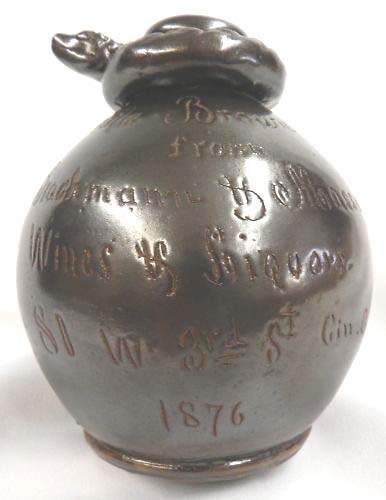
The two Albany slip jugs shown here were commissioned by Brachman & Massard from the Kirkpatricks and Anna Pottery And who were Brachman and Massard? They ran a wine and liquor wholesale and retail business that was located at 81 West Third Street in Cincinnati. The first jug, shown from three angles, features a snake that wraps around the neck of the jug and then loops out to form the handle. The incised letters in the Albany slip on the front identifies the item as a “Little Brown Jug” from the liquor dealers and bears the date 1876.

If the witness of this jug is not enough to dispel the notion of the Kirkpatrick’s temperance crusade, a second ceramic crafted for Brachman & Massard should be sufficient. Shown here in two images, this small jug carries a similar label, including identification of the company as wine and liquor dealers. But it adds a most unusual feature: At the base are incised a group of slashes that indicate 8 to 7.

The most likely interpretation is that this was the Kirkpatrick’s enigmatic reference to the Presidential Election of 1876 in which Samuel Tilden, the Democrat, received a larger popular vote than the Republican, Rutherford B. Hayes, but the electoral vote essentially was a tie. To decide which one would become President a group of five House of Representative members, five Senators and five Supreme Court Members were selected. By an 8 to 7 vote -- widely thought to have been swayed by political promises - - they determined that Hayes was the winner. The result set off a firestorm of protest as expressed in a Thomas Nast Harper’s cartoon of the time. On another snake jug the brothers emblazoned “Eight villains to seven patriots.”

While the Kirkpatricks frequently made such political statements on their ceramics, it is clear that the brothers were not demonstrating a pro-temperance attitude by fashioning two jugs for Cincinnati liquor dealers. Or by creating a ceramic pig, shown here, that invites “a little good old Bourbon.” Rather, the symbolism of the Anna Pottery snake jugs expresses the brothers’ sardonic, highly individualistic look at the world just as they did with other ceramic objects they created.

As a postscript to the story it should be noted that Brachman & Massard went out of business sometime around 1897. The Kirkpatrick’s Anna Pottery ceramics continue to elicit great interest and one snake jug recently sold at auction for $83,650, a new record.

Friday, September 24, 2010

Snakes in Clay


Right now somewhere in the Carolinas, I believe a potter lovingly is molding a snake onto a ceramic jug or pot. Although he assumes a ready sale for this work of his hands, the artist may be unaware that he is following a tradition almost 500 years old. In fact, this year is the 500th anniversary of the birth of the artisan who early conceived the idea of creating snakes in clay.

His name was Bernard Palissy, French, born in 1510. Shown here, Palissy was a early biologist during a period of great interest in the natural world. Also a potter, he made casts of actual specimens of animals and sea life and reproduced the forms on ceramic platters. Rampant on his dishware are fish, frogs, lizards, crayfish, shellfish, and -- most prominent -- snakes.

Palissy’s pottery developed a cult following in Europe and America during the 1800s. Many potters copied his plates and created ceramics in his “rustic” style. Two Americans were among them. In 1859 Cornwall Kirkpatrick (1814-1890) and his brother Wallace (1828-1896) founded the Anna Pottery in the southern Illinois town of Anna. Although their production included a wide range of ceramic items they have become best known for their snake jugs. Two shown here are among several dozen known specimens.

The traditional view of the Anna Pottery snake jugs has been that they were a temperance artifact and a warning against strong drink. More recent interpretations, with which I am in accord, have a different view. They point out grotesque, sexual and scatological aspects of the jugs, their humor and satirical “over the top” style. Moreover, the Kirkpatricks regularly supplied ceramic jugs and other containers for the whiskey trade. The conclusion is that the Anna snake jugs really are an attack on Victorian values and that the brothers were, like their contemporary Mark Twain, misanthropic humanists.

Whatever their motivation, the Kirkpatricks created snake jugs that fetch tens of thousands of dollars in the rare instances when the ceramics come up for sale. They also inspired generations of future potters to create serpent-featuring jugs, right up to our own time. Shown here are three contemporary examples.

The first is the product of W.A. “Bill” Flowers. Flowers, a North Carolina resident, specializes in ash glazes that impart a “tobacco spit” look to his ceramics. His jug shown here features a single large, smiling snake that seems to be guarding the contents of the jug.
The originator of the second ceramic is Marvin Bailey, a folk potter and artist from South Carolina. He works with salt glazes and often uses color to “dress up” his reptiles. His jug appears to bear the replica of a coral snake.

The third contemporary jug shown here is by a Kansas City artist, who signs his work, “W. Painter.” Known particularly for his mini-jugs, Mr. Painter is a student of earlier potters like the Kirkpatricks and tries to recreate their techniques and motifs. He has given his jug a surface approximating tree bark and looped a thin snake around it that eventually becomes its handle.

The tradition Bernard Palissy began a half millennium ago still is being carried on in small ceramic studios throughout America. For a long time to come we can be assured of viewing snakes in clay. Of Palissy himself, after a lengthy career as a favored potter to royalty, an intemperate outburst led to his being thrown into the Bastille. Although the French king offered Palissy freedom if he would recant, he refused and died in a dungeon cell in 1889 at the age of 80.

Wednesday, August 12, 2009

Swigging the Pig


The picture shown in my last post of a pig drinking from a jug of moonshine triggered some thinking about how many porker shaped bottles there are and the fact that the swigging hole is located at a particularly unattractive place at the rear of the animal. Many believe that this was an anti-alcohol message and cite the Kirkpatrick brothers, Cornwall and Wallace, as the example.

After having failed in the pottery business in Mound City, Illinois, the Kirkpatricks in 1859 founded a pottery in Anna, a small town in southern Illinois, and called it the Anna Pottery. Their new location was successful because of rich deposits of clay in the neighborhood and access to railroad transportation to ship out their regular line of utilitarian stoneware and earthenware products.

Both men were staunch Prohibitionists with strong opinions about drinking, a habit they associated with political corruption. The Kirkpatricks set out on a single-minded campaign to create pottery containers that would discourage people from imbibing alcohol. These included jugs with snakes crawling over them and, more important for our purposes, a wide range of pig flasks. In an 1869 article for a local newspaper, the brothers summed up their feelings this way: “It is rather a hoggish propensity to be guzzling whiskey, and if the habit is indulged in, will soon reduce a man below the level of the hog and cause him to wallow in the gutter.”

In addition, drinking from the rear of the pig was assumed to be disgusting. The first flask shown here purports to provide a “railroad and river guide” on its body but also extols “a good little old Bourbon,” that it apparently contained. The wording may indicate a certain ambivalence, or perhaps sarcasm, on the part of the Kirkpatricks,

Today Anna Pottery jugs and flasks are among the most valuable American pottery bottles. They never fail to elect considerable attention whenever they are displayed and usually sell for multiple thousands. The first pig flask shown here recently sold for $23,000. The second flask also is from Anna Pottery, again showing rail and water routes., Despite displaying kiln burns, it sold for $12,000.

As for the Kirkpatrick Brothers , Cornwall died in 1890 and Wallace in 1896, spelling the end of Anna Pottery. Thus, neither saw the passage of the 18th Amendment to the Constitution that brought National Prohibition for which both men had campaigned with so much vigor and imagination.

Although Anna Pottery’s pig flasks command top prices, others produced similar containers both before and after the Kilpatricks--but with very different motives. Considered emblems of prosperity at the end of the 19th Century, pigs ate corn, the same grain from which whiskey was made. Moreover, pigs generally were considered “cute.” Seizing on porcine popularity and presumed appropriateness, distillers issued pig figurals as a marketing gimmick.

Among them were the honey brown flask advertising Lancaster Whiskey from Bardstown, a major whiskey-making town in central Kentucky. Pigs could get political, as demonstrated by this Albany slip covered hog advertising the 1880 candidacy of Grover Cleveland, two time President of the United States. This item sold recently for $1,725.

Pottery pigs are not the only one inviting swigs. Glass examples abound as well. The dark amber Berkshire Bitters bottle was the product of Amann & Company from Cincinnati, Ohio, founded by Anthony and Edmund Amann in 1869. It was appropriate for them to put their highly alcoholic bitters in a pig bottle since Berkshire is a well-known breed of swine. Boars can weight up to 750 pounds. Suffolk Bitters similarly featured a pig flask, green and embossed “Life Preserver.”

The Theodore Netter Distilling Company of Philadelphia offered a swallow of whiskey in a clear glass pig bottle given away to customers. Having left a partnership with two other brothers, in 1898 Theodore set up his whiskey business with wife, Hilda. With success they also opened branches in Chicago and Cincinnati but finally succumbed to Prohibition and closed in 1920. Netter’s oinker was a practical item: Once the contents were emptied it was meant to be filled with sand and used as a paperweight.