Saturday, August 22, 2020

A Salute to Wisconsin Printmakers


“…A gifted group of artist-professors who, through their creative and innovative approach to the teaching of printmaking, helped to initiate a renaissance in printmaking that has become a singular addition to twentieth century American artistic expression.” — Clare Romano, artist.

Ms. Romano was referring to a creative outburst that occurred in Wisconsin, centered at the University of Wisconsin, Madison, in the 1950s and 1960s.  Having lived in Madison briefly and then in Milwaukee during that period and having with a strong interest in art, I was keenly aware of the phenomenon.

Upon leaving the state to work for a Wisconsin congressman in Washington D.C., I decided to buy prints by several of the university’s notable printmakers and hang them in the legislator’s office to bring them some notice on Capitol Hill.  When the congressman proved amenable, I contacted Warrington Colescott, the leader of the artist-professors, about the project and he was interested.

My first move was to purchase a Colescott print called “Park Sunday,” shown here.  Although the artist is best known for his witty and satirical rendering of historical and contemporary events, my choice was a print that showed bicycles and riders racing against a wooded background.  Colescott’s ability to represent speed fascinated me.  He was gracious enough to arrange for framing and later came to the Washington office to see the print and the small display.  

Colescott in turn recommended a print by his close Madison colleague, Dean Meeker.  Meeker was one of the first printmakers to overprint silk-screens with polymer intaglio and, and to that end, he co-invented a motorized etching press. The combination of those techniques allowed him to build images that were so seemingly three-dimensional that, as one critic said, they “almost dance and sing.”  Although my print gave the illusion of three dimensions, the figure stayed firmly on the paper.  Titled in French “Le Vitrier,” and shown here, it is of a glazier fitting a window in front of what appears to be a jumble of street signs.

The third artwork from my “Hill project” was an etching by Harold Altman, a prolific draftsman who produced more than 1,200 editions of lithographs and etchings during his 65 years as an artist.  Critics lauded his “mastery of endless variation on a simple theme,” and praised his ability to reveal the extraordinary within the ordinary.  The print is one of those subjects to which Altman returned frequently — a poignant scene of two women talking in a park as figures emerge from the background.  Although Altman is not closely identified with the Wisconsin “school,”  my recollectoion is that he spent some time in Madison.


Another Wisconsin printmaker of note was Eugene Mecikalski, an artist-professor  at the University of Wisconsin-Milwaukee.  He was a well-regarded local artist who provided a range of prints depicting scenes in and around Milwaukee.  I was drawn to his color lithograph “Bird Signs” because it captured so well autumn in city as the light dims earlier and earlier and the birds begin their migration south.

A more traditional printmaker was Glenn Villwock, a respected Wisconsin artist active for many years in the Milwaukee area.  He was an art instructor to my mother-in-law to whom he presented this woodcut entitled “Coming Berkshire Storm,” a gift which we have now inherited.  It is our second Villwock, added to a humorous print of a goat purchased at a local art fair.

The final Wisconsin printmaker was a friend, Neil Fischer, who was the staff artist of the Marquette University Journal, the literary publication of which I was editor in 1956-1957.  He lithographed a series of four superb covers for the magazine.  He later gave me a picture related to one.  It shows students walking on busy Wisconsin Avenue in the vicinity of the Marquette Library.

In time, the display in the congressional office had to be moved.  The prints migrated to our home where they hung for many years. As we gathered more art  some original prints were relegated to storage.  Two years ago I contacted the Museum of Wisconsin Art (MOWA) in West Bend, shown below, about donating several to its collection.  When the curator was interested, the Colescott, Meeker and Altman went off to MOWA.  The curator subsequently was in touch, enthusiastic about the uniqueness of Colescott’s “Park Sunday” and held out the possibility of putting it on display.


The Mecikalski, Villwock and Fischer prints remain on the walls of our home, a continuing reminder of the period when printmaking in Wisconsin was, as Ms. Romero said, “a singular addition to twentieth century American artistic expression.”  Both Mecikalski and Villwock are in the MOWA collection.

Note:  For those interested in knowing more about this artistic “blooming,”I recommend the book, “Progressive Printmakers: Wisconsin Artists and the Print Renaissance,” co-authored by Warrington Colescott.  Available from Amazon, it is liberally illustrated, including prints by Colescott and Meeker.


Saturday, August 8, 2020

Celebrating 300 Posts - A Retrospective


When this website  was begun in April 2009, I promised it would be about “more things than you can shake a stick at.”  That may have been an overstatement, but, as will be seen in this retrospective, this blog has covered a lot of territory in eleven-plus years.  Beginning largely about various aspects of  liquor artifacts and ads, over time it has evolved into more personal reminisces.  To reflect that change I recently altered the name from “BottlesBoozeandBackstories” to “MemoriesandMiscellany”

Recently having exceeded a half-million “hits” on the blog, this 300th post marks a milestone.  To celebrate it, I have decided to reprise briefly those posts that have drawn the most attention through the years.  Only one post has exceeded 6,000 look-ins and that is somewhat of a surprise.  On June 31, 2011, I posted a piece entitled:  “The Vernacular Art of Cast Iron Bottle Openers.”  Now approaching 7,000 hits the post has proved to be by far the most popular. 

I was fascinated by the variety and creativity embodied in cast iron bottle openers. Far from being antiques, most were manufactured in the ‘40s, ‘50s and ‘60s. Although the openers were cast from standardized molds, they were hand-painted by workers who often gave them individualized “personalities.”  Among the examples I chose was a top-hatted man with a sour look generally known as “Mr. Dry.” Mr. Dry was a Prohibition advocate and his frown greets anyone uncapping a beer bottle on his face. While the origins of many of cast iron bottle openers are unknown, this one was created by Wilton Products, Inc., of Wrightsville, Pennsylvania. 

The post in second place with some 5,740 look-ins was called “The Kiss of Prohibition: ‘Lips That Touch Liquor…”.   The allusion was to a poem that concludes:  

O women, the sorrow and pain is with you,
And so be the joy and the victory, too;
With this for your motto, and succor divine,
The lips that touch liquor shall never touch mine.


The last line became iconic and was used in various formats by anti-drink advocates frequently in the run-up to National Prohibition.  The image also lent  itself to countless parodies. One photograph that seems timeless in its appeal has a group of ten chastely dressed matrons beneath a sign.  They clearly are making themselves look as “un-kissable” as possible.  My attention was drawn to the woman in the center with a strange hat and what appears to be serape around her shoulders.  Her eyes seem to indicate that her lips might have been on a bottle not long before.  Later someone wrote me claiming that her long-diseased great aunt was that woman. My correspondent provided no other details.

In third place with 5,310 hits was my attempt to unravel the riddle of what was contained in the ceramic bottles imported from China for many years by workers brought to the U.S. to work on the railroads and other infrastructure projects. They carried with them or imported distinctive pottery containers, such as the one shown here. For years these bottles were considered to have held Chinese wine.  Under the title “What Were the Chinese Drinking?” and out of personal experience in China, I posited that the bottles contained a strong whiskey-like drink called “Maotai.”  Subsequently I found out that while generally connect, I had named the leading brand of the liquor. Generically it is known as “beijou.”


Only three posts have broken the 4,000 mark.  “Discovering the Swasey Solution” on May 12, 2012, marked the end of my years-long search for pottery companies that created “fancy” advertising whiskey jugs. For the first time in print I had identified several of them but one that left no mark continued to be confounding.  That ended when I came across a catalogue from E. Swasey & Company of Portland, Maine.   It advertised “Light and Dark...Glazed Bristol Ware, Decorated Ware and Fine Glazed Stoneware.”  As I turned the pages surprise after surprise greeted me.  There were many of the mystery jugs.  It turned out to be the Swasey solution.

Another “best seller” has nothing to do with either bottles or alcohol. It was  Entitled “Charles Darwin and ‘The Monkey’s Uncle,’” posted January 30, 1915.   Although Darwin was a thoughtful, serious scientist who made a monumental breakthrough in human thinking, his theories on evolution were often ridiculed by skeptics and, in his time, made the subject of satirical cartoons and other illustrations.  In many cases, a monkey was at the center of such lampoons.  Darwin himself frequently was depicted as a simian by cartoonists and illustrators.  The popularity of the piece indicates interest from both Darwinian adherents and skeptics.

Irwin S. Cobb once was among America’s top celebrities:  Author of 60 books, he was America’s highest paid journalist, a star of radio, motion pictures and the lecture circuit. More celebrated in his time than Johnny Carson or David Letterman in ours, he hosted the Academy Awards in 1935, received the French Legion of Honor, and two honorary doctorates.  A bridge over the Ohio River, several parks, a major hotel, and a brand of cigars were named after him. Yet today, little more than 60 years after his death almost no one knows who Cobb was or what he did.  My post of October 5, 2012 set out a short biography of this “forgotten man.”  As of now some 4,175 individuals have been interested in finding out who Cobb was.

An unexplained large number of hits — often 3,000 or more on every post — occurred over a ten month period from the latter half of 2015 into the early months of 2016.  Then things returned to lower and more traditional numbers. This phenomenon has been explained to me as the effect of another blog or blogs picking up my material and replicating it.  I hope to learn more about how that happens.  

Meanwhile I expect to keep this website active by adding a new post every two weeks.  Given the evolution of the blog, going forward it may have a more personal touch, while still dealing with the wide range of subjects that have been dealt with in the past.  On to #400!


Saturday, July 25, 2020

What I Learned From the Class of ’61


These days a fragment of a Rogers and Hammerstein song keeps running through my aging brain.  Something about as a teacher “from your pupils you’ll be taught…”  But singing was the last thing on my mind on that September day in 1957 when I — twenty-one years old — first stepped in a classroom to face an expectant group of freshmen at Marquette University, the first of two classes to be faced that day.

Copus Hall, MU College of Journalism
That I was there was mere chance.  Bob Dufour, the School of Journalism instructor for all the school’s special English classes, had left the campus temporarily to be in residence one year at the university of Wisconsin while getting a PhD.  Bob was a terrific teacher, a mentor from whom I and others  learned an immense amount about writing.  The fabled Dean of Journalism, Jeremiah L. O’Sullivan, had divided Bob’s teaching load between two of us graduate assistants, allocating to me approximately forty students.

In our final interview, the Dean casually mentioned that I also was to be the “faculty advisor” to the forty, expected to meet with each at least twice a semester.  In other words: “The blind will lead the blind”.  Then he casually mentioned that he also was appointing me faculty advisor to Sigma Delta Chi, the journalism fraternity.  Bob had been the advisor and now no other faculty member was willing to step in.  When I expressed concern on obvious grounds that I was still a member, O’Sullivan said take the job or SDX would be abolished.  I capitulated.

The Young Instructor
That was just the tip of the Dairy Queen cone.  In addition to lesson planning, the classroom, and reading and grading forty papers weekly, I also was attempting to get an MA in journalism.  That meant going to classes where anything less than a “B” was unacceptable, studying for comprehensive exams, and beginning work on a thesis.  My personal life was also a bit, shall we say, problematic. Cooking for myself for the first time, I trembled on the brink of malnutrition.  The summer and fall had seen me emotionally torn between two young women, both of whom had invited me to meet their parents.  Finally, my usual routine included the 
11:45 PM “last call” at the bar of the Stratford Hotel.

Teaching the Class of ’61 turned out to be highlight of my days.  Although some students, particularly those with sub-par high school backgrounds, struggled at first, in time and with practice virtually all of the students improved markedly.  They had enlisted in a school where writing was paramount and seemed to understand that a new writing assignment every week, while burdensome, was important.

Being a student advisor proved to have its moments.  One young woman early came to see me to say she was having difficulties “because I am thinking of getting married.”  When I inquired whether it was someone she had just met on campus or someone back home, she replied:  “No one in particular, I’m just thinking of getting married.”  As her faculty mentor, my comment was: “Happy hunting.”  Soon after she transferred from Marquette.

When a male student handed in a piece he had written for class about the Jehovah Witnesses, I called him in to ask why he selected that topic, gently suggesting it was best to take a subject close at hand.  He rocked me by replying:  “I am a Jehovah’s Witness.”  Having checked earlier, I noted that he had said “Catholic” on his admissions form. He explained: “I am a Catholic too.  My girl friend is a Witness and I am boring from within….”  That left me speechless.  The paper earned a B.

The Teacher Makes a Mistake
As the school year ground to a close in May 1958, I had still not been evaluated for my classroom skills by a member of regular English faculty.  By the luck of the draw, the head of the department showed up, a professor I did not know.  During the class I attempted a blackboard diagram of a complicated sentence. Almost immediately hands went up and voices raised to tell me I had done it wrong.   Turning to my evaluator, I said:  “You may have thought I did the diagram in error to test the class. No, I got it wrong and they got it right. These are great people.”

That was all the Class of ’61 needed.  The kids figuratively were “bouncing of the walls” to participate in the discussion of sentence structure, paragraph formation, and the elements of style.  My subsequent rating as a classroom instructor was complimentary.  Dean O’Sullivan was pleased.

After I left Marquette for the Air Force in May of the following year, I never again taught English rhetoric and writing skills.  Or freshmen.  My subsequent experience was teaching political science to upperclassmen and post-graduates, frequently adults.  No class, however, matches my memories of the Class of ’61.  To quote Philosopher Bertrand Russell, they taught me that: “Education is not to be viewed as something like filling a vessel with water but, rather, assisting a flower to grow in its own way.”   Those “flowers” did grow.  Many of the class went on to have distinguished careers in journalism and other forms of communication. I have followed their trajectories with pride.

Note:  This post is derived from a piece I wrote following a “virtual” reunion of the Class of ’61 in late June of 2020 while the pandemic was still raging in America. Via ZOOM, I was connected with former students and others from my Marquette days, many of whom I had not seen in years.  The organizers of these reunions have been very gracious over the years to invite me and my wife, Paula, who was Dean O’Sullivan’s secretary.  We have been able to attend only one or two, and those years ago.  After the recent get-together participants were asked to contribute reminisces and the above was the result.


Saturday, July 11, 2020

What the Chinese ARE Drinking

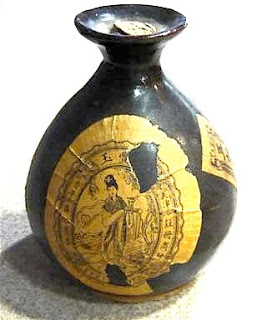
More than a decade ago I did a post for this blog entitled, “What Were the Chinese Drinking?”  It was an exploration of the origins of a ceramic bottle, like the one shown here, widely found in the United States and often identified by American collectors as a Chinese wine bottle.  As the result of personal experience, I was convinced that the Chinese were drinking a distilled spirit that I had imbibed in China in July 1976.

I was among a group of U.S. Congress staff aides that had been invited to China and were staying in Beijing’s Peace Hotel when the Great China Earthquake, one estimated to have killed a half million or more people, shook the city and caused our group hastily to leave the next day by special train to sites further south.  After two weeks on the road, we returned to the capital and the Peace Hotel.

During our trip we had been feted with a drink our hosts called “moutai.”  Several of us had developed a taste for it.  This highly potent liquor is made from rice or sometimes sorghum. It has an aroma and taste that some have called reminiscent of turpentine and cat urine. Famously, President Richard Nixon swallowed maotai and grimaced as he toasted Zhou Enlai during his groundbreaking trip to China.


On our last night in Shanghai before returning home, a several of us were partying with maotai but quickly ran out. Very enthusiastic, I ran to a nearby tourist store to buy another bottle. My recollection is that it cost only a dollar or two.  Four of us continued to drink up the new bottle before going to bed.  The next morning I woke up with what has been called the “dreaded maotai sweats.” A not-so-subtle aroma seemed to be exuding from every pore of my body. And my head was pounding. The experience even 44 years later is unforgettable.

My analysis that the Chinese in America were importing a liquor called maotai was only partially right.  Moutai is a brand name for a particular distilled spirit, the generic name for which is “baijiu,”  pronounced something like “bye joe.”  Despite this mistake, that post has been one of my most popular, attracting some 5,300 “hits” to date.  Among those looking in was an anonymous descendent of the Wing Lee family, apparently prompted by the image of the bottle shown here.  That individual provided this additional information:

“My grandfather was the third generation owner of the Wing Lee Wai company, producing Chinese wine and spirits in China, Hong Kong and Macau. The twin storks on the bottle are our family crest. It is the mark of a clan of high standing, and my grandfather's uncle was a Mandarin, an advisor to the Chinese Emperor.

“One of the most famous of the Wing Lee Wai concoctions was a rose liquor, which was brewed from the finest Rosa Damascena petals sourced in their native Turkey. Other popular beverages they made included an alcoholic cola drink, long before Coca Cola hit the mainstream.

“My father still holds the handwritten recipes for these amazing concoctions, many of which contained unusual Chinese herbs. The simple ceramic bottles were hand thrown and glazed on the family property and the shape was traditionally determined by the kind of spirit they contained.”

More recently the subject of Chinese tippling was exhaustively covered by author Derek Sandhaus in his 2019 book, “Drunk in China:  Baijiu and the World’s Oldest Drinking Culture.”  The book takes an lively and encompassng look at the ages old tradition of Chinese drinking such spirits. They come in many forms and may contain as high as 53 percent alcohol, registering them at 106 proof. Compare that to 80 proof for most gins and vodkas.

Sandhaus notes that despite its potency many Chinese contend that baijiu does not leave a heavy drinker with after effects.  He points out that Kweichow Moutai, the very one of my 1976 imbibing, for years has claimed its liquor is hangover proof.  He suggests, however, that by overindulging “you will feel like a fish slapped against the sidewalk the next morning.”  I can relate to that.


Perhaps the most startling information in the book is the revelation that the bottle of Kweichow Moutai that I bought for a couple of bucks in Shanghai has become the prestige libation of Chinese elites. Today that same baijiu sells for about $300 a bottle and might have gone higher if the Communist regime had not acted to rein in the cost.  Recently a bottle of Kweichow Moutai, vintage 1966, was up for sale on eBay at $2,800.

Despite biujiu’s popularity and the number of Americans of Chinese ancestry, there is only one U.S. outfit distilling the spirits.   In Wilsonville, Oregon, the Ly family make several varieties of baijiu in a barn behind their  home.  Shown here are the senior Lys, who are assisted by their five children.  Called Vinn Baijiu, a bottle retails for about $40 but is sold mostly in the Northwest.   The curious might wish to try some but, on my advice, not too much at one time.


Saturday, June 27, 2020

Sniffing the Sauce with Nipper Clones II

                
Forward:  On February 18, 2012, I devoted a post to the many satires that the image shown above have spawned.  Known as “His Master’s Voice” the picture of a dog called Nipper listening to a gramophone became a decades long symbol of RCA Corp. and generated dozens of “send ups.”  In doing that piece I became aware that among them were representations of dogs sniffing at a liquor container and recognizing “his master’s breath.”  As a result I did a follow-up post on that subject May 9, 2014, called “Sniffing the Sauce with Nipper’s Clones.”  During the ensuing years and months I have collected an additional number of examples and believe the time has come to reveal them.


The first object is a ceramic ashtray that features a spotted dog, likely a terrier, similar to Nipper sniffing at a jug, helpfully labeled “whiskey.”  The bowl of the ashtray carries the punch line.  Why the tray is in the form of a horseshoe is not explained.  The second object below, this one in metal, apparently had utility as a penholder.  It is unclear, however whether the jug served as a reservoir for ink.  I like the enthusiasm being shown by the dog, one of uncertain breed.

The photo of a dog looking at a decanter labelled “whiskey,” capped by a syphon is a riffle on the theme.  Here “vice” has been substituted for “breath,” sending a strong anti-alcohol message.  Although the next example, a post card, returns to the usual nomenclature, the artist has given us only the siphon to be sniffed by Fido.  Perhaps the master had just been filling his gas tank and the dog is smelling the fumes.


The following two flasks are from the Schafer & Vader ceramics factory in Thurlinga, Germany, founded in 1890.  Among the wares flowing from their pottery were a wide variety of figural bottles, each containing several swallows of liquor and meant as giveaways by saloons and other drinking establishments. Initially these items were produced and sold primarily in Germany and Austria, but about 1910 the U.S. department store giant, Sears Roebuck & Co., began to import and distribute nationwide Schafer & Vader pottery, with English titles and American themes.


With the success of Schafer & Vader, several U.S. ceramics firms began to compete for its market.  Hip flasks became a popular item, particularly during National Prohibition (1920-1934).  The two additional flask shown below may be American “knock-offs.”  Often the origin can be determined by close examination. The copy-cats often lack the heft and fine design of the German products.

The half pint jug shown here is something of an enigma.  Once part of my perspnal collection, the ceramic is very common and comes up for auction frequently at inflated prices.  For years I attempted unsuccessfully to pinpoint the source of the item since it bears no pottery mark nor label.  The jug likely held some form of alcohol initially but remains a mystery.
The final two objects are shot glasses.  The one at left likely was designed as a gag gift for a whiskey drinker.  The depiction of the dog is bizarre at best, looking more like a Norway rat than a canine.  It seems to have grasped in its claw-like paws a jug of “pure rye” from which fumes are being emitted.  At right is a glass advertising “Old Tucker Whiskey.” a leading label of the Brown-Foreman Company in the pre-Prohibition era.  This Louisville, Kentucky, outfit was formed by George Brown and George Foreman in 1891 and has survived to the present day.  It chose this “Nipper clone” image to merchandise the Old Tucker brand, including on giveaway items it provided to favored customers, including celluloid  pocket mirrors.

With this post, I believe that the subject of Nipper clones, both alcoholic and otherwise has been virtually exhausted.  From a broader perspective the items demonstrate how over the years an iconic image like the RCA logo can be made a subject of humor and satire in so many formats and materials.  If a picture can be said to be worth a thousand words, a dog and a gramophone has been worth about that number of imitations.

Note:  My post on Schafer & Vader can be found at December 3, 2016.


Saturday, June 13, 2020

Playing “I Spy” with Apartheid


The regional entities of U.S. labor unions for years operated U.S.-funded programs to strengthen the free labor movements in dozens of countries around the world.   Unlike most USAID grantees, the AFL-CIO had gained the right to approve individuals sent to evaluate the effectiveness of their programs.   My credentials as a former member of the American Newspaper Guild proved useful for obtaining consultant contracts to provide labor-based evaluations and related services.


In January 1990 I found myself in South Africa at the head of a team of three to evaluate the African Free Labor Institute (AFLI) program there.   This was still the “bad old” days.  Apartheid was in full force.  AFLI officials were barred from visiting South Africa and did business from nearby Lesotho.  USAID maintained a mission in Pretoria, however, and we were given visas.  Shown here is a photo of our group:  from right, Dr. Jerry Barrett, a labor specialist;  Ann Mullins, a local woman with ties to the black labor movement, and me.


The evaluation took us to several major cities where we interviewed dozens of trade union officials, some of them white or of mixed race.   A number were well known for their opposition to the de Klerk government.  On occasion we met with union officials late at night at locations down dark alleys. Among them was Cyril Ramaphosa, the current President of South Africa, shown here.

It took several days to realize that our team was being followed by de Klerk government agents everywhere we went.   The first glimmer occurred in Durban.  We hailed a cab outside our hotel and kept it with us much of the day.   The next day, the same driver -- a tall mixed race man about 45 -- was waiting at the door of the hotel to drive us again.  “Did any of you ask him to come back this morning?”  I asked other team members.  No one could remember doing so, nonetheless we made use of his services for the second day.

Our next stop was Capetown, a hotbed of dissent against the discriminatory labor laws of South Africa.  We took a cab, apparently at random from the taxi stand in front of our hotel, shown here,  out to the University of Capetown.  I told the driver -- a white Afrikaner -- not to wait and that we would call for another taxi as we were leaving.   A university official called the cab company for us -- and the same driver showed up. That seemed a little unusual, but we took him anyway.

On the way back downtown we stopped for lunch at a well-known outdoor restaurant.   The Afrikaner,  a stocky laconic sort,  said he would wait in the parking lot located on a hillside above the eatery.   After ordering my meal, I rounded the restaurant to find a restroom and noticed our driver standing at the edge of the parking lot.  He was looking down at our table intently -- with binoculars.

Cautioning my colleagues against making any ill-advised remarks in the cab, we went back to town.   The next day our driver, again apparently one we picked at random, was a young man of mixed race in a cab with a broken door handle.  Like the others, he stayed most of the day with us.  The next day the driver was different but the cab and the door handle were the same.   No doubt a vehicle with a recording device.  

When the time came to fly back to Johannesburg, Jerry Barrett went ahead to the airport.  He later called my room:  “I suspect you will be getting an Indian driver who will ask a lot of provocative questions about your attitude toward the South African Government.  He pestered me all the way out here.”

True to form,  when I emerged from the hotel later that day with my luggage,  the first cab in the queue was being driven by an Indian.  I got in.  He immediately began to bombarded me with questions about apartheid, the government, and race relations.  To all his inquiries I replied that we were in the country to learn, not to make political statements.  I tried to speak directly into the dashboard. 

After landing at Jan Smuts Airport,  Jerry and I went our separate ways.  He to Johannesburg to give a talk and I to Pretoria to have dinner at the home of the U.S. Mission Director, an old friend, Dennis Barrett (no relation to Jerry), shown here.  While waiting for a bus to town I noticed a burly, very bald, white man looking intently at me from a single automobile standing in a clearly marked “no parking” zone.   I stared hard at him for several minutes.  He bolted out of the car and into a nearby building where he continued to watch me through a window.  The bus arrived and I waved a jaunty goodbye.  At dinner that night Dennis, shown above, confirmed that he too was shadowed wherever he went and that he had gotten to know several of his “tails” by sight.

The following day as our team boarded an aircraft to take us to London, a large white van pulled up on the tarmac next to the plane.   The driver was looking at me intently.  It was the same bald man.  As I walked up the stairs to the door of the aircraft, I turned and waved at him again.  Once again he failed to wave back.  The entire experience seemed like something from a John LeCarre novel.

Things changed dramatically after Nelson Mandela was released from prison and subsequently was elected President of South Africa.  In 1995 I returned for another evaluation and found that several labor leaders we had met five years earlier now were cabinet ministers.  Jay Naidoo, whom we had interviewed, now was Labor Minister and had crafted a new labor law.  He made me a guest at the formal rollout of the new law, one that eliminated the discriminatory processes of the old regime and opened a new era in South African labor affairs.  Being invited was a singular honor.  This time I was not followed.