
Friday, June 2, 2017

Celebrity Women in Ads: The Good, the Bad, and the Shootist


The British started it.   Their advertising geniuses by the mid-1800s had figured out that by putting celebrity faces in ads — people like Queen Victoria — the attention of the public was virtually assured.  Their U.S. counterparts were not long in copying.  Among those singled out were the Good — the young and beautiful wife of a President, the Bad — the notorious wife of a millionaire, and the Shootist — a woman whose rifle was her livelihood.

The Good — Frances Folsom Cleveland.  A close friend of Frances’ father, Grover Cleveland met his future wife shortly after she was born.  As she grew up, he doted on her and the bachelor’s feelings toward her turned romantic while she was still in college.  Now President, the 49-year-old Cleveland proposed, she accepted, and at 21 she married him in the White House in June 1886.  The ad men had a field day.   Her face appeared on trade cards in both photo and illustration advertising a wide range of products.

At right is a colorized portrait of Frances that frequently was used.  This one was issued by the Philip Best Brewing Company of Milwaukee, the forerunner of the Pabst Brewery.  It advertises the “Best” Tonic, an alcoholic elixir that was alleged to be concentrated liquid malt and hops, capable of curing dyspepsia, strengthening the system, and just the thing for nursing mothers.  Identified on the cards as “Mrs. President Cleveland,” Frances’ image could be obtained by sending 12 coupons obtained — one each — on bottles of “Best” Tonic.

My favorite image of Mrs. Cleveland is the illustration above on a trade card for Ivory Tooth Polish.  Done pointillist style it is a strong representation of the First Lady, one that increases her appeal by showing a few strands of hair out of place.  It clearly was drawn from the photograph shown right.  There Frances is advertising “Seal of North Carolina Plug Cut Tobacco,” claimed to smoke cool, last long, and “not bite the tongue.”  By softening the eyes and providing a fuller mouth, the drawing presents a much handsomer woman.

The Sparks Medicine Company of Camden, New Jersey, found it expedient to use a photo of Frances to advertise its “Sparks’ Perfect Health” nostrum, said to be a remedy for kidney and liver distress.  Dating from about 1885, her image appears on in a transfer printed ironstone plate that likely was available upon submission of coupons.  Issued by the Sparks Medicine Company of Camden, New Jersey, it was designed by Robert H. Payne of another Camden firm, “Porcelain Show Cards.”

The “Lady of the White House” was not done any favors by the Yatisi Corset Company for its trade card picture of her.  She seems intensely absorbed in some task, perhaps getting accustomed to her Yatisi corset, claimed on the back of the card to be “recommended by all the prominent physicians in all the leading cities of the U. States and Canada.” She was, however, guaranteed to to be able to return it after wearing for ten days and have her money refunded.  

A final look at the First Lady is a trade card from W. F.McLaughlin Company, a coffee merchant located in Chicago. William Francis McLaughlin came from Cloneybecan House in county Laois, Ireland, from a well-to-do family and a college graduate.  He started from the bottom in Chicago, however, first selling coffee beans from a wheelbarrow and then from a wagon. He eventually owned several mansions on Rush Street and the family had several estates in Lake Forest. 

The Bad - Florence Evelyn Nesbit.  While the Clevelands likely looked askance at the use of Frances’ face to sell tobacco, toothpaste and corsets, Ms. Nesbit reveled in the ad role.  She was a celebrity, later to be known as “the girl in the red velvet swing,” for her role in sex parties staged by famed architect Standford White.  Her millionaire husband, Harry K. Thaw, subsequently gunned White down in a rooftop restaurant at Madison Square Garden, insuring her notoriety.

At the outset of the 20th Century Nesbit’s figure and face were everywhere, appearing in mass circulation newspaper and magazine advertisements, and on souvenir items and calendars, often in suggestive modes.  The image left, with bare skin and lily was typical of the pose Florence or Evelyn — she answered to either — adopted for doting photographers and artists.

Rainier Beer, by contrast, chose to present Nesbit on a serving platter looking like a “Phi Beta Kappa” graduate of an exclusive girls seminary.  Note her modest garments and her hands folded if in prayer.  The original brewery dates all the way back to 1854 when A.B. Rabbeson opened Washington Brewery, which was Seattle’s first commercial brewing company.  In 1872, Rabbeson renamed his brewery Seattle Brewery.  They launched Rainier beer in 1878. 
It has been said of this damsel:  “By the time of her sixteenth birthday in 1900, Evelyn Nesbit was known to millions as the most photographed woman of her era, an iconic figure who set the standard for female beauty, and whose innocent sexuality was used to sell everything from chocolates to perfume.”  Make that “supposedly innocent.”   As shown here, she could even be used to sell newspapers.   The ad references her role in a 1902 Broadway musical comedy called The Wild Rose.”  It ran 136 performances.

The Shootist — Annie Oakley.   Our final female celebrity had thousands of performances.  Born Phoebe Ann Mosey, Oakley adopted the stage name after being discovered at 15 years old when she won a shooting match with Frank Butler, a nationally known marksman who later became her husband.  After becoming a famous international star, performing before royalty and heads of state, Oakley became a prime ingredient for the advertising mill.


A prime attraction for the Buffalo Bill Wild West show, she was often showcased in the color flyers and broadsides for the extravaganza.  Note that in the upper right of the sheet above, Oakley is shooting while riding a bicycle.  The Sterling Bicycle Company of Kenosha, Wisconsin, was not long in picking up on that ability and featuring Annie in their ads.  In 1898 Sterling won a silver medal for its “chainless bicycle” at the Trans-Mississippi International Exposition.   Two years later company went bankrupt.
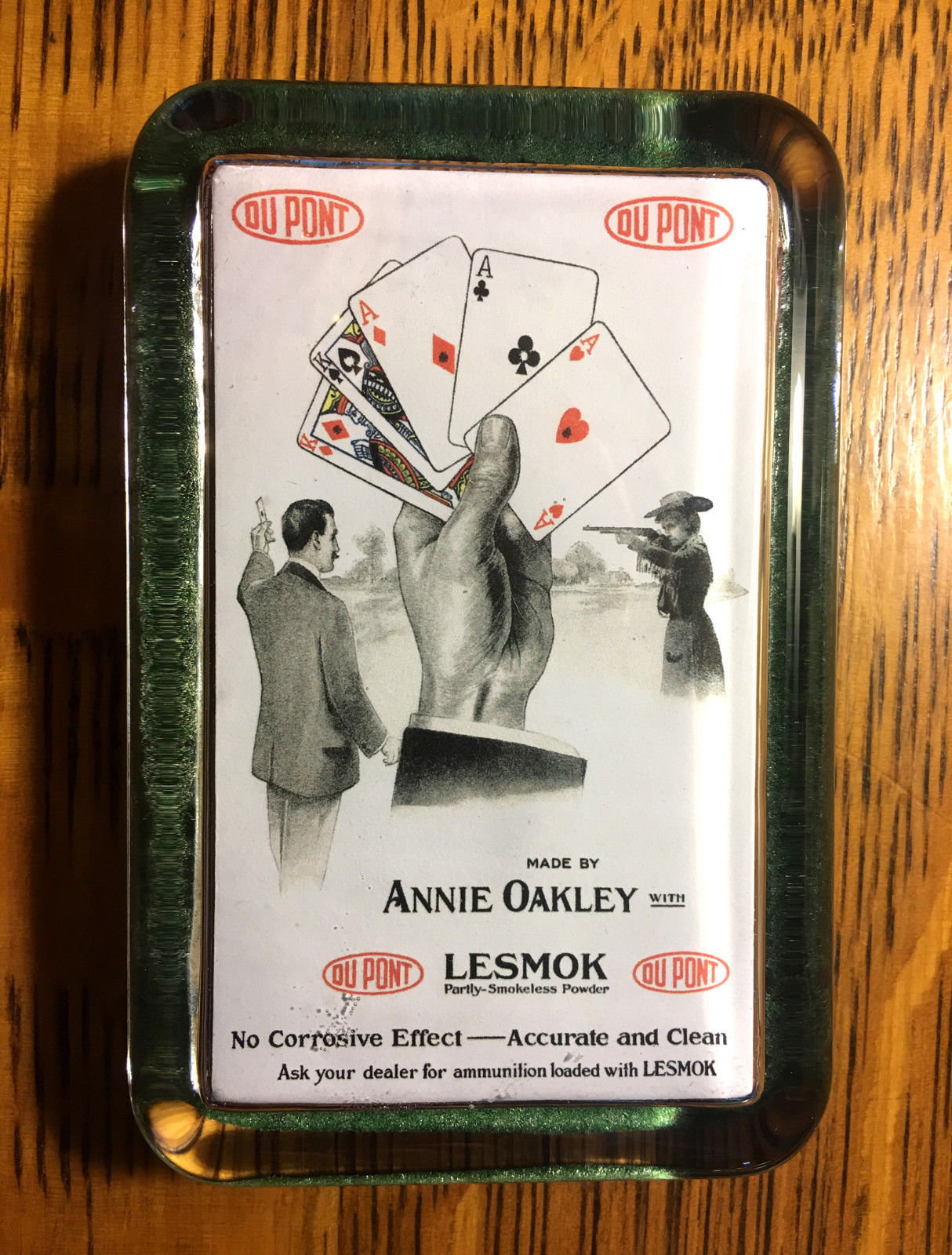
Du Pont, the chemical company of Wilmington, Delaware, also was quick to pick up on the fame of Annie Oakley.  An advertising paperweight showed a gent with five playing cards, each of which had been plugged in an appropriate place by the female sharpshooter.  Her bullets, it suggested, had been with “Lesmok,” ammunition loaded with a substance that was “accurate and clean” with “no corrosive effect.”

A singular difference between Oakley and Nesbit or Folsom is that Annie has continued to be featured in ads.  In the 1950s, for example, she was used to sell Canada Dry ginger ale.   A recent ad, shown here, is from Red Ants Pants, a clothing manufacturer located in White Sulphur Springs, Montana, a town of less than 1,000.  Oakley is presented as a woman who forged the way for those who followed.

Presented here have been three women and three paths to celebrity.   Regardless how they got there — being good, or bad, or a shootist — made no difference to the ad gurus.  Fame was, and still is, the name of the ad game.


Saturday, May 20, 2017

Tete-a-Tetes with Chiefs of States

                      
After more than a half century living and working in and around the Nation’s Capital, I have had an opportunity to meet a number of Chiefs of State.  The years have brought perfunctory handshakes with three American presidents (Kennedy, Johnson and Carter) as well as with foreign leaders like Tito of Yugoslavia, Marcos of the Philippines, Suharto of Indonesia, and Nguyen Van Thieu of Vietnam.  They do not bestow the same quality of remembrance as do up close and personal encounters with leaders of counties — as recalled here.

From 1976 until 1981 I served in the Carter Administration as the Assistant Administrator responsible for all the Agency for International Development programs from the Khyber Pass to Hawaii.  This brought me in contact with Asian leaders, often a context of negotiating agreements on development programs.  Upon occasion those discussions would involve a Chief of State.  Here are stories of three such encounters.

My first venture into a presidential office was in Bangladesh in 1978.  I went alone to meet Ziaur Rahman, a major figure in the country’s independence from Pakistan who was considered a reformer. He had fostered multi-party politics, freedom of the press, free speech and free markets. He had initiated large agricultural efforts and initiated social programs.  The U.S. was assisting him by massive shipments of food that could be given away or sold to provide funds for government services.

Even before I took office, those shipments had become a problem.  Critics were showing photographs of American “Food for Peace” grain piling up on Bangladeshi docks or in makeshift earthen “warehouses” where rats were feasting.  At the same time, however, some USAID personnel were telling me that there was insufficient food stockpiled and a danger that famine might return to the country.  Reaching the correct balance in supplies was critical — and my responsibility.
That day, however, I was to speak to President Zia about reducing the amount of food on the idea that such imports discouraged domestic production of grains, something Zia was himself interested in doing. It was just the two of us in his modest office.  He was very patient about hearing me out and the said very quietly, “Mr. Sullivan, if food shortages occur the rioters will not be coming to hang you, they will be coming for me.”  Internally I had to agree and left without further argument.

On my way out in the parking lot I noticed the Volkswagon Beetle that Zia famously drove to work in by himself — no chauffeur — and marveled that a man who already had had a dozen coup attempts aimed at him could move about with so little security.  His luck ran out in 1981 when he was assassinated by disgruntled Army officers.  Bangladesh lost a marvelous leader.

My next adventure with a Chief of State was in Sri Lanka. For reason I still have never figured out, one or two scientists at the Smithsonian Institution in 1979 had decided that Sri Lanka was not doing well by its elephants and, through higher ups in the Agency, insisted that I meet personally with President J. R. Jayewardene, shown right, to discuss the problem.  I had been in Sri Lanka before and had no experience of those noble animals being abused.  

Regardless of my personal misgivings, I asked for an interview and Jayewardene granted one on a Sunday at his home.   After a life in political activism he had become president of the country in his 70s and was noted as a “tough old bird.”  Nevertheless, he was very gracious as he ushered me onto a comfortable couch in his library and offered tea.   He was alone except for servants.  I explained why I was there and the concerns of my fellow Americans.  

After hearing me out, almost lounging in his chair, Jayewardene responded:  “I am the biggest environmentalist in Sri Lanka and the greatest protector of the elephants.  Where a railroad crosses a well-used elephant trail, we build a trestle so that the elephants can cross underneath.”  I had seen and photographed just such a structure.  He followed up:  “Do you do that for wildlife in your country?”  I gulped hard and had to admit — no — and left shortly after.

In 1978 the Carter Administration had decided to re-establish an aid program to India that had been cut off at the time of the Bangladesh War.  A skeptical Congress decreed that the Indians first would have to ask for aid.  An equally skeptical Indian government thought the U.S. formally should offer it first.  How to break this dilemma?  One dark and rainy night in 1978 the USAID Administrator, John Gilligan,  and I went to the residence of Prime Minister Moraji Desai in hopes of a breakthrough. 

Greeted by Desai’s aides, we were strictly advised that our meeting could go on for no longer than 15 minutes and that we would be timed to the second.  Desai arrived alone.  The early conversation between Gilligan and the prime minister was theological, comparing Hindu religious thought with Christianity.  Five minutes went by along those lines — and then another five.   I could feel the cold sweat beginning to run down my sides.  Transmigration of souls was dominating  the dialogue as both participants seemed to be warming to the subject even more intensely.  A voice inside my head began shouting:  “Time, time, time” as more minutes slipped by and we had yet to begin the real discussion.

Barely a minute remained when Gilligan broke off the theological discourse and asked abruptly:  “If the United States were to offer foreign assistance, would you be willing to take it.”  In an Zen-like response,  Desai replied, “If we were willing to take it, would you offer it?”  There ensued barely perceptible affirmative nods on both sides.   Satisfied that the Gordian Knot had been cut,  Gilligan immediately stood up,  shook Desai’s hand, told him we would meet with his top government officials the next day to hammer out details, and we left.  Fifteen seconds remained.  We did not look back.

If lessons can be taken from these three interactions with Chiefs of State, it is that they are meetings of high intensity for the visitor whose outcomes can never be accurately predicted beforehand.  One inevitably leaves relieved that the encounter is over — but with memories for a lifetime.


Saturday, May 6, 2017

Rise and Fall of Back-of-the-Bar Bottles


 While never owning any, I have been fascinated by back-of-the bar bottles (BoBB), the line of fancy containers shown above.  Gifted by distillers and liquor wholesalers in the pre-Prohibition era to favored customers like saloons and restaurants, the bottles were among the most expensive giveaways, often featuring fine glass and gold accents.  They were expected to catch the eye of the patron  — and did.  Because the legislation that accompanied the rollback of Prohibition outlawed them, today most of these bottles are more than 100 years old.  Displaying well, they are eagerly are sought by collectors.

A good example of the value these bottles have achieved is the the one shown right.  It was issued by Julius Goldbaum, a pioneer whiskey man in Tucson, Arizona.   Although most such bottles are clear glass,  Goldbaum chose his in amber with white and gold accents.  The results are a stunning bottle of which only a few are known.  One recently sold at auction for over $22,000.

In featuring back-of-the-bottles, it occurred to me to feature one wholesale house that stood out for the variety of attractive items it issued — Rosskam, Gerstley & Co.  Isaac Rosskam and his wife’s kinsman, Henry Gerstley, both immigrants from Germany,  had settled in Philadelphia and in 1869 opened the doors of their establishment.  The company initially was located at 336 North Third Street but within a year had moved to larger quarters at 402 North Third, where it would stay until 1876.”  Their proprietary brands were “Old Saratoga,” “Monogram," and “Fine Old Whiskey.”

Reflecting the rapid and impressive growth of its business volume, the partners that year moved to two new buildings.  One was five stories at 226 S. Front Street that advertised “Rye & Bourbon Whiskies” on the storefront.  The other at 133-135 Dock Street of six stories proclaimed “Old Rye Whiskies.”  Both locations allowed the firm adequate space to undertake “rectifying,” that is, blending whiskey bought from multiple sources to achieve tastes determined to have broad public appeal.

As their business grew the partners branched out into other cities. In 1870 the partners opened an office in Cleveland at 100 River Street.  About 1882 they located an outlet  in Chicago at 79 Dearborn Avenue, one of the Windy City’s premier commercial locations.  That was followed a year later by their establishing a branch  at 38 Broadway in New York City.   This proliferation of outlets indicated the kind of vigorous national customer base Rosskam, Gerstley built over time.

Because Philadelphia, and indeed the U.S., was loaded with distillers, rectifiers, and wholesalers, the partners had to combat stiff competition for the business of  restaurants, bars and saloons to stock their liquor.  They also had to appeal to members of the drinking public to request their brands from bartenders.  One way of advertising was to provide giveaway items that contained the name of a Rosskam, Gerstley products.  Although the partners gave away tip trays and shot glasses, they specialized in elegant back-of-the-bar bottles.

These included bottles in fancy molded glass with stoppers,ornate gold lettering, and in one case a metal or pewter body.  Shapes varied from bulbous bases to ginger jar shapes to straight sided bottles. At least one was metal.  Lettering might be in script, squared-off letters or san serif, and colored black, gold or cobalt blue.  I have counted at least twenty-one varieties of Rosskam, Gerstley & Co. bar bottles.  Nine of them are illustrated throughout this post.  No other distiller or whiskey house comes close in number or variety.  Isaac and Henry were the kings of the back bar.

At the turn of the Century, things changed at thePhiladelphia liquor house.  In 1899, Henry Gerstley died at age 61 at his residence.  As Rosskam aged he turned over the reins of management to his son.  A 1900 Philadelphia business directory lists William Rosskam as president of the firm.   In 1904 Isaac died, age about 70.  According to the press, he left a large estate.  Although the company continued to prosper for a time under William,  eventually it was forced to shut down by the enactment of National Prohibition.
The banning of bar bottles after the end of Prohibition was the result of their  having been used for purposes that neither Rosskam nor Gerstley would have approved.  Bartenders had a tendency when “Old Saratoga” or another whiskey had been dispensed from its fancy bar bottle to refill it with an inferior brand and cheerfully pour it out to customers under false pretenses.  Today bottles behind the bar must be the container in which the liquor was sold, carrying an original label and tax stamps.

That leaves a treasure trove of back-of-the-bar bottles.  They steadily grow older and all of them will have achieved “antique” status by 1920.  No more will be made and I have seen little evidence of fraudulence.  Many can be bought for under $200.  Attractive and displaying well, they are certain to accrue in desirability and value in the future.


Saturday, April 22, 2017

More When Drinking and Driving Was Cool

                            
In November 2015 this blog featured a series of pre-Prohibition ads in which the automobile and beer drinking were juxtaposed in a fashion that would be generally unacceptable today.  In the ensuing months I have found a number of other examples of drinking and driving that deserve some scrutiny.   Although almost all of the examples here are from beer ads, I begin with one right from a whiskey dealer.

He was C. H. Ritter, a liquor wholesaler from Detroit, noted for issuing this humorous saloon sign for his flagship brand, Westminster Rye.  Done by fine lithograph, the image was of a young man offering a drink to  a local farmer.  A closer look showed  a pig lying dead in the road, apparently struck by a roadster from which three passengers are watching. The title is “Settled Out of Court” and implies that a drink of Westminster Rye is so appealing that the farmer will let he motorist off the hook for the death of his hog.  Representing the dawning of the automotive age, Ritter’s sign likely was a favorite of the drinking crowd.
While Ritter’s farmer seems ready to trade a sip of whiskey for his hog, the farmer in the Falstaff beer ad above appears to be less convinced that a glass of foaming brew will pay for the wreck of his wagon and the spillage of his apples on the road.  Entitled “The Peacemaker,” this was a lithographed saloon sign issued by the Lemp Brewery of St. Louis.  Note that the owner of the errant automobile has come well stocked.  From the hamper at his feet are peeking several bottles of Falstaff.

Ruhstaller was a West Coast brewery, founded in 1898 and located in the heart of Sacramento California.  It provided a lithographed image on a serving tray that would have been given to saloons and restaurants carrying its Gilt Edge beer.  A young dude, apparently the driver, is pouring a beer for two female riders.  A full bottle and a glass remain, indicating that the driver himself will imbibe before driving on.  

The Edelweiss beer ad is entitled “A Case of Good Judgment.”  Is this a double entendre message?  Can it mean both a wise buy of beer as well as where the case is stowed, safely away from the driver and passengers?  Edelweiss was a brand of beer made by the Schoenhofen Brewing Company of Chicago.  The founder, Peter Schoenhofen was a Prussian immigrant who was working in the brewing trade as early as 1850.

This saloon sign shows two couples being served at curbside.  A waiter in a tuxedo has come from the confines of his restaurant to serve the motorists.  The Oshkosh Brewing Company was formed in 1894 with the merger of three Oshkosh, Wisconsin, breweries facing a tsunami of beer from Milwaukee.  Both Schlitz and Pabst had created distribution centers in a town known for its voracious beer drinkers.  With their survival in doubt, the three combined to create a viable brewery. 

Although no open alcohol is on display in this saloon sign, Schell’s Carbonated Mead was no mere soft drink, but a fermented beverage involving honey.  The New Ulm, Minnesota, company is still around, second only to Yuengling as the Nation’s oldest family-owned brewery.  Founded in 1860, Schell claims that through the years it has produced at least 100 varieties of “German craft beer.”

The Seattle Brewing & Malt Company, from the city of the same name, was famous for its Rainier Beer for which this picture was an ad.  The automobile shown here clearly is one of the earliest models, steered with a lever rather than a wheel.  Interestingly, unlike all the other vehicles shown here, it is being driven by a woman while her male companion looks on from the passenger seat.

Of Seib Beer I can find little information.  Its founder appears to have been William Seib, who is credited with bringing scientific knowledge to bear on the brewing process.  His brewery may have been in the Chicago vicinity.  Here on a lithographed pin an early automobile with passengers is stopped on the road, apparently stymied by a huge bottle of beer smack in the middle.  

The final example is an advertising sign from the early post-Prohibition era.  It shows an automobile that has frightened a horse but not a dog, the latter barking at the white-garbed driver who is attempting to crank the vehicle to life.  Pabst issued a series of these signs, all of them aimed at eliciting nostalgic responses about the “good old days” from potential customers.
 This image ends this second parade of drinking and driving examples from the people who ran some of America’s notable breweries and one liquor house.   While the close proximity of alcohol and gasoline in advertising today would be unthinkable, in earlier times drinking and driving was definitely cool.

Labels:  C. H. Ritter & Co., Falstaff Beer, Ruhstaller’s Gilt Edge Beer, Oshkosh Brewing Co., Schell’s Carbonated Mead, drinking and driving, Eidelweiss Beer, Rainier Beer, Seib Beer, Pabst Blue Ribbon, 


Saturday, April 8, 2017

Five Women Who Found Success in Whiskey


The history of the liquor industry in the United States traditionally has been dominated by men, particularly in the era before National Prohibition was imposed in 1920.  Over time as I have profiled more than five hundred “pre-pro” distillers, whiskey wholesalers and saloonkeepers, I have found five women whose careers in whiskey were truly outstanding and deserve special recognition.

Mary Dowling from Anderson County, Kentucky, not only owned and ran major distillery, shown here, she found a way to stay in the liquor business after 1920 and, in effect, thumbed her nose at Prohibition.  Kentucky-born to Irish immigrant parents, at seventeen she married a distiller at least 17 years her senior who saw her intelligence and brought her into the business.  When he died, she inherited his interest in the Waterfill & Frazier distillery, bought out his partners, and ran it successful for two decades.
Her success, however, came to screeching halt with the imposition of National Prohibition.   Federal records shown her withdrawing large quantities of whiskey from her bonded warehouse in the run up to the ban on alcohol.   Some of this whiskey she is reported to have sold to those Kentucky distillers fortunate enough to be licensed to sell liquor for “medicinal purposes.”   Other stocks, she successfully “bootlegged” for four years until Federal agents arrested her. 

After authorities were unable to convict her, Mary Dowling hatched a new -- and more successful -- business plan.  About 1926 she hired Joseph Beam, one of Kentucky’s premier distillers but now out of work, to dismantle the distillery, transport the pieces to Juarez, Mexico, reassemble it there, and resume making whiskey.  Mexico had no prohibition so the liquor production was completely legal.  Using several strategies to get her whiskey legally over the border to American consumers, she continued to operate until she died, four years short of Repeal.

Mary Jane Blair also was a Kentuckian who inherited her late husband’s share of a distillery, this one in Marion County, shown here. She promptly bought out his partners and changed the name to the “Mary Jane Blair Distillery.”  Although the greater part of her life had been spent in the Blair home as housewife and mother, evidence is that she took an active role as president of the company, one that distilled about five months in the year.   Limited production was not unusual in the Kentucky whiskey industry,  some distillers believing that fermentation was done best only in certain months.  As the distiller Mrs. Blair hired W. P. Norris, a well known Marion County whiskey man.
For the next seven years, with the help of a son, Mary Jane Blair operated the distillery, considerably expanding its capacity.  By 1912  the plant had the mashing capacity of 118 bushels per day and four warehouses able to hold 9,000 barrels.  The Blairs produced whiskey sold under several labels; the flagship was “Old Saxon,”  as illustrated here by a back-of-the-bar bottle.  About 1914 the family sold the facility.  Mary Jane Blair died in 1922 at the age of 76.

Lovisa McCullough was a strong women’s rights advocate who successfully ran a liquor wholesale business in Pittsburgh following the death of her husband.  A 1888 Pittsburgh directory under the heading “Liquors, Wholesale,” lists forty-nine such establishments in the city.  All of them save one are readily identifiable as male-run companies.  The exception is “McCullough, Louisa C., 523 Liberty Av.”    That same year Lovisa became a delegate from Pittsburgh to the historic founding meeting of the International Council of Women (ICW) devoted to women’s suffrage.  It is a safe bet that she was the only liquor dealer at the convention. 

Obviously a woman of great energy, Lovisa McCullough threw herself into other causes.  A lover of animals, she was a longtime member of the Humane Society and served on the board of the Pittsburgh chapter.  She also was among women who worked toward buying up and preserving the grounds and structures at Valley Forge, Pennsylvania, where Gen. George Washington and his troops passed the winter.  A true “Daughter of the American Revolution,”  Lovisa’s grandfather may have been among those soldiers.

In 1893, after more than a half century of operation, the McCullough liquor dealership disappeared from Pittsburgh business directories.  Its demise cannot be explained by National Prohibition that still was years away and Pennsylvania was “wet” until the end.  Lovisa may have found her passion for feminist and other causes eclipsed her ardor for keeping alive the liquor enterprise.  Or it may have been advancing age.  Lovisa died in 1917, about 82 years old, and was buried beside her late husband, John, in Allegheny Cemetery. 

Mary Moll, living in Montgomery County, Pennsylvania, earned this tribute from a local newspaper: Mrs. Moll, when she took possession of the business, had many obstacles to overcome but, being a woman of wonderful business tact, she bravely fought the many unpleasant features connected with the business and successfully built up a trade far superior to any in this country.”  Like the other women here, after her husband she died inherited his whiskey wholesale trade but also his three daughters from a prior marriage.  They are shown at the family home, Mary at far right.

Rejecting advice by friends to sell the business, she set out not only to run the liquor dealership, but also to expand it.  Her first instinct was to go on the road as a “drummer,”  and give customers and potential customers her personal attention to make sales.  The strategy worked and she was credited with ultimately tripling the business.   After three years, however, Mary tired of traveling.  Looking at the costs-benefits she concluded she could build her trade more effectively by staying home and keeping prices low.

Eventually,  Mary Moll was selling three hundred barrels of whiskey a year.  Although not a rectifier, that is a dealer mixing and blending her own brands, she was decanting the barrels into her own embossed glass containers, shown here.  Those barrels would have resulted in her selling 53,400 quarts of whiskey, an impressive number for any liquor house.  Mary Moll died in 1910 while still running her business. She was 64.

Catherine Klausman, when her husband died, was left with five minor children, a saloon, liquor store, and small hotel, together known as “The German House,”  shown here.  She hesitated not a moment in taking over their management.  As a result, “Mrs. Klausman” as she was respectfully known in St. Mary’s, Pennsylvania, put her mark on selling whiskey.

With the help of her bartender, Mrs. Klausman not only kept all the businesses open, she prospered by selling both at wholesale and retail her own brands of whiskey.   Taking a leaf from the liquor wholesalers and rectifiers of the time, she bought whiskey from both Pennsylvania and Kentucky, sometimes blending the spirits, bottling them and then applying her own labels.   My favorite is Mrs. Klausman’s “Corn Whiskey,” with its predominantly yellow label showing a rural distillery and a shock of corn, a design worthy of one of the big liquor outfits.

In 1920, however, National Prohibition brought a close to the thriving business she was doing in whiskey sales.  Moreover, the hotel bar no longer could serve alcohol.  Regardless of these setback, she persevered in running the German House through the 1930s.  No evidence exists that after repeal of National Prohibition in 1934, she went back to liquor sales.  When Catherine died in 1963, at the age of 88, she was buried next to her late husband in the St. Marys Cemetery.  The German House remains standing as part of the town’s historic district on Railroad Street. 

These five women helped pave the way for the many women who have engaged in  the whiskey trade since Prohibition and today fill some of the top spots in the Nation’s liquor industry.  

Note:  Author Fred Minnick has written an interesting book on “Whiskey Women,” detailing the effects that women, past and present, have had on the American distilled spirits business.  It was through his writing that I came upon Mary Jane Blair.  Minnick failed, however, to pick up on his radar Mary Dowling, Lovisa McCullough, Mary Moll, and Catherine Klausman.  I am hopeful that this piece will bring these other four outstanding “whiskey women” the attention they also justly deserve.  For those interested in more details about these five women I have written more extended vignettes on each on my other blog, preprohibitionwhiskeymen@blogspot.com.