
The British started it. Their advertising geniuses by the mid-1800s had figured out that by putting celebrity faces in ads — people like Queen Victoria — the attention of the public was virtually assured. Their U.S. counterparts were not long in copying. Among those singled out were the Good — the young and beautiful wife of a President, the Bad — the notorious wife of a millionaire, and the Shootist — a woman whose rifle was her livelihood.
The Good — Frances Folsom Cleveland. A close friend of Frances’ father, Grover Cleveland met his future wife shortly after she was born. As she grew up, he doted on her and the bachelor’s feelings toward her turned romantic while she was still in college. Now President, the 49-year-old Cleveland proposed, she accepted, and at 21 she married him in the White House in June 1886. The ad men had a field day. Her face appeared on trade cards in both photo and illustration advertising a wide range of products.
 At right is a colorized portrait of Frances that frequently was used. This one was issued by the Philip Best Brewing Company of Milwaukee, the forerunner of the Pabst Brewery. It advertises the “Best” Tonic, an alcoholic elixir that was alleged to be concentrated liquid malt and hops, capable of curing dyspepsia, strengthening the system, and just the thing for nursing mothers. Identified on the cards as “Mrs. President Cleveland,” Frances’ image could be obtained by sending 12 coupons obtained — one each — on bottles of “Best” Tonic.
 My favorite image of Mrs. Cleveland is the illustration above on a trade card for Ivory Tooth Polish. Done pointillist style it is a strong representation of the First Lady, one that increases her appeal by showing a few strands of hair out of place. It clearly was drawn from the photograph shown right. There Frances is advertising “Seal of North Carolina Plug Cut Tobacco,” claimed to smoke cool, last long, and “not bite the tongue.” By softening the eyes and providing a fuller mouth, the drawing presents a much handsomer woman.
 The Sparks Medicine Company of Camden, New Jersey, found it expedient to use a photo of Frances to advertise its “Sparks’ Perfect Health” nostrum, said to be a remedy for kidney and liver distress. Dating from about 1885, her image appears on in a transfer printed ironstone plate that likely was available upon submission of coupons. Issued by the Sparks Medicine Company of Camden, New Jersey, it was designed by Robert H. Payne of another Camden firm, “Porcelain Show Cards.”
 The “Lady of the White House” was not done any favors by the Yatisi Corset Company for its trade card picture of her. She seems intensely absorbed in some task, perhaps getting accustomed to her Yatisi corset, claimed on the back of the card to be “recommended by all the prominent physicians in all the leading cities of the U. States and Canada.” She was, however, guaranteed to to be able to return it after wearing for ten days and have her money refunded.
  A final look at the First Lady is a trade card from W. F.McLaughlin Company, a coffee merchant located in Chicago. William Francis McLaughlin came from Cloneybecan House in county Laois, Ireland, from a well-to-do family and a college graduate. He started from the bottom in Chicago, however, first selling coffee beans from a wheelbarrow and then from a wagon. He eventually owned several mansions on Rush Street and the family had several estates in Lake Forest.
  The Bad - Florence Evelyn Nesbit. While the Clevelands likely looked askance at the use of Frances’ face to sell tobacco, toothpaste and corsets, Ms. Nesbit reveled in the ad role. She was a celebrity, later to be known as “the girl in the red velvet swing,” for her role in sex parties staged by famed architect Standford White. Her millionaire husband, Harry K. Thaw, subsequently gunned White down in a rooftop restaurant at Madison Square Garden, insuring her notoriety.
 At the outset of the 20th Century Nesbit’s figure and face were everywhere, appearing in mass circulation newspaper and magazine advertisements, and on souvenir items and calendars, often in suggestive modes. The image left, with bare skin and lily was typical of the pose Florence or Evelyn — she answered to either — adopted for doting photographers and artists.
Rainier Beer, by contrast, chose to present Nesbit on a serving platter looking like a “Phi Beta Kappa” graduate of an exclusive girls seminary. Note her modest garments and her hands folded if in prayer. The original brewery dates all the way back to 1854 when A.B. Rabbeson opened Washington Brewery, which was Seattle’s first commercial brewing company. In 1872, Rabbeson renamed his brewery Seattle Brewery. They launched Rainier beer in 1878.

 It has been said of this damsel: “By the time of her sixteenth birthday in 1900, Evelyn Nesbit was known to millions as the most photographed woman of her era, an iconic figure who set the standard for female beauty, and whose innocent sexuality was used to sell everything from chocolates to perfume.” Make that “supposedly innocent.” As shown here, she could even be used to sell newspapers. The ad references her role in a 1902 Broadway musical comedy called The Wild Rose.” It ran 136 performances.
The Shootist — Annie Oakley. Our final female celebrity had thousands of performances. Born Phoebe Ann Mosey, Oakley adopted the stage name after being discovered at 15 years old when she won a shooting match with Frank Butler, a nationally known marksman who later became her husband. After becoming a famous international star, performing before royalty and heads of state, Oakley became a prime ingredient for the advertising mill.


A prime attraction for the Buffalo Bill Wild West show, she was often showcased in the color flyers and broadsides for the extravaganza. Note that in the upper right of the sheet above, Oakley is shooting while riding a bicycle. The Sterling Bicycle Company of Kenosha, Wisconsin, was not long in picking up on that ability and featuring Annie in their ads. In 1898 Sterling won a silver medal for its “chainless bicycle” at the Trans-Mississippi International Exposition. Two years later company went bankrupt.
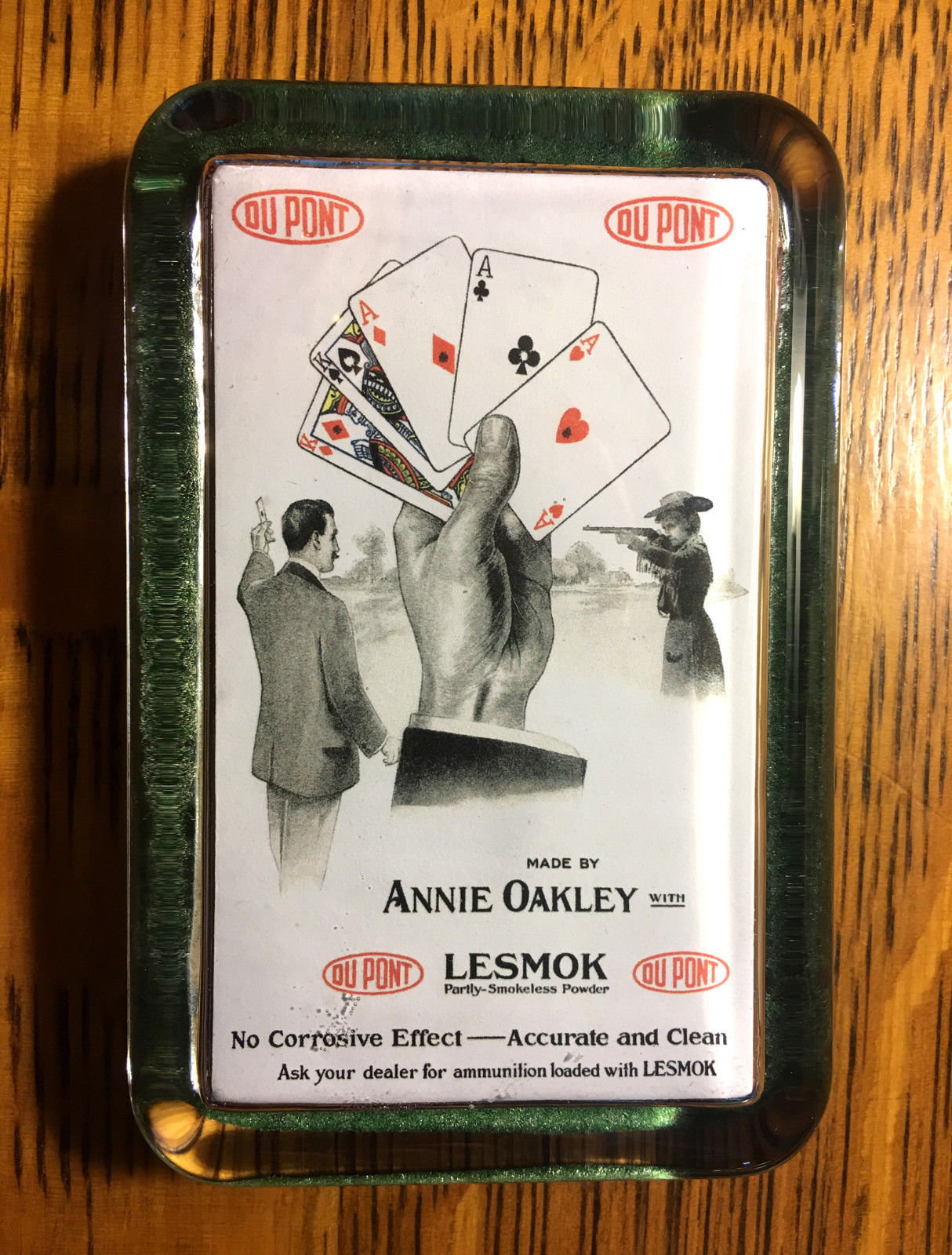 Du Pont, the chemical company of Wilmington, Delaware, also was quick to pick up on the fame of Annie Oakley. An advertising paperweight showed a gent with five playing cards, each of which had been plugged in an appropriate place by the female sharpshooter. Her bullets, it suggested, had been with “Lesmok,” ammunition loaded with a substance that was “accurate and clean” with “no corrosive effect.”
 A singular difference between Oakley and Nesbit or Folsom is that Annie has continued to be featured in ads. In the 1950s, for example, she was used to sell Canada Dry ginger ale. A recent ad, shown here, is from Red Ants Pants, a clothing manufacturer located in White Sulphur Springs, Montana, a town of less than 1,000. Oakley is presented as a woman who forged the way for those who followed.
Presented here have been three women and three paths to celebrity. Regardless how they got there — being good, or bad, or a shootist — made no difference to the ad gurus. Fame was, and still is, the name of the ad game.


