
Saturday, July 17, 2010

The Art Nouveau Whiskey Jug


Among my favorite artistic movements is “Art Nouveau,” a style that burst into wide popularity about 1890 in Europe and the United States and held sway until snuffed out by the cold winds of World War One three decades later. Characterized by lavish ornamentation with lines reminiscent of twining plan tendrils or ribbons flowing in the wind, Art Nouveau was frequently used in the merchandising of the day, selling everything from bicycles and eggs to cigarette papers, throat lozenges, and -- yes -- whiskey.

An example is the Thomas Rossland scotch whisky jug, displaying a familiar Art Nouveau theme, the “Tree of Life,” with its roots, branches, leaves and some kind of round fruit. This jug recently fetched more than a $1,000 at auction. It was the product of the Doulton Lambeth Pottery , now known as Royal Doulton. Between 1882 and 1914 this British pottery manufacturer issued dozens of whiskies that incorporated highly glazed necks, shoulders, handles and bodies with Art Nouveau themes in a range of rich and colored glazes.

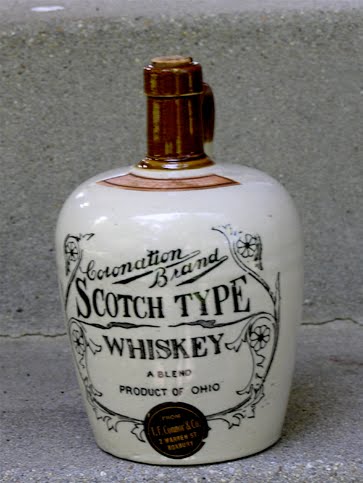
In the United States, by contrast, only a few distillers and whiskey dealers used the decors common to Art Nouveau. Note here a Doulton jug, predominantly brown and yellow with distinctive flowers in a drapery. Below it is an American jug that features similar flowers. It is from “Coronation Brand” and is “Scotch-type Whiskey.”

Thereby hangs a mystery. This jug is part of a series of three, all of which go under the name, Coronation Brand, but with presumably different contents. One of them is labeled “Irish Type Whiskey” and the other “Kornschnapps Style Liquor” -- a German alcoholic beverage. All profess to be “Products of Ohio.” Each reflects the Art Nouveau sensibility in the differing modes of flowing shapes that surround their labels. Two decades of trying to locate the origins of these highly unusual whiskeys has yielded me absolutely no clues.

Nor are there any clues to the potteries that might have made and designed the labels for these jugs. My suspicion is that it was Sherwood Brothers of New Brighton, Pennsylvania. (See my blog of November 2009.) This is the only U.S. pottery in my knowledge with the ability to do wrap around transfers of the good design and sophistication represented by these Art Nouveau containers. Sadly, often Sherwood Brothers did not mark their products.

Whoever made them clearly were taking cues and themes from Doulton jugs, such as the 1900 “Good Luck and Happiness to You” whiskey done in the Art Nouveau style. One final American whiskey jug done in that mode is also from Ohio. It is labeled “Finest Old Sour Mash” and was issued by the R. Brand & Company distillers from Toledo. Many of these Brand jugs carry a mark indicating that they were made in Scotland by the Port Dundas Pottery, second only to Doulton in its ability to create attractive whiskey containers.

As I continue to seek an answer to the puzzle of of these Coronation Brand jugs, it is my hope that through this blog new information may come to light. In the meantime I will treasure looking at these Art Nouveau artifacts on display in my house.

Saturday, July 3, 2010

Dr. Seuss Sells "The Sauce"


Last October when I used an anti-Prohibition cartoon by signed Dr. Seuss, it did not occur to me that there was a intriguing back story in the image. I have always been a fan of the Seuss books, from Cat in a Hat to Horton Hears a Hoo and beyond -- books read to my sons when they were tots.

Unknown to me then was that their author, Theodor Seuss Geisel, came from a family of brewers. His grandfather Geisel owned the Kalmbach and Geisel Brewery in Springfield, Mass. In 1894 it was renamed the Highland Brewery and five years later became part of the Springfield Brewery. In 1919, on the very day his father became president of the company, Prohibition was voted and eventually forced the brewery to close. Geisel never forgot the financial loss and trauma this event caused his family.

The 1942 anti-Prohibition cartoon was occasioned by a bill in Congress to lower the draft age that included a rider that would have outlawed the sale of liquor in areas adjacent to military installations. The concern, shared by Ted Geisel, was that there were very few liquor stores in wartime America that were not near some kind of military site. This threat occasioned the cartoon referencing the long dead Prohibition stalwart, Carrie Nation, riding on a characteristically Dr. Seuss camel.

Further research led to the realization that at times during his career Dr. Seuss not only championed strong drink but actually provided advertising materials for beer and whiskey. Before children’s books were a major occupation, Geisel had made a living largely by drawing ads for a number of U.S. companies, initially for an insecticide named “Flit,” made by Standard Oil.

Geisel’s first foray into alcoholic beverages occurred in 1937 when he was commissioned to do a series of ads for Schaefer Beer. A New York City brewery, the F & M Schaefer Company had been founded in 1842 by brothers from Wetzlar, Germany. The brewery survived Prohibition and at one point in the 1950s Schaefer was reputed to be the largest selling beer in the world. Geisel was hired to give a lively image to Schaefer’s bock beer, a dark malty seasonal beverage that typically is available in March and April.

Because “bock” is also the word for goat in German, the brew often is depicted with that image. In keeping with this tradition, Geisel used a typically Seussian-looking mountain goat for his ad. In one illustration, the goat is a trophy animal who is looking enviously off the wall at two glasses of beer passing by. In another, the goat is a waiter carrying a foaming schooner on a tray.

When a small Scotch distillery in 1939 decided to advertise in the U.S. market, it needed a special image that would make its bottles distinctive on the shelves of bars and liquor stories. Given the assignment, Geisel created the “Hankey Bird,” an absurd looking avian with a large beak and wearing a kilt. With the use of a small spring, the figure snapped onto the neck of a bottle of Hankey Bannister Scotch. It was brought instant attention to the whiskey and sales soared.

Noting his distinctive work for Schaefer, in 1942 the Narragansett Brewing Company, located in Cranston, Rhode Island, asked Geisel to undertake an ad campaign for its beer. The president, Rudolph F. Haffenreffer, was a avid collector of Native American artifacts including cigar store Indians. Haffenreffer asked Geisel to weave an Indian theme into his advertising.

Thus was born “Chief Gansett,” a blocky figure wearing beads, carrying a hatchet and boasting a multicolored headdress. Most often this wooden Indian carried a large goblet of beer. The image proved very popular and the Chief appeared on a range of marketing items including trays, bar coasters, and posters as well as appearing in newspaper and magazine ads. In an ad for bock beer, Chief Gansett was depicted riding on an animal that bore a strong resemblance to the goat Geisel earlier had drawn for Schaefer Beer.

Throughout his career Ted Geisel as Dr. Seuss had written and drawn for youngsters. In 1957, however, he published two remarkable books that sent his reputation into the stratosphere, Cat in a Hat and The Grinch Who Stole Christmas. Thereafter he was able to abandon commercial work entirely to concentrate on children’s literature. While generations forward may be thankful for that, a look back is instructive to the time when Dr. Seuss sold the sauce and a whole lot of other things through his art. Those drawings lovingly have been gathered by Dr. Charles D. Cohen, a Springfield Mass. dentist, in a marvelous book called Seuss, the Whole Seuss and Nothing But the Seuss. It is a must read for any Dr. Seuss aficionado.

Saturday, June 5, 2010

What Were the Chinese Drinking?


In an 1883 cartoon the famous New York political cartoonist, Thomas Nast, who regularly lampooned anti-Chinese immigrant prejudice, suggested in a drawing that if the Chinese embraced our whiskey and other native vices, they would be more acceptable to the American public. The Chinese failed to heed his tongue-in-cheek advice and continued for generations to import their liquor from Asia in distinctive ceramic bottles. Those containers are considered worthy of collecting today, but the question remains: “What were the Chinese drinking?”

During the 1800’s great numbers of Chinese workers were brought to the United States to work on the railroads and other infrastructure projects. They carried with them or had imported distinctive pottery containers, such as those shown here. For years these bottles have been classified as Chinese “Tiger” whiskeys. No one seems quite sure why they acquired that name but it may have been that early ones contained a paper label picturing a tiger.

When these containers come up for sale as they frequently do, the labels almost always have been washed away and lost. When they are found labeled the pictures vary by distillery and include a geisha, rose, eagle and storks. I have never seen a tiger label.

Two styles of container prevail. The most common is a bulbous bottle with an attractive curved neck and open mouth. When found these jugs almost never have their closure which appears to have been a cork plug that was further sealed across the top. These ceramics came with a dark brown glaze and were imported in great numbers. Occasionally they are decorated but most usually are plain.

A second style is cylindrical and may be of a later vintage. These are lighter in color, often crudely thrown pottery, but occasionally are found with underglaze cobalt lettering and pictorials, such as the two storks on a Wing Lee Wai bottle. Note that the company is identified as a “wine merchant.” Similar evidence has led many to conclude that these containers contained wine, not whiskey.

What kind of wine? Some bottles in Chinese say “medicinal wine,” others indicate just wine. Having twice been to China, I have amply tasted Chinese wine. Made from grapes, it is not particularly alcoholic and very sweet to the American taste. It is difficult to believe that a Chinese laborer, even one who was sick, would send across the ocean for his native wine.

The more recent bottles may hold a clue to the contents. Many of them are found with the legend shown here: “Federal law forbids reuse or resale of this bottle.” Known as the “nasty words,” this warning was required on all containers of alcoholic beverages from 1934 -- when Prohibition ended -- until the mid-1960s. Some of these containers also have labels that indicate the “proof” of their contents, that is, the percentage of alcohol involved. Marked as 90 proof, this is far more alcohol (45%) than fortified wines contain. Such strength even exceeds many brands of whiskey and gin.

Out of this evidence, I have concluded that these bottles contained a forerunner of China’s current alcoholic beverage of choice, called “maotai,” This is a highly potent drink made from rice or sometimes sorghum. It has an aroma and taste that some have called reminiscent of turpentine and cat urine. Famously, President Richard Nixon swallowed maotai and grimaced as he toasted Mao Zedong during his groundbreaking trip to China.

I became acquainted with maotai during a 1976 visit. A group of us were partying with it and I recall running to a nearby Shanghai store to buy another bottle. The next morning I woke up with what is called the “dreaded maotai sweats.” A not-so-subtle aroma seemed to be exuding from every pore of my body. And my head was pounding. The experience even 34 years later is memorable.

To bring this discussion to a conclusion, my guess is that neither whiskey nor wine was poured from these ceramics, but rather a highly distilled clear liquid, whose closest equivalent would be Appalachian moonshine. Only such a high voltage jolt, it seems to me, could have made it worth the trouble for Chinese immigrants to haul these bottles across the Pacific.

Saturday, May 22, 2010

At Ye Olde Cheshire Cheese: Looking for Dr. Johnson


In London, England, just off Fleet Street in a mews called Wine Office Court is a tavern known as “Ye Olde Cheshire Cheese.” Dating from at least 1667 and seen here in a 19th Century etching, this landmark rates at least a paragraph in virtually every London guidebook. British Heritage magazine has listed it among the 100 best pubs in England.

Although many great writers like Charles Dickens and Mark Twain have been known to visit Ye Olde Cheshire Cheese over the centuries, the establishment has identified itself most closely with with one of England’s most renowned literary figures, Dr. Samuel Johnson (1709-1784). Johnson is perhaps best known for his pioneering Dictionary of the English Language. A man of enormous intellect, he equaled it in physical bulk, loving food, drink and conversation. In every instance, he believed, these were best obtained in a tavern.

Such establishments were, Johnson avowed, among England’s greatest achievements: “At at tavern there is general freedom from anxiety. You are sure you will be welcome; and the more noise you make, the more trouble you give, the more good things you call for, the more welcome you are....There is nothing yet which has been contrived by man by which so much happiness is produced as by a good tavern or inn.”

With such an enthusiastic customer, it seems clear why Ye Olde Cheshire Cheese has been so assiduous in claiming Johnson as its own. For example, a 1937 Cheshire Cheese pamphlet, shown here, labels itself “The Literateur’s Haunt for 300 Years” and has Johnson’s picture on the cover. A 1952 souvenir plate shows him sitting in a corner of the tavern and a 1908 postcard photograph depicts a similar scene in what is dubbed, “The Johnson Room.” No wonder years of guidebooks have steered tourists to this alley pub.

In fact, while he was compiling his historic Dictionary, Johnson lived just around the corner in a large rented house with three floors and a spacious garret. It not only was home to the writer and his wife, but also the studio/office where he worked on the tome with a team of assistants. Surely the famous Englishman must have been a frequent patron.

Or that was what I thought in 1990 when in London a friend and I -- Yankee tourists -- ventured into Ye Olde Cheshire Cheese for a lunch of roast beef and Yorkshire pudding. A rambling structure, the tavern is a series of bars and dining rooms with wooden benches and working fireplaces. It also has myriad souvenirs for sale, including beer mugs, creamers and cheese pots. Dimly lighted and smoky, the room in which we ate was dominated by a large portrait of Dr. Johnson.

After lunch we walked around the corner to Johnson’s Gough Square house, shown here, which now is a museum in his memory. “We have just come from Dr. Johnson’s favorite tavern, Ye Olde Cheshire Cheese,” I announced proudly to the curator. Clearly annoyed he replied: “There is no evidence he ever stepped inside THAT place.” “But,” I stammered, “all the guidebooks....” “Bosh,” he said with finality.

Upon returning to the U.S. I did prodigious research including rereading the famous biography of Johnson by Thomas Boswell. Boswell, who spent many evenings with the sage, mentions many taverns frequented by the literary giant. They include the Crown and Anchor, Clifton’s of Butchers Row, The Turk’s Head, Le Teliers, Parsloes, and the Mitre. Nowhere in Boswell or any other biography I could find any mention of Ye Olde Cheshire Cheese.

While it is possible that Johnson dropped into this nearby establishment from time to time, independent validation is lacking. I subsequently wrote an article on that topic that appeared in a British magazine and later in my book on UK whiskey ceramics. Recently I noted that at least one London guidebook now admits that no real proof exists that Johnson ever frequented Ye Olde Cheshire Cheese.

Would Johnson have minded that his name and image have been appropriated, perhaps illegitimately, on puff materials and souvenirs for a dingy London pub? Perhaps not. After all it was Johnson himself who once told a friend: “A tavern chair is the throne of human felicity.”

Friday, May 7, 2010

Adolph Metzner: Art in Tile


In December 2009, this blog concerned finding the past in cyberspace. My post featured a glass paperweight that revealed the fortunes and conflicts of Hungarian laxative waters a century ago. More recently I purchased a pottery tile that through Internet research has revealed the life and hard times of a talented German immigrant to the United States and his dreams -- and disappointments -- in creating high art through ceramics.

The brown Victorian-style tile, shown here, is marked on the back with the name Hamilton Tile Company. This short-lived firm was the passion of Adolph Metzner who was born in Germany in 1834 and emigrated to the U.S. in the early 1850’s. He settled in Louisville, Kentucky, and learned pharmacy but always dreamed of an artistic career. When the Civil War broke out, he joined the all-German 32nd Indiana Regiment and was made an officer. Shown here in his captain’s uniform, Metzner became the regimental cartographer and artist, creating more than 100 drawings and watercolors of army life. He also was involved in bloody combat at Chickamauga, Shiloh, Missionary Ridge, and other battle sites.

After the war Metzner, apparently at the behest of a fellow officer in the 32nd, settled in Indianapolis. Now married, he put his dreams of being an artist aside and took up pharmacy again, For the next decade and a half, he labored as a druggist. At night, he experimented with making ceramics in a back yard kiln, achieving some proficiency.

When his young wife became ill, he tried to cure her with the medicines he knew, but failed. With her death, Metzner, heartbroken, abandoned pharmacy, pulled up stakes and with his two sons, Otto and Max, moved to Hamilton, an Ohio town near the Indiana border, to pursue his dream. In 1883 he purchased an existing pottery there and set out to make art tiles, which were very popular at the time. He called his operation the Hamilton Tile Company. A contemporary source described Metzner’s efforts:

“There was no money to work with and things looked blue indeed. The tile making was a constant series of hard experiments and the Metzners stood by it nobly. They would work away and get out a batch of tiles and get them in the kiln and would then skirmish around and scare up money enough to buy a load of coal and fire up the kiln and then with anxious hearts they would watch around that kiln hoping for respectable results. When the kiln was opened out would come another failure. And this thing repeated itself time and again. A less hopeful man than Metzner would have quickly given it up.”

But Metzner did not surrender. Beginning in about 1884, with the financial participation of an old Army buddy, success crowned his persistent efforts and the firm produced enameled tiles whose quality was among the highest in the country. Examples are provided here.

Once more, however, Metzner’s dreams were dashed as success was fleeting and lucrative markets proved elusive. By 1901, the pottery had failed financially and was purchased by outside interests. Metzner himself moved to Zanesville, Ohio, to labor for another tile maker. After four years, he moved on to a pottery in Perth Amboy, New Jersey, where he worked until his retirement. This artistic dreamer, who had seen so much hardship and disappointment, died there in 1918 at the age of 84. His burial site is unknown even to his descendants.

Adolph Metzner’s artistic achievements, however, have been recognized by subsequent generations. Shown here is a tile work depicting Shakespeare’s Falstaff, the work of Metzner’s hand, which recently sold for almost $2,000. His tiles of a monk contemplating a beer was taken by a great grandson to the PBS Antiques Road Show not long ago and priced at $5,000. In death, if not in life, Metzner achieved his dream.

Tuesday, April 20, 2010

That Devil's Island Gin!


“Give me one more drink, Of that Devil's Island Gin, Give me one more drink, Of that Devil's Island Gin, I've been drunk once tonight, And I want to get drunk again.”

Excerpt from Devil’s Island Gin Blues, by Roosevelt “Honeydripper” Sykes

In March 1905 a white teenager named Margaret Lear was on her way home from school in Shreveport, Louisiana. As she passed through an African-American neighborhood, possibly similar to the one shown here, she was brutally attacked and murdered. Her accused assailant, a black man named Coleman, allegedly was drunk on “cheap gin” he had bought at a local saloon.

The murder and its aftermath garnered national headlines. Three years later a prominent muckraking American journalist, Will Irwin, writing in Collier’s Weekly of May 16, 1908, used the incident to indict the saloon trade and in particular inexpensive gin that was being produced by Northern distilleries and, as Irwin saw it, “sold in the low dives of all the black belt from the Carolinas to Louisiana and Mississippi.” .

Irwin, shown here, also blamed the names and advertising for brands of gin as suggesting that they possessed the properties of aphrodisiacs. “The gin was cheap, its labels bore lascivious suggestions and were decorated with highly indecent portraiture of white women.” Implicit was his conclusion that this liquor was responsible for sexual aggression in Coleman and other blacks. The journalist singled out for special attention Devil’s Island Endurance Gin. In quart bottles, like the one shown here, it sold for $1.

Two of the brand’s early 1900s trade cards seem to bear out Irwin’s contentions. The first shows a man peeking into a woman’s beach dressing room where it is not clear how much clothing she has on. Opened, she is seen wearing a bathing suit and seems little disturbed about being watched and says: “Those fellows who drink that Devil’s Island Endurance Gin seem to have the very “devil’ in them.” Note that from the shadows, Satan is watching. The second trade card shows a woman in the process of undressing, with scads of bosom showing. She sees the devil in the mirror with a large bottle of gin. The liquor is credited with giving “that good and funny feeling” and other positive effects. This gin clearly was being merchandised as a stimulant for something.

Devil’s Island Endurance Gin was a product of Dreyfuss, Weil & Co. of Paducah, Kentucky, which registered the trade name in 1905. In business from 1887 until 1918 and the coming of Prohibition, the company was both a distiller and distributor of a wide number of liquor brands, chiefly whiskey. One of its ads boasted that Devil’s Island Endurance Gin was made from a secret European formula and that by its third year in production 7,619,410 bottles had been sold in the U.S.

Irwin’s linking of Devil’s Island Endurance Gin and the Lear murder, caught the attention of one of America most prominent industrialists and millionaires, Henry Ford. A notorious anti-Semite,Ford did a ghost-written weekly column for a newspaper he owned, the Dearborn Independent. On the assumption that Dreyfuss and Weil were Jewish, he used the article to rail against liquor trade for selling the “products of Jewish poisoned liquor factories.” The Jewish race, he more than implied, was responsible for lawless actions of the Negro race. One derogatory racial stereotype thereby became the occasion for another.

As for Coleman, guilty or not, he was nearly killed by a white lynch mob and the Louisiana militia had to be called out to protect him. Within nine days after the crime, according to newspaper reports, he was tried in a Shreveport court, found guilty, and “legally” executed. The New York Times reported that the Governor of Louisiana was expected to be in attendance at the hanging. Another stanza of Syke’s 1933 lyrics for Devil’s Island Gin Blues goes like this:

Oh, you learn tomorrow, 'Bout a month ago, You'll learn tomorrow night, 'Bout a month ago, Couple bottles of mo' gin, Mama, Lordy, an’ I had to go.

Sunday, April 4, 2010

Mark Twain's "Jug of Empire"


Several years ago I published an article on Mark Twain, as the “patron saint” of American whiskey, one that subsequently was reprinted in my most recent book, Mostly Whiskey. With the 100th anniversary of Twain’s death approaching during April, 2010, it seems appropriate to devote attention once again to this giant of American literature and his love of Kentucky bourbon.

More than any other writer in the Nation’s history, Samuel Clemens aka Twain celebrated whiskey as the national drink of choice. He has been quoted saying: “Whiskey is for drinking; water is for fighting over.”

Twain’s most notable tribute to whiskey was an elaborate spoof on a patriotic saying known to young and old of his time: “Westward the course of empire takes its way....” Originally penned by an obscure American poet, the quote was reprinted frequently. It also became the title and theme of an famous 1861 painting, shown here, that still adorns a stairway in the U.S. Capitol. Put simply, the quotation implies that the United States was destined to move west and create an new empire in North America.

For Twain, who made a career out of debunking overly romantic notions, the driving force behind American expansion was not empire-building but whiskey. In his autobiographical book, “Life on the Mississippi,” the author took issue with the well known motto. It should have been, he said: “Westward the Jug of Empire takes its way.” Twain explained:
“How solemn and beautiful is the thought, that the earliest pioneer of civilization, the van-leader of civilization, is never the steamboat, never the railroad, never the newspaper, never the Sabbath-school, never the missionary--but always whiskey! Such is the case. Look history over; you will see. The missionary comes after the whiskey-- I mean he arrives after the whiskey has arrived; next comes the poor immigrant, with ax and hoe and rifle; next, the trader; next, the miscellaneous rush; next, the gambler, the desperado, the highwayman, and all their kindred in sin of both sexes; and next, the smart chap who has bought up an old grant that covers all the land; this brings the lawyer tribe; the vigilance committee brings the undertaker. All these interests bring the newspaper; the newspaper starts up politics and a railroad; all hands turn to and build a church and a jail-- and behold, civilization is established forever in the land. But whiskey, you see, was the van-leader in this beneficent work.”

But Twain/Clemens was not merely a man of words about whiskey. While not given to overindulging, his fondness for bourbon was well known. During his brief career as a journalist in Washington about 1868, Twain agreed to share expenses with a roommate with a similar taste for whiskey. Their total joint income per week was $24. In his autobiography he recounts: “Twenty four dollars a week would really have been riches to us if hadn’t had to support that jug; because of the jug we were always always sailing pretty close to the wind....”

When a friend sent him a case of whiskey, Twain’s thank-you note ran this way: “The whiskey arrived in due course...; last week one bottle of it was extracted from the wood and inserted in me, on the installment plan, with this result: that I believe it to be the best, smoothest whiskey now on the planet.”

In his later years, while in England on a lecture tour and to receive an honorary degree from Oxford University, shown here. Twain remarked to companions that despite enjoying their company he badly missed the taste of Kentucky bourbon. To accommodate him, his friends imported six cases and even switched from Scotch to help him drink it. Old Crow whiskey, claiming Twain for their own, ran a series of ads in the 1960s around his personna, including one with glass in hand and decanter nearby.

Twain was born two weeks after the approach to earth of Halley’s Comet. In 1909, the author predicted: “I came in with Halley’s Comet in 1835. It is coming again next year and I expect to go out with it....The Almighty has said, no doubt: ‘Now here are these two unaccountable freaks; they came in together, they must go out together.” Prophetically, Twain died on April 17, 1910, reputedly one day after the comet’s closest approach to earth.

As shown here, lensman Dave Thomson has created a photo montage of Twain’s birthplace in Missouri; his home in Redding, Connecticut, where he died; and Halley’s Comet. The only important item missing from Thomson’s picture, to my mind, is a bottle of Kentucky bourbon.