Showing posts with label Dr. Seuss. Show all posts

Friday, January 24, 2020

Dr. Seuss, Horton, Who-ville and Climate Change

Forward:   This is my third post on Theodore Geisel, better known as “Dr. Seuss.”  My first, “Dr. Seuss Sells the Sauce,” (July 3, 2010) featured Geisel’s early career when he drew beer and whiskey ads.  The second, “When Dr. Seuss Shot Down Lucky Lindy,” (July 16, 2016) displays his later work as a political cartoonist taking on the pro-Nazi movement, centered around aviator Charles Lindbergh, in pre-WW II America, This current post was occasioned by my seeing the motion picture developed from Seuss’s famous children’s book, “Horton Hears a Who.”  The theme takes on new meaning in our time of climate change.


The original Dr. Seuss story was written in 1954 and dedicated to “My Great Friend, Mitsugi Nakamura,” dean of Doshisha University in Kyoto.  It followed an extended trip Geisel made to Japan and has been seen as a subtle reference to the effects of nuclear weapons.  The movie, made more than a half-century later, elaborates on the original to bring new messages to the fore.

The story:  A speck of dusk is adrift in the air in a jungle setting. The dust speck floats past Horton the elephant and he hears a tiny yelp coming from it. Suspecting that an entire society of very small creatures are living on that speck, he catches it and places it on top of a flower.  Thus, we are introduced to Who-ville, a microscopic idyllic village that seemly has existed for centuries.  Who-ville’s Mayor smugly can trace his ancestry back to a caveman.

But the Mayor is worried. Since the Who universe began to drift, the city has begun experiencing strange phenomena — changes in the weather and violent shakings.  When he tries to warn the citizens and have them retreat into shelters, he is opposed by the scheming Chairman of the Town Council who in effect calls the warning a hoax.  The Mayor also has learned from Who-ville’s only scientist how small their universe really is and that if Horton does not find a “safer more stable” landing place, Who-ville and all its inhabitants will be destroyed.

Speaking through an amplifying device, the Mayor convinces Horton to find such a location and in the book tells him:
“My friend,” came the voice, you’re a very fine friend,
You’ve helped all us folks on this dust speck no end.
You’ve saved all our houses, our ceilings and floors,
You’ve saved all our churches and grocery stores.”


What the Mayor fails to realize is that “it’s a jungle out there” and many of Horton’s fellow animals are just as intent on destroying the speck as Horton is to protect it.  They snatch the clover and speck away from the elephant and a vulture drops it into a field.  The result is damage to the town but nothing catastrophic.  Not being able to hear the Whos, the skeptical animals are about to drop the speck into boiling oil when the message gets through and Who-ville is saved.

At the conclusion of the movie the narrator (Charles Osgood) points out that Horton’s jungle and the earth, like Who-ville, are specks floating in a giant universe.  My own thoughts take the Who-ville story futher.  The Council Chairman is like President Trump and other climate change deniers.  For short term political advantage (e.g. courting the coal industry) they are willing to sacrifice valuable time and even the future of the Earth.  Dr. Seuss’s jungle for me is the rest of the universe — chaotic, unforgiving and no help in a planetary crisis.  In that sense we are all Whos, but without a Horton to save us.


Saturday, August 31, 2019

Native Americans Advertising Beer


The official U.S. Government view was expressed in an 1833 report by the Commissioner of Indian Affairs to Congress:   “The proneness of the Indian to the excessive use of ardent spirits with the too great facility of indulging that fatal propensity through the cupidity of our own citizens, not only impedes the progress of civilization, but tends inevitably to the degradation, misery, and extinction of the aboriginal race.”   Despite that stern warning, brewers have used the names and images of Native Americans through the years to advertise and sell their alcoholic beer.

Displayed here are labels and ads all in that genre.  The first is a trade card from the late 1880s and celebrates the Cherokee Brewery of St. Louis, boasted as gold medal winners and “Bottlers and Brewers of All Kinds of First Class Malt Liquors.”  Now long gone but once located on the 2700 block of Cherokee Street, the brewery was accounted a massive complex built in the 1870s.  Shut down by Prohibition, part of the facility later became a movie theater and later a parking lot.


One of the more attractive images shows an Indian chief perched on a rock with a bow and arrow, gazing down at a lonely farm house.  Yet nothing seems sinister, just romantic. It was the label of Reisch’s Sangamo Beer.  But were the Sangamos a tribe in the vicinity of Springfield, Illinois?  During the 1960s a site was identified nearby in official Illinois Archeological Survey files as “the extinct village of Sangamo Indians.”   Later research has labeled that finding a mistake.

The Jacob Leinenkugel Brewing Company has made a great deal of a Native American heritage. It is made in Chippewa Falls, Wisconsin, the seventh oldest active brewery in America.  The brewery is located adjacent the Chippewa River, located in Chippewa County, and according to the label the beer is made with Chippewa Water.  For years their figurehead was — and still is —a Native American maid.  The Chippewa, by the way, were a dominant tribe in the Upper Midwest.

This advertising tray provides a vivid colorful side view of an Iroquois chief, appropriate branding for the Iroquois Beverage Company of Buffalo, New York.  Its claim to be founded in 1842 is valid.  It was the successor to the Jacob Roos Brewery, the name changed to Iroquois by a subsequent owner in 1892. It would become one of the oldest and longest-lasting breweries in Buffalo, surviving Prohibition by brewing soft drinks and near beer. With the reintroduction of real beer, Iroquois grew and prospered after Prohibition ended in April 1933. It became the largest brewer in Buffalo; eventually reaching a capacity of 600,000 barrels per year.


It is a wonder anyone would label a beer “Rosebud” and depict an Indian chief.  The Battle of the Rosebud in 1876 was a long and bloody engagement in which the Lakota and Cheyenne fought with persistence and demonstrated a willingness to accept casualties rather than break off the encounter. The U.S. general barely escaped a devastating defeat.  This beer was the product of the Harold C. Johnson Brewing Co. of Lomira, Wisconsin.  Only briefly in operation, the company opened in 1945 and closed nine years later.

Another beer-maker that found it expedient to issue an advertising tray featuring a Native American, in this case a comely squaw, was the Wieland Brewery of San Francisco.  A gold miner, baker and later “beer baron,” bought an existing facility, named it for himself, and built it into one of the largest and most successful breweries on the West Coast.   Wieland himself died in a fire in 1885 and the brewery was sold to new owners who kept his name.  Prohibition ended its operations.

In a little known sideline, Dr. Seuss (Theodore Geisel) took a turn a putting a Native American into the beer trade.  In 1919, on the very day his father became president of a  Springfield, Massachusett brewery, National Prohibition was voted and eventually forced the brewery to close. Geisel never forgot the financial loss and trauma this event caused his family.  Among his commercial drawings, Geisel did ads for beer and liquor companies.

in 1942 the Narragansett Brewing Company, located in Cranston, Rhode Island, asked Geisel to undertake an ad campaign for its beer. The president, Rudolph F. Haffenreffer, was an avid collector of Native American artifacts including cigar store Indians. Haffenreffer asked Geisel to weave an Indian theme into his advertising.


Thus was born “Chief Gansett,” a blocky figure wearing beads, carrying a hatchet and boasting a multicolored headdress. Most often this wooden Indian carried a large goblet of beer. The image proved very popular and the Chief appeared on a range of marketing items including trays, bar coasters, and posters as well as appearing in newspaper and magazine ads. In an ad for bock beer, Chief Gansett was depicted riding on an animal that bore a strong resemblance to a mountain goat. 


Stout Native Americans have also been summoned from time to time to help Anheuser-Busch sell Budweiser.  As a colonist sits with his rifle, three Indians are vigorously poling a raft on which stand a chieftain with a barrel of beer at his feet.
Labeling the beer “The Chief of All,”  the ad stretches to link the picture with selling the suds.  Somehow because the chief represents “deeds of valor in war and wisdom in peace,” and Bud “quality and purity,” they both belong on the same page.  The ad boys clearly had been imbibing when they thought up this pitch.

The same crew must have been at work on the next one.  It has Pueblo Indians celebrating Thanksgiving.  Once again Budweiser stretches for a Native American theme:  With joyous chants and throbbing tom-toms, the Indians celebrated each bountiful harvest of maize.  How the red man would marvel to see the part his native grain plays in the nutrition and industrial prosperity of modern America!”   How demeaning of Native Americans!   It is as if there were no “red men” left in the U.S., all of them apparently eliminated (by alcohol?) in creating “modern America.”

As has been seen here, the use of Native American images to sell beer could sometimes result in attractive images and artifacts, sometime in humorous, and sometimes in the ludicrous.  But no such uses answer the concern raised at the beginning of this post about the effects of alcohol among indigenous Americans.


Saturday, July 16, 2016

When Dr. Seuss Shot Down Lucky Lindy

 When an American icon in the making launches a strong attack against a nationally recognized and up-to-then respected American icon, it definitely has historical interest.  The incident occurred in 1941 during the run-up to World War Two and involved Theodor Geisel, “Dr. Seuss,” and Charles Lindbergh, “Luck Lindy,” hero of the first trans-Atlantic solo flight.

In 1941, Geisel as “Dr. Seuss” was barely known.  He had done several modestly received children’s books and a number of advertising cartoons.  In 1941, with World War II raging in Europe and impending for the U.S., he turned to political cartoons, drawing more than 400 during two years as the editorial cartoonist for a left-leaning New York City daily called PM.

By contrast, Charles Lindbergh was known in virtually every household in America as the “Lucky Lindy” who had earned worldwide fame when he piloted his monoplane, “Spirit of St. Louis,” nonstop from Long Island to Le Bourget Field in Paris, France.  By 1941, however, Lindbergh had become the face and voice of The America First Committee, the most powerful isolationist organization in the country.  The photo left shows him speaking at a meeting of that group.
When Geisel, who strongly favored standing up to the Fascist powers, took up his editorial pen for PM in 1941, he quickly used it to skewer Lindbergh.  Three of his first four cartoons dealt with the aviator.  The first, on April 25, showed Lindbergh in a airplane trailing a banner that read, “It’s smart to shop a Adolf’s, all victories guaranteed.”  This was a reference to Lindbergh’s contention that the German war machine was invincible.  The high-flung bird at the top of the cartoon is a typical Dr. Seuss whimsical animal depiction.

The next PM cartoon, dated April 28, continued the comic assault on Lindbergh.  Captioned, “Since when did we swap our ego for an ostrich,”  the image is a Seussian idea of the flightless bird, one that legend said stuck his head in the sand at any sign of danger.  It is displayed on a mythical “Lindbergh quarter.”  Geisel’s reference to the ostrich was taken from an allusion FDR had made in his inaugural address earlier that year.

Obviously taken by the symbolism of the ostrich, Geisel repeated it the very next day.   This time it is an “ostrich bonnet” being handed to Americans by someone who has donned the hat and is promising that it relieves “Hitler headache.”  A piece of verse, often a part of a Dr. Seuss production is included:  “Forget the terrible, news you’ve read.  Your mind’s at ease, in an ostrich head.”  The dig at Lindbergh is in the smallest print:  “Lindy Ostrich Service, Inc.”
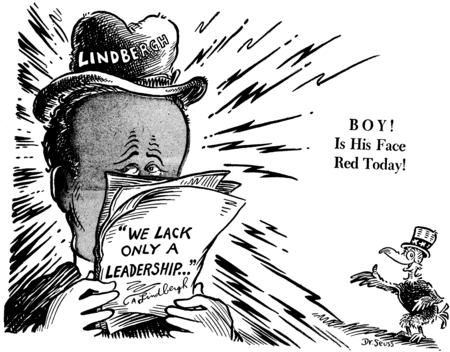
In May, the aviator was the cartoonist’s target only once, on the 28th, apparently after Lucky Lindy had made a speech for the America First Committee that apparently was considered an embarrassment by some observers.  Geisel never attempted to depict Lindbergh realistically, often showing just his back but here he shows a partial face that bears little resemblance to the man himself.  We know it is Lindbergh only because it is written on his hat.  By this time the artist had settled on an eagle with an “Uncle Sam” headpiece as the symbol for America.  Here the eagle comments: “BOY!  Is His Face Red Today!”

Geisel followed up five days later with one of his most memorable Lindbergh jabs.  Here the American Firster is seen on a soap box petting the head of a sea monster with a Hitler-like hairdo and swastikas running down his body.  In the background is a smoldering ruins of a city.  Lindbergh is intoning:  “Tis Roosevelt, Not Hitler that the World Should Really Fear.”

In July Geisel made Lindbergh a target three times.  His first cartoon ran on Independence Day, July 4.  He resurrected the ostriches who now are carrying a sign reading “Lindbergh for President in 1944.”  The humor of twenty-some marching birds with smug smiles is dampened by a trailing, furtive individual wearing a mask and identified as “U.S. Fascists.”  His sign says “Yeah, but why wait ’til 1944?  The implication here is that some may be plotting to oust Roosevelt who was still in the first year of his third term. 
The July 16 offering was truly in the Dr. Seuss ludicrous mode.  There a whale, spouting water, sits on the top of a mountain peak, startling a climber.  The image sets the scene for a limerick that prefigures so many clever rhymes from the head of Geisel:

The Isolationist
Said a whale, “There is so much commotion,
Such fights among fish in the ocean,
I’m saving my scalp
Living high on an Alp…
(Dear Lindy!  He gave me the notion!)

The last PM cartoon for July returned to the pilot theme that marked Geisel’s first slap at the tarnished hero.  Here Lindbergh is depicted as an aviator presumably guiding the American eagle with a detached steering wheel.  The message here is a bit opaque:  “Atta boy, Lindy!  Keep me under control.”  The implication is that the Nation itself is happy to guided toward isolationism, as Lindbergh was preaching, at a time when public opinion actually was moving, albeit slowly, toward intervention.

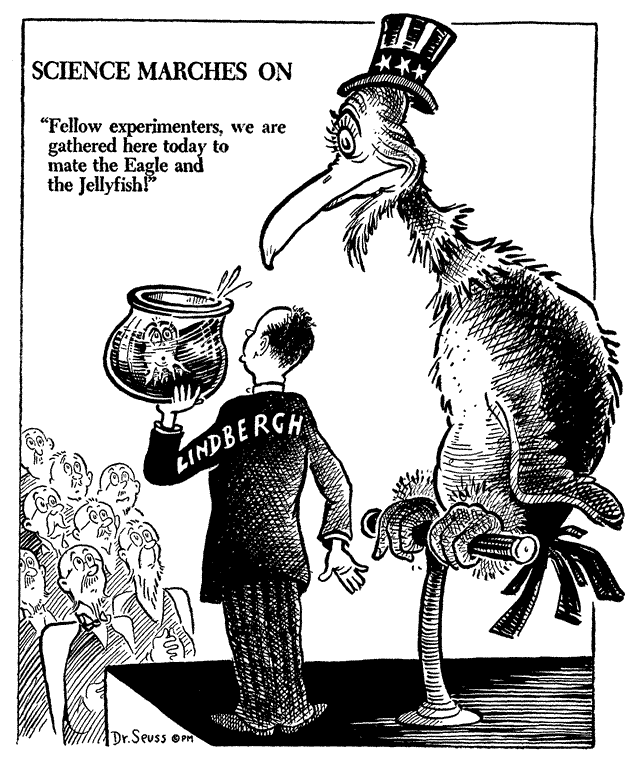
Avoiding Lindbergh in August, Geisel returned to the attack on September 2. This time the Uncle Sam eagle is seemingly an alarmed captive bird who is being asked by the America First orator to mate with a similarly distressed jellyfish.  A little over a week later Lindbergh would give a speech that one author has said, “fully knocked him off his pedestal.”  His anti-Semitism was fully on view as he blamed the Jews for pushing the country into war.  “Their greatest danger to this county lies in their large ownership and influence in our motion pictures, our press, our radio and our government.”  
This outburst was met with outrage from many quarters, including from Geisel. It triggered a Dr. Seuss editorial cartoon with the most savage attack yet.  Geisel depicted Lindbergh standing on top of a pile of garbage, shoveling it off, replete with cats and fish bones.  Written on the side of the wagon was “Nazi Anti-Semite Stink Wagon.”  The identification of the former U.S. colonel with the Fascists was in the caption:  “Spreading the Lovely Goebbels Stuff,”  a reference to the anti-Semitic rants of Hitler’s Minister of Propaganda.  On September 22, he followed up with another with the American eagle wearing a sign, “I am part Jewish,” and an alleged repost by Lindbergh and Senator Nye, an anti-Semite , that “This bird is possessed of an Evil Demon.”
With increasing number of U.S. merchant ships being torpedoed in the Atlantic,  on October 31 the cartoonist featured an American sailor floating on a raft with a radio, hearing that “Uncle Lindy-Windy” would be explaining that: “There ain’t no boogy man now!”  That was a clear reminder that Hitler’s Germany was not shy in targeting American shipping.

Then on December 7, the Japanese struck at Pearl Harbor and four days later Hitler declared war on the United States.  On December 8 Geisel featured an editorial cartoon that featured an explosion labeled “WAR,” blowing the isolationism bird out of the sky.  He would go on for the rest of the war doing cartoons that encouraged the U.S. military effort.

Lindbergh attempted to recoup his reputation by seeking to re-enlist in the U.S. military.  Roosevelt denied him that privilege.  As a civilian he later flew 50 combat missions in the Pacific (avoiding Germany) and in later years redeemed some of his reputation by becoming a prolific author, international explorer, inventor and environmentalist.  Whether he ever changed his anti-Semitic views seemingly is not recorded.

Note:  The complete set of Seuss/Geisel’s cartoons for PM were archived 2012 on the Web by the University California - San Diego under the title:  “Dr. Seuss Went to War:  A Catalogue of Political Cartoons. The Dr. Seuss Collection in the Mandeville Special Collections Library at the university contains the original drawings and/or newspaper clippings of all of these cartoons. This website makes these cartoons available to all internet users and were the source of this article. In a post of July 7, 2010, entitled, “Dr. Seuss Sells the Sauce,”  I previously featured the cartoonist’s ads for whiskey and beer.  

Postscript:   Since June the number of "hits" that this blog has experience have increased markedly.  Since it was begun in 2010, Bottles, Booze and Back Stories has averaged from 1,000 to 2,000 look-ins per month.  By contrast, this past June 39,583 hits were recorded, about 18% of the five year total of 221,624.  That pace seems to be continuing in July.  What is going on?  I am hoping some alert follower will give me a clue by leaving a comment below.  


Saturday, July 3, 2010

Dr. Seuss Sells "The Sauce"


Last October when I used an anti-Prohibition cartoon by signed Dr. Seuss, it did not occur to me that there was a intriguing back story in the image. I have always been a fan of the Seuss books, from Cat in a Hat to Horton Hears a Hoo and beyond -- books read to my sons when they were tots.

Unknown to me then was that their author, Theodor Seuss Geisel, came from a family of brewers. His grandfather Geisel owned the Kalmbach and Geisel Brewery in Springfield, Mass. In 1894 it was renamed the Highland Brewery and five years later became part of the Springfield Brewery. In 1919, on the very day his father became president of the company, Prohibition was voted and eventually forced the brewery to close. Geisel never forgot the financial loss and trauma this event caused his family.

The 1942 anti-Prohibition cartoon was occasioned by a bill in Congress to lower the draft age that included a rider that would have outlawed the sale of liquor in areas adjacent to military installations. The concern, shared by Ted Geisel, was that there were very few liquor stores in wartime America that were not near some kind of military site. This threat occasioned the cartoon referencing the long dead Prohibition stalwart, Carrie Nation, riding on a characteristically Dr. Seuss camel.

Further research led to the realization that at times during his career Dr. Seuss not only championed strong drink but actually provided advertising materials for beer and whiskey. Before children’s books were a major occupation, Geisel had made a living largely by drawing ads for a number of U.S. companies, initially for an insecticide named “Flit,” made by Standard Oil.

Geisel’s first foray into alcoholic beverages occurred in 1937 when he was commissioned to do a series of ads for Schaefer Beer. A New York City brewery, the F & M Schaefer Company had been founded in 1842 by brothers from Wetzlar, Germany. The brewery survived Prohibition and at one point in the 1950s Schaefer was reputed to be the largest selling beer in the world. Geisel was hired to give a lively image to Schaefer’s bock beer, a dark malty seasonal beverage that typically is available in March and April.

Because “bock” is also the word for goat in German, the brew often is depicted with that image. In keeping with this tradition, Geisel used a typically Seussian-looking mountain goat for his ad. In one illustration, the goat is a trophy animal who is looking enviously off the wall at two glasses of beer passing by. In another, the goat is a waiter carrying a foaming schooner on a tray.

When a small Scotch distillery in 1939 decided to advertise in the U.S. market, it needed a special image that would make its bottles distinctive on the shelves of bars and liquor stories. Given the assignment, Geisel created the “Hankey Bird,” an absurd looking avian with a large beak and wearing a kilt. With the use of a small spring, the figure snapped onto the neck of a bottle of Hankey Bannister Scotch. It was brought instant attention to the whiskey and sales soared.

Noting his distinctive work for Schaefer, in 1942 the Narragansett Brewing Company, located in Cranston, Rhode Island, asked Geisel to undertake an ad campaign for its beer. The president, Rudolph F. Haffenreffer, was a avid collector of Native American artifacts including cigar store Indians. Haffenreffer asked Geisel to weave an Indian theme into his advertising.

Thus was born “Chief Gansett,” a blocky figure wearing beads, carrying a hatchet and boasting a multicolored headdress. Most often this wooden Indian carried a large goblet of beer. The image proved very popular and the Chief appeared on a range of marketing items including trays, bar coasters, and posters as well as appearing in newspaper and magazine ads. In an ad for bock beer, Chief Gansett was depicted riding on an animal that bore a strong resemblance to the goat Geisel earlier had drawn for Schaefer Beer.

Throughout his career Ted Geisel as Dr. Seuss had written and drawn for youngsters. In 1957, however, he published two remarkable books that sent his reputation into the stratosphere, Cat in a Hat and The Grinch Who Stole Christmas. Thereafter he was able to abandon commercial work entirely to concentrate on children’s literature. While generations forward may be thankful for that, a look back is instructive to the time when Dr. Seuss sold the sauce and a whole lot of other things through his art. Those drawings lovingly have been gathered by Dr. Charles D. Cohen, a Springfield Mass. dentist, in a marvelous book called Seuss, the Whole Seuss and Nothing But the Seuss. It is a must read for any Dr. Seuss aficionado.