Showing posts with label Miller High Life Beer. Show all posts

Saturday, September 29, 2018

The Brewery Millers: Laughter Amid Tears


Coming across a set of comic postcards that Miller Brewing Company of Milwaukee issued before National Prohibition, I decided to make the cards and several other examples the subject of a post.  Although I am from Milwaukee and knew something about the family, some additional research revealed that although the Millers could see humor in their brewing efforts, tragic events seemed to stalk them.


First the Miller cards:  It is a set of six, artist unknown, in which the comic theme was linked to various modes of transportation ostensibly available in Milwaukee.   Street cars were common in the city but none like the one shown below.  Entitled “A Trolley Ride in Milwaukee,” the card depicts a beer barrel teaming with passengers, all seemingly drinking beer, rolling down the tracks on bottle caps (!) in front of the Miller plant.  A pedestrian has been knocked down and a dachshund runs along side.


“The Water Wagon in Milwaukee” enlists two of those “weiner dogs” to pull another High Life barrel that has been transformed into a street sprinkling device while locals aboard enjoy steins and goblets of beer.  Note that the gent sitting right behind the driver holds an outsized bottle of Miller beer.  Unlike its Milwaukee competitors, Miller always sold in clear (not amber) bottles. 


Even a sightseeing van could become a vehicle using a High Life Beer barrel to hold customers.  The engine is case of Miller bottles, the wheels are sausages, and one of those weiner dogs is running along side.  Although the beer-swigging passengers are alleged to be “touring Milwaukee,” they appear to be in front of, what else, the Miller brewery.


One of Miller’s bottles became the “S. S. High Life” on the next postcard.  Although the ship seems to be steaming through choppy waters, the crew seems mostly intent on drinking beer, ignoring the mustached captain who is peering anxiously at the horizon.  Note that the ship’s antenna is a string of hot dogs.


An intact beer barrel became a substitute for a balloon in a postcard entitled “In Milwaukee Looking Over the Town.”  It illustrates three hirsute men floating over the Miller Brewing Co.  The pilot carries a stein of beer while one passenger carries a foaming goblet and a second is sucking at a hose directly connected with the barrel.  The propeller is four bottles of Miller High Life beer.

The final card in this series is an airplane with weiners and pretzels for struts and sausages for propellors.  At the single control is a little old man who seems as intent on his foaming stein of beer as he does on piloting responsibilities.  As aways the brewery provides the terrestrial scenery.


Although these postcards deserve special attention for the their ingenious designs and humor, Miller also provided other light-hearted cards, some of them linked to Milwaukee.  Seen here is one that presumably shows a stout German gentleman swigging from a bottle and intoning “How Ish Dot for High Life Beer.  The brewery issued it at a time when it was not uncommon to hear German spoken in everyday discourse.

A final card likely dates from the post-Prohibition era when Miller was able to resume making beer.  It shows a suited gentleman looking at a soaring thermometer in the heat of a summer while holding a towel to sop his brow. 
In the next frame, he has found a bottle of Miller High Life and as the cartoon indicates, the temperature is going down.


The use of humor by the Miller Brewery to sell beer, while not unique in Milwaukee, was taken to a new level by that company.  It made all the more interesting when one considers the tragic circumstances that have plagued the Miller family over the years.  I was in Milwaukee in 1954 when Frederick C. Miller, the president of the firm, and his college age son both were killed when their plane crashed on take off.

The original brewery founder, Frederick Edward John Miller, and also suffered heartaches.  He and his wife Josephine had six children, most of whom did not survive infancy.  Josephine is said to have died of influenza in 1860 while on a trip traveling back to the couple’s German homeland, leaving Frederick with a two-year old daughter who herself would succumb to tuberculosis at age 16.  

Although Frederick married a second time and sired five children who survived to run the brewery after his death, this marriage also produce several children who died in infancy.  In an 1879 letter, Miller offered a glimpse of his personal torments: "Think of me and what I had to endure - I have lost several children and a wife in the flower of their youth…."Whenever I think of all of them, how they were taken away from me so quickly and unexpectedly, then I become sad and melancholy….”


Tuesday, March 15, 2016

Brews and Bullets: Mixing Beer and Hunting


Several weeks ago I posted a piece on ads that juxtaposed whiskey and hunting.  Most of them were from a pre-Prohibition era when the notion of rugged manhood was very high.  Not so with beer and hunting.   Although two items here can be dated before the 14-year American experience going “dry,” the majority of the ads shown can be dated later — some just a short time ago.
The pre-Prohibition Jacob Schmidt Brewing Co. ad above shows an amazing kill.  The three hunters standing in the background appear to have bagged three moose, two young buck deer, and what appears to be a fox.  They are celebrating their “big game” with Schmidt’s City Club beer, advertised as “The Better Brew.”  This was a leading brewery in St. Paul, Minnesota, for many years, founded in 1855 by Christopher Stahlmann.  The complex was purchased in 1900 by Jacob Schmidt and eventually became one of the leading regional beer producers in the country.  Converted to ethanol in 2000, odor and noise from the plant eventually forced its closure in 2004.
The scene at the right of the vintage trade card above seems to show hunters in the midst of their woodsy activities pausing to enjoy a bottle of beer while their dog looks on in anticipation.  They seem not to have shot anything yet, but, we hope, their aim will be steady as they move on. The H. Clausen & Son Brewing Co. opened in 1888 and closed a short eleven years later in New York City.  At that time, the Big Apple boasted 220 breweries, a whopping number even for the metropolis.   Competition was fierce and H. Clausen and Son likely were casualties of ensuing “beer wars.”

Immediately the images take us into the post-Prohibition era, 1934 to the present.  The Falls City Brewing Co. was organized in 1905 in Louisville, Kentucky, by local saloon and grocery store owners attempting to break a monopoly in the city by a brewery that also owned taverns, called “tied houses.”  They called their facility “Falls City,”  a nickname for Louisville’s location on the falls of the Ohio River.   Despite the interruption of Prohibition, the brewery operated until 1978 and the Fall City brand was extant as late as 2010 and after.  The saloon sign, entitled “Man’ Best Friend,” makes it clear from the hunter’s gaze that it is the bottle he adores — not the pooch.  The sign likely dates from the late 1930s or early 1940s.

The next ad, from United Breweries, a trade organization, can be dated during World War II.  The text tells of a soldier who has been “doing a different kind of hunting overseas,”  writing a letter home.  In it he expresses his desire to going hunting again when he gets back.  Meanwhile his relatives have bagged mature buck and are having a beer to celebrate.  The text goes on to explain:  “A glass of beer or ale — not of crucial importance, surely, but it is the little things like this that mean home to all of us, that do so much to build morale….”   This ad was just one of hundreds that brewing industry issued as the war ended to promote beer — likely remembering that National Prohibition had occurred after World War I.  

I doubt that the miss with the shotgun in the Rheingold Beer ad ever pulled a trigger in her lifetime.  But Margie McNally was “Miss Rheingold” of 1852 and the winner of that famous beauty contest could be expected to pose in a variety of tableaus, including hunting scenes.
Rheingold, founded in 1883 in Brooklyn, was a New York beer that held 35% of the state’s beer market from 1950 to 1960.  Its Miss Rheingold pageant began in 1940 as customers voted for the girl of the year.  The contest ended in 1965 and Rheingold shut down operation in 1976, when the company was unable to complete with large national breweries.  The brand name later was revived. 
The bar sign from Narragansett Brewing Company seem aimed at a humorous look at drinking beer and hunting.  The three nimrods are enjoying a bottle of beer from a case on the ground when they are startled by the sight of a huge buck behind them.  Unusually, however, at the far left of the scene appears to be a live rooster.  Was this bird meant for the grill at center, or did he wander in from another ad?   The Narragansett Brewery, founded in 1890 in Cranston, Rhode Island, ultimately became the largest in New England.   After several ownership changes it closed in July, 1981.

A Falstaff beer sign sounded a similar theme.  This time the hunter is torn between his meal on the fire and the stag running in the snow behind his tent.  Although he seems torn, the gent is leaning for his gun that is sitting on a case of Falstaff.   This ad made use of original art work from a well-known illustrator,  J. F. Kernan, famous for his many Saturday Evening Post covers.  Because Kernan passed away in 1958, this sign can be dated earlier in that decade.

The hunter illustrated in the Stroh Bohemian Beer sign might have felt short-changed by the brewery.  Narragansett and Falstaff gave their hunters a full case of beer.  This genial fellow has been given only three bottles.  Unlike the others, however, he has dinner fully in hand as he roasts the grouse he has shot, while his dog looks on hungrily.  During my supermarket career I sold Stroh's for $1.98 a case (24 cents a bottle).  Located in Detroit, Michigan, Stroh’s for years was the “economy brand” of choice, particularly among the young.   The company, founded in 1850, was taken over and broken up in 2000, but some of its brands are still being sold.  

This Miller brewery newspaper ad once again has a happy hunter with a full case of beer at his disposal as he checks out his shotgun.   “Nothing quite hits the spot after a day’s hunt…like a bottle of delicious Miller High Life,” the text proclaims.  From the looks of his waders and the mallard decoys in the picture, this gent has been duck hunting with nothing much to show for his effort.  The Miller Brewing Company was founded in Milwaukee by Frederick Miller in 1855 and remained in the family until 1966.  Although the brand continues as one of the Nation’s most popular, the company has changed hands several times.

Even in contemporary times, beers sometimes advertise in a hunting mode.  The pastime has been a central theme for Keystone Beer, a product of the Molson Coors Brewing Company in Golden Colorado.  First introduced in Chico, California, in 1989, Keystone Light can be found primarily in cans and frequently with the implication of some gunning going on.  Note, for example, the trophy plaque with a can of Keystone and a pair of horns.  The juxtaposition of hunting and beer is evident.  Another Keystone ad, below, makes the same pitch, with a can of Keystone in the crosshairs as “beer of the day.”  
Countering Keystone beer and the other brands with hunting motifs is the final illustration shown here.  It is a spoof on the Dos Equis beer ads that show a suave gentleman who assures us that he does not always drink beer but when he does it is — no surprise — Dos Eqius.  Here the hunter apparently has been drinking while nude (except for his boots) and staggered into the snow with a bottle in one hand and his rifle in the other.   His fate is a lesson to all:  Drinking beer and hunting don’t really go together.  


Saturday, November 21, 2015

Drinking and Flying: “Are You Kidding Me?”


This post begins with a personal story.  During the summer of 1957 while working on a Northern Wisconsin weekly newspaper, I was told by my boss to take aerial photos for a prominent resort owner of his place.  When I arrived the owner clearly was drunk but he proceeded to tell me how he would fly his Cessna sideways with me leaning out to take the shots.  When he picked up the phone to call the local airport, I figured on running away to join the circus.  Then he put down the receiver, explaining: “I never fly if I have been drinking.” The photos never got taken.
This incident caused me to follow up on my last post about “drinking and driving” as captured in pre-Prohibition beer advertising.  It is evident beer and liquor interests have also linked drinking and flying in their merchandising — not only in the early days of flight but even more recently.

Wilbur and Orville Wright flew the first airplane in 1903 at Kitty Hawk and it quickly sparked many innovation so that by 1914 the first commercial passenger service was established.  Beer manufacturer were quick to seize on public interest in flying as an advertising gimmick.  
Falstaff Brewery appears to have embraced the idea of advertising its beer with flying early on.  It issued a postcard that showed a comely young woman, an early aviatrix, holding a bottle of beer.  The caption is very clear about the purpose:  “A bottle of Falstaff as a ‘bracer’ before the flight.”  The message was “drink before flying.”

The brewery returned to this theme by issuing a trade card showing a Gibson girl sitting in something that looks vaguely like an airplane.  She is quaffing a glass of Falstaff poured from a bottle beside her.  Her seat bears the brewery logo.  Women had begun participating in aviation about 1910.  The first woman to be given a flying license was a French baroness.  Shown here is Lillian Todd, an early flyer and the first female aeronautical engineer.  Ms. Todd had designed the plane she is posing on.  She is not known to have had a beer before taking off.
The Miller Brewing Company also saw the benefit of advertising via the airplane.  Theirs is a cartoon.  The pilot, a little old man, is drinking from a stein while surrounded by large bottles of Miller High Life Beer.  He is said to be experiencing the “High Life in Milwaukee.”  The pilot may never be able to land; his struts are actually sausages.

Charles Lindbergh’s flight from New York to Paris in May 1927 had made him a national hero.  His popularity extended beyond the repeal of National Prohibition in 1934 prompting Haffenreffer and Company to use his image and associated message to promote its Pickwick Ale and Stout.  According to the ad, Pickwick has experienced a “flight of popularity.”  The public is assured: “And you will have no fears for safety when you’re navigating with Pickwick.”  Maybe, but I suspect that if “Lucky Lindy” had been navigating with a few drinks in him he might have landed in Chicago.

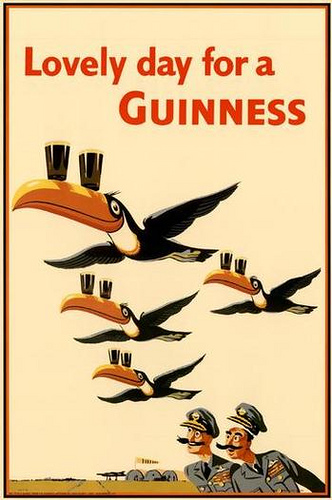
Fast forward to more recent times.  An ad from Guiness shows its toucan mascots flying over a military airfield with glasses of stout balanced on their ample beaks.  Two military chaps are looking at them and while clearly startled seem to be thinking, “Lovely day for a Guiness” just before they take off into that “wild blue yonder.”

Powers Gold Label Irish Whiskey seems to be conveying a similar message, showing a man dressed for flying who is drinking an Irish coffee made with Powers.  The drink is said to “Warm the cockles of your heart….”   It also may warm up other bodily organs, some of which are better left cool in flying.

The illustration here of a stewardess holding an Foynes Irish Coffee in front of a airplane needs some explanation.  As one author has put it, “Foynes and flying boats will be forever connected with the Irish coffee.”  Foynes was an airbase near Limerick and the main airport for flying boats — fixed wing planes that landed on water — traveling between Europe and the United States.  Weather conditions along the West coast of Ireland can be notoriously bad, and after taking off for New York, on one occasion the pilot had to return to Foynes.  To warm up the passengers an airport restaurant brewed some coffee, added some Irish whiskey and brown sugar, topped it off with whipped cream — and the rest is history. 
The last example of linking strong drink and flying appeared in a Smirnoff Vodka ad in 1969.  It features a group of picnickers who are drinking the potato alcohol,  two of them equipped with helicopter backpacks.  Two women also seem dressed for flight.  The caption should have been:  “Don’t try this at home.”
The last illustration is a cartoon that indicates my close scrape with a potentially drunken pilot narrated above was not so far-fetched.  Back in 1990, all three members of a Northwest Airlines flight crew were legally intoxicated when they flew 91 passengers from Fargo, North Dakota, to Minneapolis, Minnesota, roughly an hour-long flight whose landing came without incident. Authorities had received a tip from someone who had seen them drinking in a bar the previous evening. The three served prison sentences.

I escaped making a decision to bolt if the inebriated resort owner had actually order up his airplane.  The passengers on that Northwest flight probably never knew — until they read of the arrests in the paper the next day.  All of us were lucky but luck should be nothing to count on when flying.