Friday, October 21, 2011

Andrew Clemens: He Found a Voice in Sand


Among American folk artists the work of Andrew Clemens stands out as an amazing story of creativity while working under severe handicaps. Clemons, shown here, was born in 1852 in McGregor, Iowa. As the result of a severe illness at the age of five, diagnosed as “brain fever,” he was rendered deaf and mute for the rest of his life.

At age 13 Clemens was sent to the Iowa State School of for the Deaf and Dumb in Council Bluffs. The school was located in along the drainage of the Bridal Veil Falls near an area of exposed cliffs called “Pictured Rocks.” The sandstone exposed there has acquired a variety of colors from the minerals that have seeped from overhanging rocks and permeated the sandstone.

Clemens saw these sands as an outlet for his artistic talents. As one guide to his work explains it: “Clemens collected the sand from ‘Pictured Rocks’ and allowed the sand to dry. He separated the dry sand into piles of uniform grains of each color. These naturally colored grains formed the basis for Clemens’ sand paintings. To create his sand paintings, Clemens used only a few tools: brushes made from hickory sticks, a curved fish hook stick, and a tiny tin scoop to hold sand.” His simple tools are shown here.

Selecting the appropriate color, he tediously inserted the sand using the fish hook stick, grain by grain, into empty apothecary bottles, The brushes helped keep the picture straight. No glue was used. The sand was held in place only by pressure from the sand layered on top of it. When the picture was finished and the bottle full, it was sealed with a stopper.

His sand paintings included both original designs and reproductions of other images. Some, as three shown here, were created from bottom to top. Some had separate pictures on back and front. Even more amazing were those bottles that required he create his designs upside down. After completion these were sealed, turned over, and stood up on their openings. Few better uses have been found for empty bottles.

Clemens sold his creations in a McGregor grocery store. A small bottle was $1; more elaborate creations might go for as much as $8. He established a customer base among both locals and travelers looking for unusual souvenirs. It is estimated that during his brief lifetime, Andrew created hundreds of sand art bottles of which only about 50 are estimated to have survived. He is said to have created most of them in the six years between 1880 to 1886. Today they can fetch as much as $30,000 at auction. A number are in museums.

Clemens' efforts have never been duplicated. He both invented the art form and is likely its sole practitioner. I have seen sand paintings by American Indians, South Asian holy men, and folk artists. None can compare with the beauty and ingenuity of the designs this artist produced. Thus it is with a certain poignancy that we contemplate the label that was attached to the bottom each sand painting: “Put up by A. Clemens, Deaf Mute.”

Saturday, October 1, 2011

Enlisting Uncle Sam to Sell Booze


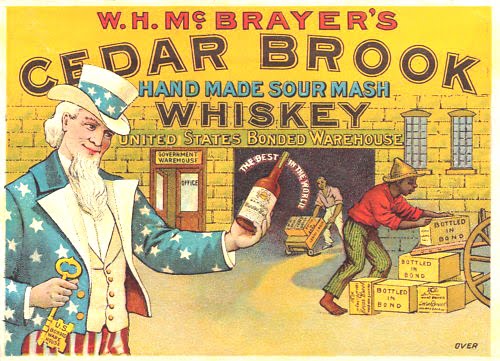
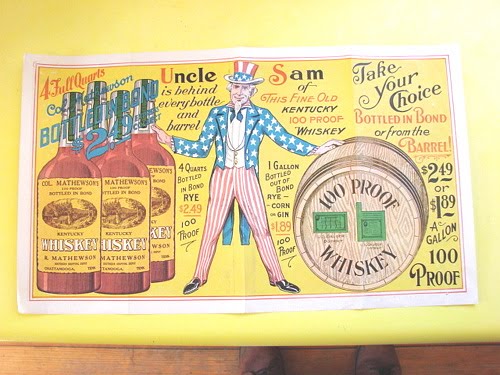
In the pre-Prohibition era, it was not unusual for distillers and dealers to conscript the familiar figure of Uncle Sam to merchandise their whiskeys. Shown here are eight examples of trade cards and newspaper ads exploiting the old gentleman’s image in the cause of selling liquor.

There was a good reason to enlist Sam: In 1897 after a Congressional investigation uncovered massive counterfeiting and adulteration of whiskey nationwide, the Bottle in Bond Act was passed and signed into law by President Grover Cleveland. It permitted the marketing of whiskey that would be sealed in bonded warehouses and and sold under proprietary names with a guarantee of integrity from the United States Government.

“Bottled in bond” or “bonded” whiskey was (and still is) whiskey that was produced according to the guidelines set forth in this more-than-century-old statute. The requirements are: 1) whiskey must be stored in a federally bonded warehouse for at least four years before bottling; 2) it must be legally defined straight whiskey and distilled in a single season by a single distillery, and 3) it must be bottled at one hundred proof (50% alcohol).

The government then certifies that the whiskey was bottled at this proof; it also vouches for the aging period. The federal guarantee is symbolized by sealing the whiskey with a green strip stamp on each bottle. In exchange for meeting all these requirements, distillers do not pay taxes on their whiskey until it is bottled and removed from the warehouse for sale. Treasury agents are assigned to distillery warehouses to insure the rules are followed.

In a day when trust in government ran higher than today, the federal guarantee was seen as something to be exploited in merchandising by canny whiskey men. How better to take advantage of “bottled-in-bond” than by appropriating the national symbol?

The W.H. McBrayer trade card depicts the situation in vivid colors. Uncle Sam stands in front of a bonded warehouse, key in hand, as workers withdraw crates of Cedar Brook Hand Made Sour Mash Whiskey. A second Cedar Brook ad has the old gent and his key riding a flying bottle of whiskey and the motto: “Way above everything on earth.” This Lawrenceville, Kentucky, distillery was founded in the late 19th Century by Judge W. H. McBrayer. After his death in 1887, the Judge’s estate went to his grandchildren and their father, D. L. Moore, ran the distillery. The Kentucky Whiskey Trust bought the plant about 1900 and under various managements continued production until Prohibition.

A trade card from the Thompson Straight Whiskey Co. of Louisville, shows us Uncle Sam “Catching the Fakir.” He is peeking through a door leading to a workroom in which a whiskey “rectifier” is pouring a number of suspicious ingredients, represented by bottles on the wall, into a stoneware container. The inference is that Sam will arrest the fakir. Thompson also tells us: “ Uncle Sam says: The Label must tell the truth so always read carefully the label.”

Thompson was in business from 1910 to 1918. The company used the brand names: "Country Club", "Forelock", "Lucky Stone", "Old Kentucky", "Old Medicinal Corn", "Old Mountain Corn", "Thompson Old Reserve", "Thompson Select", "Thompson Straight", "Very Old Special", and "White Bird Gin.”

Steinhart Bros. in an 1890s ad portray a distinguished looking Uncle Sam pointing to one of the many brands they featured as wholesale liquor dealers. It is “Roxbury Rye,” a Maryland-made whiskey of which they had purchased an entire years supply. This firm was highly successful and grew to have outlets in many sections of the Big Apple. Founded in 1872 Steinhardt Bros. succumbed with Prohibition.

The trade card of Uncle Sam holding some bottled-in-bond whiskey in glass containers with one hand and a wooden barrel with the other is presumably from the R. Mathewson Company of Chattanooga. Little appears in normal sources but my surmise is that this brand was produced by the Rufus Rose family of “Four Roses” fame during a brief period 1907-1910 when son Rudolph moved their distillery from Atlanta to Chattanooga. “ R. Mathewson” was Rufus’ first initial and middle name.

The Clarke Brothers, Charles and Chauncey, inherited a distillery business founded in 1862 by their father in Peoria, Illinois, After his death they incorporated the company under their own names. For a time following the passage of the Bottle in Bond Act, they claimed that their whiskey was distilled by the U.S. Government. Probably warned off that approach they subsequently featured Uncle Sam in their advertising, emphasizing, more factually, that the Feds had set a seal on every bottle.

The Turner-Look Co. of Cincinnati provided a list of the brands it sold in an 1897 ad, depicting the American flag and Sam with an umbrella. The text assures customers that quality is assured by “the Best Government on Earth.” This firm were wholesale dealers featuring a wide range of brands. Cincinnati directories indicate that they were in business from 1887 until 1918.

Although Guckenheimer ads often alluded to the bottled-in-bond character of their whiskey, in this one only Uncle Sam appears, holding a scale to demonstrate that Guckenheimer Pure Rye Whiskey has a balance of quality and purity. This Pittsburgh firm was founded by Asher Guckenheimer in 1857. His liquor became a leading national brand after winning top prize at the 1893 Colombian Exposition in Chicago. Following his death family members carried on the business for several years after Prohibition until 1923.

The final example deviates from the mantra of “Uncle Sam guarantees whiskey quality.” The image advertises “Five Jacks” brand from I. Michelson & Bros. of Cincinnati. It is trying to make the point that their whiskey is one “for All Nations.” Uncle Sam is leading the way for Britain’s John Bull, others dressed in national clothing, and a donkey to try
it. This whiskey distributor and rectifier were in business from 1898 until 1918.

Today we are accustomed to seeing Uncle Sam represented in a number of poses, both commercial and patriotic. Since Prohibition, however, he has been strikingly absent from whiskey merchandising even though “bottled-in-bond” has continued unabated.

Friday, September 16, 2011

Whiskey in a Full Metal Jacket


In December 2010, this blog featured eight metal teapots issued by whiskey distillers and distributors to advertise particular brands. Subsequently additional metal containers issued by the whiskey trade have come to light. In addition to teapots they include metal jugs and metal pitchers. Nine are displayed here, along with information about their origins.

We begin with the jugs and a metallic container that advertises Hinkel Pure Rye. It was as the product of the Mathias J. Hinkel Co., located at several addresses in Cleveland, Ohio, including 461 Pearl (1892-1905), 1778 W. 25th NW (1906-1908), and 814-820 Prospect Av. SE (1909-1919). Since the jug does not bear an address, it is impossible to date it exactly.

Hinkel himself was a native son of Cleveland, born in 1867, who left school at the age of twelve to work as an office boy at Edwards, Townsend & Co, eventually rising to the position of manager of the liquor department. In 1892 he struck out on his own, establishing a wholesale liquor business. Eventually it became one of Cleveland’s largest.

The second jug comes from Sandusky, Ohio, bearing the name of August Guenthur. Guenthur was a self-described wholesale dealer in “fine whisky etc.” The metal container advertises Old Jug Rye, which was a proprietary brand produced by J. & A. Freiberg of Cincinnati. Brothers Joseph and Abraham Freiberg traced the origins of their firm back to 1866. Among a blizzard of liquor brands, their “Old Jug” was the flagship. They issued their own metal jug for Old Jug Whiskey, shown here, but in other instances allowed their dealers to add their own names, as August Guenthur did.

The fourth jug hails from the Kentucky Liquor Company. Despite its name, it appears that this vessel was the product of a liquor company in Chicago. Very little appears about it in the public record, but the firm shows up in city directories, located at 295 Wells Street, from 1892 to 2896.

Whiskey Teapots

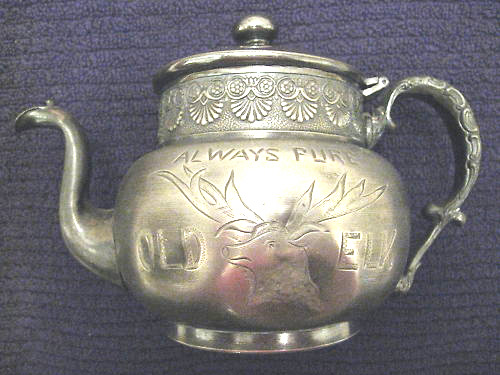
Three additional whiskey teapots are shown here. The first is from “Old Elk.” the flagship brand of Stoll & Co. of Lexington KY. The Stoll family, operating under this name, established the Commonwealth Distillery in 1880. There followed a number of ownership changes in which family members took varying roles, including a time when the company became part of the notorious “Whiskey Trust.” In 1902 James Stoll reformed the company and acquired control of several Kentucky distilleries, making it the largest distilling concern in the state. When James Stoll died in 1908, family once more turned over their interests to the Trust.

M. H. Chamberlain & C0. of Detroit saw a real opportunity in issuing a silver plated teapot. Their flagship brand was “Chamberlain’s Silver Rye” and the metal container was appropriate advertising. This firm was founded in 1879 and existed into the early 1900s. Warehouse records show that the company was obtaining whiskey over the period 1901-1904 from the Burks Spring Distillery in Kentucky. Michigan was the first Midwest state to vote Prohibition in and led to the demise of M.H. Chamberlain & Co.

The third teapot is from a firm that had outlets in Fond du Lac and Milwaukee, Wisconsin. “Tom Benton” was its flagship brand with others being “Crystal Brook” and “Rosehill.” The originating firm may have been Rahte, Haas & Watke (1891), with the partners eventually going their separate ways, at least two of them, including Albert Watke whose name is on this teapot, claiming the Tom Benton brand.

Metal Pitchers

Two metal pitchers issued by whiskey outfits conclude this post. The first advertises the Zeno brand from one of the feuding McBrayer family. One of the clan's distillery was founded in the late 19th Century by Judge W. H. McBrayer. After his death in 1887, the Judge’s estate went to his grandchildren and their father, D. L. Moore, ran the distillery. This jug, however, may have come from another distillery using the McBrayer name, something that fueled intra-family lawsuits.

The final item is a highly decorated silver plated pitcher bearing an embossed crest and the name Gannymede “76” Rye. It is from Cincinnati, an advertising item issued by Sigmund and Solomon Freiberg, brothers from the Ohio whiskey dealing family and related to J. & A. Freiberg. This company first showed up in city directories in 1899 and from the blizzard of brands it featured appears to have been successful for almost two decades. Gannymede “76” brand was its flagship.

These are just a few of the “full metal jackets” through which American distillers and liquor distributors merchandised their whiskey. A subsequent post will describe and depict others that have come to light.

Friday, September 2, 2011

A New Find: Diamond Club Rye


One of the more rewarding aspects of this blog, herein marking its 75th posting, is the response from readers who “stumble on it” while researching collectible items on the Internet and send me emails about them, often with pictures attached. One such reader was Greg Johnson of Minneapolis who sent me the picture of a transfer printed mug, shown here. It was one that I had never seen before. Its provenance was revealed from the bottle from which two men, a farmer and a banker, were drinking. This clearly was the handiwork of George W. Meredith.

George’s story begins in Utica, New York, where he was born in April 1850, the son of Thomas and Elizabeth Meredith. Not long after the family moved to Trenton, New Jersey In 1852, the father died. Mother soon followed him to the grave, leaving George a orphan from boyhood. The youth soon abandoned school to learn a trade as a potter and in 1877 moved to East Liverpool, Ohio.

During the late 19th and early 20th Century this town on the Ohio River was America’s largest producer of ceramic table and vanity wares. Known widely as “Crockery City,” in 1887 East Liverpool boasted 270 kilns and annually produced ceramic products valued at $25 million -- in a time when 25 cents would buy dinner. The largest pottery in town was KT&K -- Knowles, Taylor & Knowles, founded in 1854.

After a year working for a small pottery operation, Meredith in 1878 joined KT&K, working in one of the lowlier jobs -- as a jiggerman. This was the relatively unskilled the laborer who turned the potter’s wheel to shape the clay. But the occupation did not suit him and may even have injured his health. After a little more than two years he left the factory, ostensibly on his doctor’s recommendation.

Almost immediately this 30-year-old determined that a far better occupation was making and selling whiskey. The late 19th century was a time when saloons were opening in every city and town. They did not lack for customers. Lots of folks were going into the whiskey business, many as rectifiers -- operations that refined and blended liquors made by others. Meredith was a rectifier. He rented a storeroom in downtown East Liverpool and with one employee began buying grain neutral spirits in large quantities and blending his own brands, adding color and flavoring.

It soon became clear that despite his lack of book learning, Meredith had a real genius for marketing whiskey. Early on, for example, he called his principal brand “Meredith’s Diamond Club Rye.” Diamond Club was the name of East Liverpool’s most prestigious grouping of businessmen. It took lots of nerve for Meredith to associate his liquor with the club and his use of the name raised considerable ruckus around town. Before long, however, Diamond Club whiskey was a big seller, not only in East Liverpool, but in Ohio, and eventually across America. In time the businessmen’s club itself surrendered and changed its name to “Buckeye Club.”

Key to the popularity of his whiskey were Meredith’s advertising campaigns. His signs were painted on barn sides and rock outcroppings for miles around East Liverpool. He maintained a boat that was moored on the Ohio River and carried a mural advertising his products. One hot August day he even distributed hand fans to Temperance marchers that had an plug for his whiskey printed on the back.

Meredith’s knack for publicity was matched by the themes of his advertising. His newspaper ads and container labels insisted that the whiskey was “pure,” once again exhibiting his merchandising savvy. The hottest consumer issue of the decade was the safety of merchandised food and drink products. The Pure Food and Drug Act would be enacted a several years later and “purity” had the same draw as “all natural” does today. Diamond Club’s purity, Meredith announced, made it “the safest whiskey on earth” for medical purposes. He claimed that one “nip” was worth 10 doses of medicine and boasted that his liquor had been “officially recognized” by the medical profession. How and where, he did not elaborate.

By stressing his whiskey’s therapeutic rather than its lubricating qualities Meredith also was attempting to circumvent the burgeoning Temperance Movement. The business of selling “the safest whiskey on earth for medicinal use” expanded rapidly. Within a decade Meredith was one of North America’s largest whiskey distributors, serving a clientele, as he put it, “from Maine to California and Canada to the Gulf.”

This canny, self-promoting businessman also saw the customer appeal that bottling his whiskey in a whiteware china jug might have. He talked his former employers at KT&K into shaping a distinctive container, one with a graceful tapering body, a serpent handle, a fancy over-glaze label and plenty of gold trimming. On April 4, 1891, the East Liverpool DAILY CRISIS ran an ad stating: “The G.W. Meredith Co. is offering its Diamond Club Pure Rye Whiskey in china jugs that will come in three sizes.” The KT&K whiskey jug was launched -- every one of the bearing the message: “Expressly for Medicinal Purposes.” He also approved a striking design for an “1880” Meredith Rye.

As Meredith grew in wealth and prestige, he branched out in East Liverpool, organizing and becoming principal stockholder in the Crockery City Brewing & Ice Company. He also helped found and later became the president of The Colonial Company, a pottery with six kilns. Greg Johnson’s mug bears the Colonial mark, as does a Meredith stein bearing three monks, also shown here.

The town Meredith had adopted as his own ultimately disappointed him. In 1907 the Temperance marchers had their way when East Liverpool by local option voted itself dry.
He retaliated by eliminating the town name from his bottles and jugs and in 1908 moved his whiskey operations to Pittsburgh. After National Prohibition wiped out his liquor business there in 1920, Meredith migrated to Atlantic City, N.J., where he is said to have made another fortune in real estate. He also bottled a soft drink called “Whistle,” an orange-flavored beverage that had been invented in St. Louis just as Prohibition began. He died in Atlantic City in 1924 at the age of 74.

Meredith’s legacy is in the many advertising artifacts he left behind, ranging from a tiny watch fob in the shape of a jug to a giant ornate lamp stand. Greg Johnson’s recent find of the Diamond Club mug is a strong reminder of the genius of this pre-Prohibition whiskey man.

Thursday, August 18, 2011

Ludwig Bemelmans: Whiskey and Whimsey


My earlier post, Dr. Seuss Sells the Sauce” (July 2010), chronicled the beer and whiskey ads created by the famous children’s author. Although Ludwig Bemelmans may not be as well known, his children’s books have been avidly read for decades. Like Seuss, Bemelmans, shown here, used his distinctive artistic style to draw a series of ads for a whiskey maker. His pictures remain a marvelous, whimsical legacy.

Bemelmans, who was an author as well as an illustrator, was born in the Austrian Tyrol in 1898. Employed at 16 in his uncle’s restaurant, he shot a headwaiter in a dispute and the family gave him the option of reform school or emigrating to America. He chose the latter and as he said...” I bought two pistols and much ammunition. With these I intended to protect myself against and fight the Indians.”

After landing in New York City, he soon joined the U.S. Army during World War I, despite just barely being able to speak English. His antics as a soldier, including firing his pistol at unruly prisoners he was guarding, were captured later in his humorous memoir, “At War with the Army.” After the war Bemelmans writings and art began to gain important recognition. It was not until 1934, however, that he published his first children’s book and followed in 1939 with the adventures of a Parisian school girl named Madeline (named after his wife). As shown here, his delightful drawings were an instant success and the Madeline stories became a series, ending only with his death.
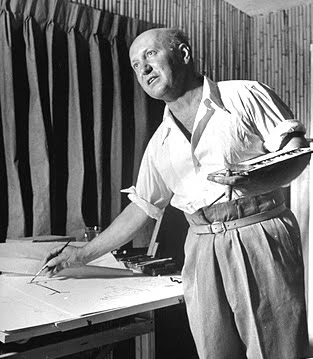
As his fame as a children’s author grew, he continued to contribute drawings and writing to national magazines such as Vogue, Town and Country, The New Yorker, Fortune, Harper’s Bazaar, McCall’s, Holiday and Stage. It was perhaps natural then that the Hiram Walker Company of Detroit and Walkerville, Ontario, one of America’s largest distilleries, would tap Bemelmans’ talents for advertising its flagship brand, Walker Deluxe Bourbon. This whiskey for years had featured a black waiter serving whites -- a theme that probably was losing its market appeal as the Civil Rights era dawned.

As a result, from 1957 to to 1959 Bemelmans drew a series of color ads for Walker Deluxe. By my count there were 11 in all, of which 5 are shown here. The consistent theme is the enjoyment of the whiskey by people who clearly are very, very rich, but each illustration has a waggish twist.

The first ad shown here is of a butler taking a nip from the Walker Deluxe bottle. This caused one contemporary observer to ask: Oh, Ludwig Bemelmans, it’s a mere hop, skip, and a jump from little Madeline causing mayhem in the orphanage to butlers helping themselves to a swig from the drinks cart, isn’t it? Please note the dog in the picture at left: His arch attitude mimics the butler.

The next two ads are similar in theme. In the first, a group of three yachtsmen are served whiskey by a cabin waiter. They are clearly on a yacht while in the background their own yachts are anchored nearby. The second features three Texas oil tycoons, hats and shirts of the type, enjoying a drink while in the background their limos and sports cars, with uniformed drivers, await. Snob appeal with a twist.

The next ad features at least four waiters serving a number of gents (no women appear in any of the 11 Bemelmans ads) in an African safari tree house. The waiter at far left, as in the first picture, is helping himself to a nip of whiskey before serving it. Note that no waiter in any of the ads is a person of color. Hiram Walker executives apparently had seen the error in that depiction.

My favorite is the last image. It shows a waiter serving two portly gentlemen sitting beneath the trophies of prior hunting expeditions. Each animal is worth examining for its slightly different expression, ranging from anger to puzzlement. Bemelmans has injected into this scene, just under the rabbit, top left, the framed picture of an elderly woman, probably the mother of one of the drinkers. They apparently see no irony in her appearance among the trophy heads.

During the 1950s Bemelmans became involved in show business, designing the set for a Broadway production and doing several stints in Hollywood. The murals he painted at New York's Carlyle Hotel bar are still prized for their delightful whimsy. He died in that city in October, 1962 at the age of 64.

Ludwig Bemelmans is buried in Arlington National Cemetery outside Washington, D.C. There his gravestone records none of his many accomplishments as an artist and writer. It states simply, Cpl.U.S.Army, World War I. Of that service to his adopted country, Corporal Bemelmans clearly was justly proud.


Friday, August 5, 2011

Collecting: A Focus on Fantasy


Recently on eBay I saw, bid for and won a heavy brass paperweight on a marble slab, shown here. In bas relief It features a bare-breasted young woman holding a bottle high against the familiar Coca Cola logo. Other features are a ribbon on which appear the words “Refreshing and Delicious” and “Atlanta Ga USA.” In small letters in the upper right appear the words “Tiffany Foundry.”

Tiffany Foundry was a enterprise of Louis Comfort Tiffany (1848-1933) an American artist and designer, shown here, who worked in the decorative arts and is perhaps best known for his work in stained glass. As a foremost adherent of “Art Deco” -- the design of the paperweight -- he also executed numerous metal work items in his foundry, such as the inkwell shown here. Most Tiffany items fetch high prices.

My paperweight is an interesting and attractive piece. It surprised me then to win it with a bid of $15, the price of a modest lunch. Subsequent research revealed, however, that presumably knowledgeable collectors of Coca Cola items, of whom there are many, consider this object a “fantasy.”

The concept was new to me. After some thirty years of looking at, accruing and writing about collectibles, I have become accustomed to looking out for reproductions knowingly or unknowingly sold as the real thing. There are dozens of “repros” that collectors of expensive glass bottles are aware of. Antique watch fobs with value are reproduced (counterfeited?) so frequently that it plagues the hobby.

But “fantasy” items are not reproductions or imitations. They are described by commentators as items that were not designed or in any way issued by the company advertised. In this case Coca Cola. The question remains whether they were meant to fool collectors. Describing them as fantasies seems to me to avoid the question.

The image on my paperweight shows up in other formats, including a belt buckle and a bracelet, shown here. The back of the belt buckle identifies “Tiffany Studio” and “JJ Willard-Phila” as identifying marks. One Coke specialist says: “Unfortunately these buckles are really worthless...Most experts seem to agree that the value of each buckle range from nothing to no more than $10.” ($5 less than I paid for the weight.)

Presumably these fantasies proliferated at one point in history. Shown here is different Coca Cola belt buckle that also is disparaged by the cognoscenti as a fantasy.

The Tiffany folks for a long time were unsure if their foundry had made the items bearing their name because the records had burned during the 1930s and were unavailable. Eventually they decided that the company had not been involved and identified the items as a fraudulent. In the interim, according to reports, some collectors had been gulled to purchase them to the tune of hundreds of dollars.

My paperweight has a felt base and a sticker label, indicating rather recent manufacture, and a reference to the “The Art Mint, Ltd” of St. Louis, Missouri.” Information on this firm is sketchy. It seems not to exist anymore but produced other novelty objects including resin wizard figures, shown here. They surely qualify as fantasy.

For me the personal question remains: Was I defrauded by paying a modest amount for this object, no matter who made it and when, one that has a elegant Art Deco design and format? I don’t think so. It will keep its place in my collection. Given its strong appeal , it would seem ridiculous, regardless of value, to think of this paperweight as something as flighty as a fantasy.