Saturday, August 18, 2018

Uncle Sam — The Distillers’ Man


Foreword:  This is the third in a series of posts demonstrating how American whiskey distillers, rectlifiers (blenders), and wholesalers used the image of Uncle Sam prior to 1920 as the Prohibition “noose” tightened on the industry.  It was a ploy to lend a patriotic aspect to their marketing.  But as the cartoon shown above indicates, the force of “dry” also saw Uncle Sam abetting the liquor industry by profiting significantly from the taxes collected.   Before 1920 the largest source of federal revenues were excise taxes on alcohol.

The trade card from “Wolf’s Famous Distilling Company” of Kansas City was a typical depiction of Uncle Sam in the whiskey trade.  The old gentleman is pointing to a federal revenue stamp on “Wolf’s Monogram Whiskey” that indicates it has been “bottled in bond,” that is, under government mandated conditions that dictated length of aging, alcoholic strength or “proof” and other requirements in return for delayed taxation.  Although the claim that the stamp guaranteed “strength” might have some validity, it had nothing to do with quality or purity.

“Freeland Sour Mash” was a whiskey brand from Henry W. Smith & Company of Cincinnati.  Although this outfit has been described as operating a distillery in Covington, Kentucky, across the Ohio River from 1890 to 1901, records indicate that Smith was a rectifier, re-distilling and blending whiskeys obtained from Kentucky distilleries, particularly several in the Covington area, Federal District #2.  It somewhat strange then that Uncle Sam is shown sitting whittling on the 7th District in Kentucky, some distance from Cincinnati. 


The Yellowstone Whiskey ad specifically identifies Uncle Sam with “Bottled in Bond.  A whiskey wholesaler, the firm of Taylor & William was established in Louisville just after the Civil War in 1865.  In 1871 the sales manager, Charles Townsend, made an annual trip to the West Coast. En route he visited the newly opened Yellowstone National Park and, noting the enthusiasm over this natural wonder, decided it might be a good idea to name a whiskey after it.  Viola!  a 
national brand was born! 


This tradecard from what purports to be “Mascot Rye,” is an unusual depiction of Uncle Sam.  In the first place, he is without his trademark top hat and bears a collar on which is written “honest and good as I am.”  The label on the bottle bears an image of a horseman riding through a horseshoe and identifies J. Polsnek” of Akron, Ohio, as the source of the whiskey.  My extensive research on Polsnek and Mascot Rye has failed to reveal any information on either.

By contrast, George Benz & Sons are well documented St. Paul, Minnesota, whiskey wholesales and eventually distillers, after buying the Blue Ribbon Distillery in Eminence, Kentucky.  One of the company’s premier brands was “Uncle Sam’s Monogram Whiskey.”   The image of Uncle, however, gives him dark skin, looking like a strutting performer in black face.

A second representation of this whiskey in a Benz saloon sign, finds him safely white, albeit with a pot belly.  George Benz and his wife bore five sons, many of whom entered the business. In 1887, the name was changed to George Benz & Sons to reflect their role in the business. The sons continued the enterprise following George Benz's death in 1908 at age 69, switching to real estate upon the advent of Prohibition in 1918. 

This ad for McCulloch’s Green River Whiskey, a major Kentucky bourbon is more subtle in its identification of Uncle Sam with the product.  In the background, is one or more “guagers,” federal officials tasked with testing each barrel from the distiller to ascertain the “proof,” i.e. percentage of alcohol contained on which the tax can be levied.  It may be symbolic That Uncle Sam is looking away from the testing process and busy whittling.  Too often, it seems, distillers bribed the gaugers to under-report the alcoholic content and lower their tax obligations. 

Theodore Netter, one of several Philadelphia brothers who were in the liquor trade, united two symbols of America for his trade card.  Uncle Sam stands on one side and (Miss) Freedom, here wrapped in the flag, stand toasting each other.  Netter adds in a shield to claim that his blended  — and not bottled in bond — “American Famous Fine Whiskey” is “guaranteed under the National Pure Food Act.”  This was yet another false claim in an effort to appear government approved.  The food and drug authorities soon reacted to such claims and levied sanctions against their use.

The notion of not just one but two symbols of the United States also appealed to the Scottish makers of Haig Whiskey.  A trade card for American consumers featured Miss Liberty of statue fame holding aloft a bottle of the famous pinch bottle while Uncle Sam takes an obsequious bow before this United Kingdom import.   Haig distillery, now known as the Cameronbridge Distillery was founded in 1824. In 1830, it became the first distillery to produce grain whiskey using the column still method.  

Each of the images above was created before 1920 and the advent of National Prohibition.   After Repeal in 1934, and the effective end of the “dry” threat, the use of Uncle Sam as a symbol for whiskey merchandising largely came to and end.  From time to time, however, a whiskey-maker will decide to resurrect the image in whole or in part.  One of the nation’s oldest and most iconic brands not so long ago decided to advertise its longevity at Christmas time by stowing a bottle with a gift package in Uncle Sam’s top hat.   The simplicity of the design can be compared with those shown earlier.

Note:  The two prior treatments on this blog that featured Uncle Sam in liquor ads were “Enlisting Uncle Sam as Booze Salesman,” October 1, 2011, and “Return of Uncle Sam - Whiskey Salesman,”  February 15, 2013.  


Saturday, August 4, 2018

Chewing Gum As Viewed Through Glass


Although homo sapiens have been chewing a variety of substances for centuries,  it was an American, John B. Curtis, who first commercialized chewing gum in 1848.  He knew that American Indians chewed resin made from the sap of spruce trees and decided a market existed. As time went along other enterprising individuals enhanced the product by using other chewing substances and adding flavorings.  Today annual sales of worldwide are in excess of $26 billion annually.  Much of this growth can be laid to the imaginative, vigorous promotions by U.S. gum companies, including the use of glass advertising paperweights and change trays.

This post is devoted to a selection of these, beginning with a 1931 weight from the Beech-Nut Packing Co. of New York.  Best known for baby food, the company launched its line of chewing gum in 1910.  In May 1931, the famous aviatrix Amelia Earhart flew across America in an aircraft that had been specially made for her by the Beech-Nut folks to promote their chewing gum.  Called an “autogiro,” they featured it on a paperweight.   A forerunner of the helicopter, this was a relatively new aviation design that many at the time believed to be dangerous.  Earhart made the trip safely only to disappear over the Pacific six years later.

Teaberry Gum, celebrated on a weight, dates from about 1900 when it was patented by Charles Burke, an inventor from Pittsburgh who was experimenting with various flavors of chewing gum in his basement.  Commercialized by the D. L. Clark Co. of Pittsburgh the product managed a slow and steady sales record, peaking in the 1960s when Clark, hoping to create a dance craze called “The Teaberry Shuffle,” created commercials using the Mexican-themed music of Herb Alpert and the Tijuana Brass.  The dance failed to catch on and more recently manufacture of the gum went “south of the border.”

Few among us have never tasted Juicy Fruit, particularly popular with kids.  The average age of the typical Juicy Fruit consumer reputedly is under 20, with three to eleven year olds making up 60% of the business.  The Wrigley Company that issued the paperweight above, first marketed the gum in 1893.  Although the brand name is familiar to 99% of American polled, there is strong disagreement about what fruit serves as the model for Juicy Fruit flavor.  Some say a combination of banana and pineapple, others jackfruit, still others get a whiff of peach.  Wrigley won’t say.

Thomas Adams, an American scientist and inventor, is credited with substituting a natural gum called “chicle” for resin and founded a company that soon dominated the market with Black Jack, rolled out in 1884, and Chiclets, 1889. Prosperity allowed Adams to experiment with new flavors and substances, including pepsin, the chief digestive enzyme in the stomach.  By using pepsin (or claiming to) the gum could be marketed as a digestive aid. Since the enzyme apparently has little flavor, the company could add the taste of “tutti frutti” to the mix and issue a paperweight to celebrate it.

“I didn’t know that the Coca-Cola Company once upon a time issued a chewing gum?”   You didn’t because Coca-Cola didn’t.   This gum was produced by an entirely different outfit, The Coca-Cola Gum Company of Atlanta.  Although Coke’s people fiercely protected their trade name, by contract they allowed the gum to carry their trademark but insisted that the product include Coca-Cola as an ingredient.  A 1904 ad asserted that Coca-Cola Gum “contains the delightful tonic properties of Coca-Cola.”  The public, however, seemed averse to chewing — rather than drinking — their Coke.  Despite a dandy paperweight the gum company was in business only a short time.

Mo-Jo Gum may have been a latecomer to the chewing wars, made by The Chicle Products Company of Newark, New Jersey.  Its ads, circa 1915, were aimed squarely at denigrating the competition, suggesting that the others contained impurities.  “We have no monopoly, we simply will not make Dirty Chewing Gum.”  Take that Adam’s Black Jack!   Symbolizing its “purity” Mo-Jo was white but its labels, as shown on a weight, were highly colorful, likely to appeal to children.  Just how a tiger, squirrel and macaw sent a message of “pure, clean chewing gum” has gone unexplained.  Another Mo-Jo label featured an alligator and two egrets.

One of dozens of gum companies that emerged in the late 19th and early 20th Century America was the Chusit Gum Company that shows up in Cincinnati business directories around 1903.  It was a company headed by a well-known local businessman and investor named O. M. Bake, with an equally prestigious group of officers.   Their financial gamble, symbolized by the dice they included in their paperweight, may not have paid off because the company shortly disappeared from directories.  The name they chose for their gum, however, was clever, suggesting both “chews it” and “choose it.” 

As an afficianado of bubble gum myself, I am reminded that the product,  invented in 1928 by Walter Diemer for the Fleer Chewing Gum Company of Philadelphia, disappeared during World War II, as I was growing up, possibly because of a shortage of basic materials.   Fleers’ Double Bubble, the first commercially made bubble gum, made sales of $1.5 million the first year of its marketing even at one cent a pop.  To help sell the new gum, Diemer himself taught salespeople how to blow bubbles so that they in turn could teach potential customers.  In the post-war period, bubble gum returned and Double Bubble issued a number of paperweights, each with the same motif but various names attached of their dealers and representatives. 


Bazooka bubble gum, always my favorite, was first marketed in the U.S. shortly after WWII by the Tops Company of Brooklyn, New York.  As advertised on the weight shown here, the company included within its wrapper a color comic strip called “Bazooka Joe,” harking back to the war when “bazooka” was the name given to a man-portable recoilless anti-tank rocket launcher.  The offer of a “free gift” on the paperweight was a bit misleading.  For example, a telescope was offered “free” if someone sent in 200 Bazooka comics but just five and 40 cents also would suffice.


The ten paperweights shown here help to anchor in time chewing gum, a product developed more than a century and half ago as a result of American ingenuity and inventive spirit.  As a result, the jaws of  Americans, and indeed the world, ever since have been working up and down with regularity — “chewin,’ chawin’, chewing gum.”


Saturday, July 21, 2018

Still More Kids Selling Beer


I continued to be astonished, amused, attracted — you find a word — for the use of children in beer ads in the pre-Prohibition era, that is, before 1920. This is my third post on the subject.  I find that some brewers regularly used kids to sell their suds.  Two of them are profiled here.  Others seem to have featured them as a “one off,” among a variety of images.

Franz Falk’s Bavaria Brewery of Milwaukee (1856-1892) may have set a record for the use of children in its ads.  In addition of two trade cards I have already shown,  I have collected five more images, like the one shown right.  Initially Falk seems to have been reluctant to show the youngsters in close association with his beer.  This card shows two children ice skating, with the male on the right holding the hand of the girl.  Although skating is a common winter occupation in Milwaukee, the presence of mountains in the background make it clear we are not in Wisconsin

We might be in Bavaria because that is where Falk got his start, learning how to make beer in a local brewery.  He struck out for the U.S. in 1848 settling first in Cincinnati and three months later went to Milwaukee with its strong German population.  By that time all of Milwaukee’s famous breweries — Pabst, Schlitz, Miller, and Blatz -  had been established.  Falk found work at smaller breweries, saving his money until in 1855 with a partner, he built a malting and brewing enterprise in the city’s Menomonee Valley.  

Shown above, a second kiddie card from Falk depicts a young girl contemplating a golf club.  There is no indication what this illustration may have to do with beer.  Later trade cards are more explicit in that connection, for example showing a youthful waiter attempting to bring bottles and glasses full of Franz Falk Brewing Co.’s Milwaukee Export Beer while a dog imperils the exercise by biting onto the lad’s belt.  

Although a similar disaster is implied by a trade card of a small girl who seemingly has been carrying three bottles of beer and two glass goblets on her apron.  She is finding out that the arrangement does not work well as the items begin to spill on the ground.  The little curly hair does not seem to mind, however, as she provides a wan smile.  The only youngster who seems to be having no trouble getting beer from here to there is a well-dressed black girl.  She has put her beers in a sturdy basket.


In a city full of breweries, Falk’s advertising apparently was successful.  By 1872, Franz’s was the fourth largest in Milwaukee.  In 1880 the Bavaria brewery consisted of five brick and stone buildings, including the yards, outbuildings, and side track to the Milwaukee & St. Paul Railway. The site occupied about 5 acres, operating with eight icehouses and on-site malting production of approximately 100,000 bushels annually. Falk employed 100 men, twelve teams of horses and operated its own cooperage. In addition Falk owned their own rail cars for shipping beer.  After a major fire in 1892, however, the Falk family sold out to Pabst.


The Krug Brewery is another that featured children on it's advertising trade cards.  As shown above, Krug went a step further than Falk by showing its kids sitting at a table with bottle and glasses of beer of varying amount of liquid.  They are announced as having a “theatre party,” dressed in costume.  The text makes clear that Krug’s “Cabinet Beer” is “specially brewed for family use” — apparently no matter how young.

In 1859 Fred Krug established the Krug Brewery with an original output of one and a half barrels a day.  Located in Downtown Omaha, by 1880 the company was brewing approximately 25,000 barrels a year. In 1894 the brewery moved to new facilities adjacent to South Omaha.  The plant cost $750,000 and was reportedly one of the best equipped breweries in the country.  Fred was doing well by making children his salespersons and emphasizing family use.

I am particularly struck by one trade cards that show a young lad perched on a stool with a large bottle of Krug’s Cabinet beer on the table in front of him.  He is said to be writing a testimonial to the brew, which would indicate considerable personal interaction with the bottles.  It likely read, as does the card, “Cabinet Beer bring Health and Joy to Every Family.”

My  favorite kiddie ad for beer is the toddler depicted on a trade card by the Indianapolis Brewing Company, the city’s biggest and longest-lived brewery.  Formed in 18897 from a consolidation of three already established brewing companies in the Indiana city.  It survived through National Prohibition and continued operations until 1948.

The last example here is a trade card from the Imperial Brewing Company, the creation of a group of Kansas City investors who saw a growing market for lager beer in a burgeoning population. Financed at $50,000, the facility was to have a brewing capacity of 50,000 barrels.  Plagued by problems of profitability, it went bankrupt in in 1905, had new ownership that changed the name and downgraded Imperial from its flagship brand.  The trade card makes use of the art work of Ellen Clapsaddle, whose depictions of wee ones were highly popular at the turn of the 20th Century.  The card here would have been sent by the brewery at Christmas.

None of these images of children selling beer survived after the fourteen years of National Prohibition.  By then sensibilities about advertising of alcoholic beverages had changed markedly and it was no longer appropriate to identify kids with booze.  Thus these images are now just short of one hundred years old and approaching “antique status.”

Note:  For this blog my first post on the subject of “Kids Selling Beer” was June 18, 2011, followed by a second article on May 21, 2016.  A post devoted to the life and work of Ellen Clapsaddle ran on March 2, 2012.


Saturday, July 7, 2018

Reviewing My Life Through Cartoons


During the last 45 years from time to time people have given me magazine and newspaper cartoons that they believe have some particular relevance to my life.  Sometimes the motivation is that the drawings cite my given or surname;  sometimes because they are relevant to a particular chapter or event in my life.  I have kept those cartoons and, exclusively in this post, now present them in what seems like a reasonable order.

The first cartoon is from Gary Larsen depicting two couples separated by tiny islands, one frolicking on an automobile tire hanging from a palm tree.  The wife of the other couple, apparently critical, remarks:  “Well, the Sullivans are out on their tire again.”  This scene recalls those giddy years 1963-1965 when as newlyweds my wife, Paula, and I lived in Georgetown, D.C., and did at least our share of partying.

But ambition also had to have its day and a New Yorker cartoon seeming caught me at my desk as a young Congressional staffer — appropriately the sideburns, glasses and tie — admonishing my wife:  “Paula, how many times have I told you not to bother me when I’m on the way up.”  (She likely was calling to say one of the children had croup.)

Charles Rodrigues (1926-2004) did not know me when he penned the cartoon above for Playboy, using my surname.  But the situation in my House Foreign Affairs Committee office with my colleague, Jack Brady, was highly pertinent.  The other prisoner wants to spring Sullivan “in the faint hope of getting your incessant babble out of this cell.”  Brady frequently told me:  “With you the second bullshitter never has a chance!”

No question but when Jimmy Carter won the Presidency in 1976 that I wanted out of the Committee “cell” and a place in the Administration.  Another colleague spotted this cartoon by Barney Tobey (1906-1988) in the New Yorker that shows two college professors seeking a “nibble from the Carter transition team.”  I was fortunate enough to get that nibble and ended up as head of the Asia and Pacific Bureau of the U.S. Agency for International Development.


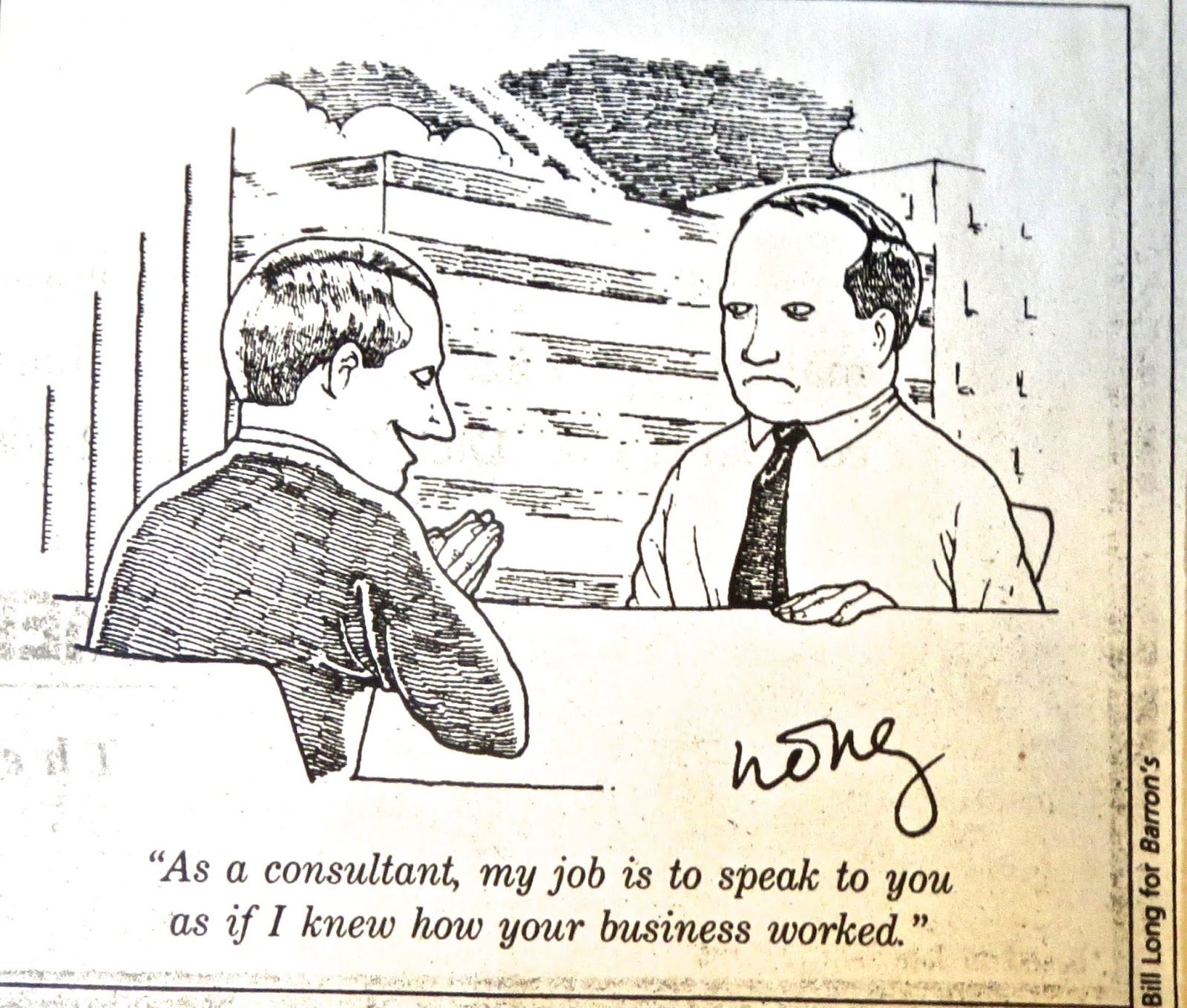
During my four years as head of the Asia Bureau, I trust my service was not as authoritarian as the cartoon right.  The drawing was altered to fit the occasion and sent to me by one of my staff, a noted jokester.  In 1980, Reagan having won the presidency from Jimmy Carter, I was thrust after 20 years back into the private sector, working for an international consulting firm.  One of my friends thought that the Bill Long cartoon was appropriate to my new situation.  


During the period of adjustment, I was engaged in a variety of activities, including organizing kazoo bands, both among extended family members and my co-workers at the consulting firm.  As a result, a Gary Larsen cartoon of cavemen playing a tune on what appear to be lizards appealed to at least one family member as appropriate for me.

In his inaugural address in 1989, George H. W. Bush mentioned “a thousands points of light…all the community organizations that are spread like stars throughout the Nation, doing good.”  The comment gave rise to a multitude of cartoons at the time, including one by Robert Maxwell Weber, known for over 1,400 cartoons that appeared in The New Yorker from 1962 to 2007.  Given my obsession with televised sports, this one had a certain appropriateness.


The final cartoon by Dave Coverly (born 1964) below, also has some relevance.  Although ordered to retire at age 75 by my consulting firm boss after twenty-some years on the job, a man who might be compared with one at the podium, I quit and got another job right away.  But if there had been a retirement ceremony for “Jack,” I might well have written my own “goodbye.”

They say that art imitates life.  It would seem that idea can be expanded to cartoons that, now and again, have imitated my life.  Or was my life imitating those cartoons?


Saturday, June 23, 2018

The Maxwell Touch on Glass Paperweights


On June 15, 1882,  the U.S. Patent Office received an application for a patent from William H. Maxwell of Rochester, Pennsylvania, a town not far from Pittsburgh.  Maxwell, submitting the drawlng shown here, said he had invented “a new and useful improvement in the manufacure of Glass Paper-Weights and other Articles of Glass….”  Granted a patent in September, Maxwell over the next six years produced myriad glass weights using his invention.  As one writer has said:  The Maxwell paperweight is a rare and treasured item for any collector to have in his possession.”

Although I do not own a Maxwell weight, they have always fascinated me by their unique qualities of design and the fact that after Maxwell’s firm disappeared in the late 1880s, no other glassmakers subsequently have tried to replicate the effects he was able to achieve with his distinctive concave base and varying motifs captured in solid glass.  Maxwell’s products may be divided into three categories.  One were one-of-a-kind portrait weights with actual photographs of unidentified people encased in them, as the one shown here.  Unfortunately, because they bear no identification of the subject, they are of limited interest.  

The second category were weights that featured a business. These were mass produced — and probably the major profit center for Maxwell — for businesses who provided them to their customers for advertising purposes.  Among the most interesting of those paperweights is one commissioned by the B. W. Wood & Bros. Coal Merchants of New Orleans.  The main feature is a tug boat, apparently one of two owned by the company and named for members of the Wood family.  A New Orleans Times-Democrat article of March 9, 1882, featured the owner describing him thus:  “Wood is the prince of gentlemen and will pass anywhere as pure gold.”

The next weight advertises the S. P. Shotter & Co, a businessman who began his company in Wilmington, North Carolina and later moved it to Savannah, Georgia.   His company, among other things, made “brewer’s pitch” related to the yeast used in brewing.  The major interest on the weight is the image of two small boys, possibly black, sitting on a barrel.  Shotter probably would not pass as “pure gold” like B. W. Wood.  According to news stories in May 1909, as chairman of the board of a company Shotter was sentenced to three months in jail and fined the equivalent today of $125,000 for violating the Sherman anti-trust law.

Residing in Beaver Falls, Pennsylvania, the Metzger & Company roofers were neighbors to Maxwell’s glass blowing operation.   One can imagine the owner visiting the factory to check out and approve the design, particularly the look of the roof feature.  This weight, like others shown here was a large three inches in diameter and one and three quarters inches high.  The pontil marks on these weights was smooth and fire polished, allowing some to bear Maxwell’s signature or a stamped maker’s mark.

A final weight in the advertising category is from the Amazon Fire Insurance Company of Cincinnati.  It shows a man on horseback with a spear lancing a fiercesome creature on the ground, ala depictions of St. George and the dragon. This horseman, however,  seems to be naked from the waist up.  This firm was headed by a president with the unusual name of Gazam Gano and reported $847,000 in assets for 1871.

The last and perhaps most interesting category of Maxwell weights were those one of a kind paperweights ordered by an individual or perhaps a group to be given to a specific person as a memento.  Prominent among them is a item that depicts a railroad train in considerable detail, down to the number 544 on the coal car.  It appears to have been given to John H. Doyle by a Miss Maggie Tattersall.  Why?  Were they sweethearts?  Was this an engagement gift? The speculation can be endless.

A second individualized Maxwell weight appears to have been made for a woman named Irene Zieg who apparently was competent enough in playing the coronet as to be allowed to play solos.  The picture of the instrument seems well rendered and presented in two colors.   It assuredly must have encouraged Irene on those dismal days when she brought her coronet to a party and no one asked her to play.

Another professional based paperweight was provided to R. T. Betzold who presumably was a pharmacist in Baltimore.  My initial efforts to find this Betzold through city directories of the time have been unsuccessful.   The major element here is the mortar and pestle, often a symbol of the druggist trade.  Again we have two colors, with green plants, perhaps themselves symbols of medicinal remedies, flanking the mortar.

The final Maxwell paperweight was a gift to J. W. Hum, likely related to his activities as a Mason.  I was able to trace him to a news item in which he is numbered among the men who founded a new Pittsburgh Masonic chapter, called the St. James Lodge.  Hum subsequently was elected treasurer of the organization.  This weight I consider the apex of Maxwell’s art.  It is multi-colored, involving shades of yellow, brown and green, with a delicately crafted vegetative design.  There are other weights with a similar motif, including one for “T.B. Wells, Chicago” and one with Maxwell’s own name on it and the date 1882 — marking when he first patented his invention.

Maxwell’s professional career was filled with mishaps.  In 1879 a fire at his glassworks destroyed the entire factory.  His second effort was thwarted in 1883 when a problem with a furnace shut down the plant and caused him to put it up for sale.  Even though he patented a second invention for improving printing on glass, mention of his firm ceases in the late 1800s.  Maxwell's later years are unknown.  For less than a decade, however, this inventive glassmaker provided hundreds of weights, now eagerly sought by collectors.