
Saturday, November 5, 2016

Funeral Home Ambulances: A Conflict of Interest?

There was a time in America when funeral homes were the chief purveyor of  ambulance services, a phenomenon I have highlighted in two earlier posts [see references below]. Someone needing immediate hospital attention often would be transported there by the local undertaker who frequently issued artifacts such as paperweights to advertise the service.
Memphis blogger Vance Lauderdale sees this practice as a business conflict: “This is just so wrong.  It would be like morticians sitting in the emergency rooms, with an embalming kit in their laps.”  Among the Memphis undertakers to whom he was referring was Spencer Company.   Its scalloped glass weight advertised “Superior Ambulance Service.”  The stained glass windows at the rear would indicate that their vehicle also doubled as a hearse.

A fancier ambulance with a longer body and front mounted spare tire graced thescalloped paperweight from John V. May.  May, a lifelong resident of Chicago, opened his undertaking business in 1914 on Milwaukee Avenue.  As was often the case he and his family lived on the premises.  Many other morticians were completing with May for customers and his ambulance service was a way of setting himself apart and gaining a business advantage.

Like May, John A. Gentleman was an undertaker, opening his Omaha, Nebraska, funeral home in 1906.  In the 1920s the firm moved to the “Gold Coast” area of Omaha at 34th and Farnam Street and issued a paperweight featuring his ambulance.  Gentleman worked 50 years as an undertaker, before retiring in 1956 and selling his business to new owners who kept his name on the funeral home, one still in operation.

An acclaimed African-American business in Memphis was T. H. Hayes and Sons Funeral Home, run by Thomas Henry Hayes, his wife, and two sons.  The father founded it in 1902.  It is said that his range of services were affordable to the working class as well as to the elite.  In addition to his ambulance Hayes had ten rigs, five hearses, carriages, and 12 horses in his stables.  When the funeral home closed in the early 1970s it was acclaimed Memphis oldest African- American owned business. 
One of the few vehicles whose make was identified on an advertising artifact was this Holmes Sedan from the Ludlow Ambulance Service.  The Holmes was a popular air-cooled American automobile built from 1918 to 1923 in Canton, Ohio. The car was famous for its louvered front grill that included a series of horizontal slits bringing in air any.  An embezzlement by a top company executive in 1921 sealed the fate of the company founded by Engineer Arthur Holmes and it failed in 1923.

Perhaps the King Ambulance weight does not belong in this list.  It was truly a doctor and hospital-based service, unaffiliated with any funeral home.  Founded in 1886 and one of the first physicians exchanges and nurses registries in San Francisco, it was housed in a renovated Victorian mansion in the center city.  In 1954 King merged with American Ambulance.  The resulting King-American Ambulance Company has established itself as the longest operating private ambulance service in San Francisco and the West Coast.
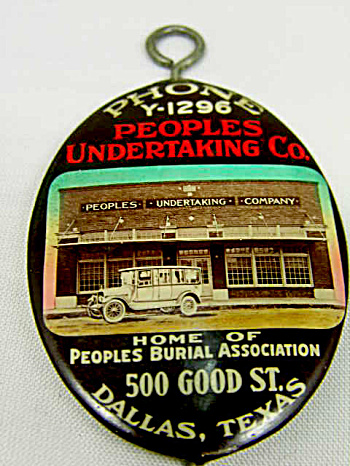
The Peoples Undertaking Company, a Dallas, Texas, business that advertised as the home of the “Peoples Burial Association,” issued this celluloid item that is described as a “paper clip and hook.”  It occurs to me that It also might have been hung on a Christmas tree as an ornament, although it lacks a certain festive flavor.  I have been unable to find any information on this establishment.  The building shown here for 500 South Good Street appears to have been replaced.
With this celluloid pocket mirror we appear to return to an ambulance clearly being part of a funeral home business, this one in Norfolk, Virginia.  It is from L. R. Cromer and Company that appears to be the forerunner of a still extant funeral business in the that city.  
Often in small town America, even into mid-20th Century, the undertaker also was a furniture dealer.  Makes sense. The funeral director was buying caskets, a kind of furniture, why not add tables and chairs?  Bayermann & Krug of Racine, Wisconsin, combined those businesses and added an ambulance service.  They issued a clothes brush for their clients that up close reveals a vehicle with a red cross in the window motoring along.  
Last month I did a post on paperweights that were issued by coffin makers to advertise their works.  One outfit particularly known and collected for their casket and animal form weights has been Crane & Breed.  At that time I was unaware that this Cincinnati company also built hearses — hearses that could double as ambulances, as in the photo here.  This model was described thus:  “The body is painted bronze green and the running gear carmine. The interior is finished in solid mahogany with an elevated cot on rollers. The vehicle is fitted with the best rubber tires and in winter will be heated with carbon stoves.”   That elevated cot, of course, could accommodate a patient on the way to the hospital or a body going to the graveyard. 
The hearse/ambulance automobile hybrid lasted some 70 years.  Until as late as 1979 hearses in the U.S. could be combination coaches that also served as ambulances.  In the late 1970s, however, stricter Federal standards were decreed for ambulances.  The hybrids were unable to meet them and manufacturing was discontinued.  In many smaller communities even today ambulances in vehicles distinct from hearses continue to be the business of the local undertaker.

Note: My first article on this subject, “Where to Buddy?  Hospital or Graveyard?” was posted during July 2009. It presented six paperweights and two pocket mirrors.  A second, called  “Chasing the Ambulance:  But Wait…Is It a Hearse?” followed in May 2013.  That one displayed ten weights.    


Saturday, October 22, 2016

Mephisto In Advertising? The Devil You Say!


As we move into the Halloween period and all manner of spectral figures appear on houses, it is an appropriate time to look at a famous demon featured in German folklore; in the writings of the German writer, Johann Wolfgang von Goethe, and in a French opera by Charles Gounod.  The demon is Mephistopheles, often called simply Mephisto.  Despite his sinister reputation, Mephisto often has been portrayed in advertising messages.

It is through Goethe and Gounod’s works on Dr. Faustus that this figure came into worldwide prominence.  The key moment is shown above, as Mephisto shows an aging Dr. Faust that he can be young and vigorous once again, and possess the body of the beautiful and virtuous Marguerite, if he will only sell his immortal soul to Satan.  Tempted by the offer, Faust agrees and is restored to youth.  

Advertisers largely have ignored the Faust angle, preferring to concentrate on Mephisto himself, as a tantalizing symbol of attractive evil.  Among his principal fans was Adolphus Busch, the head man at the famous St. Louis brewing company.  About 1900 he issued a series of trade cards advertising Budweiser that depicted spoofed scenes from popular German operas and plays.  Among them was one showing Mephisto, dressed as a cavalier, greeting a group and offering to buy drinks.  One inquires:   “Thou are from St. Louis I suspect?”  To which Mephisto replies:  “Well say, what you relish.  I’ll give every man his choice.  Very well, If I should choose, give me a glass of Tony Faust beer.”

A close friend of Busch was Tony Faust, a man who owned an oyster house and restaurant in St. Louis.   A contemporary account said of this watering hole:  “Few people in the West have not heard of Tony Faust’s resort, and fewer still of those who come to St. Louis that do not visit his establishment.” Busch is said to have had lunch at Faust’s restaurant every day.   Busch’s daughter Anna married Faust’s son in a lavish wedding in 1897.  Adolphus showed his respect and admiration for the restauranteur by naming a brand of beer after him. The Faust beer bottle bore a figure of Mephisto, as did an ornamental stein that Busch issued.
Tony Faust himself made use of the devil image in his advertising, featuring Mephisto to advertise to advertise his restaurant and cafe, as well as his Fulton Market, a source of oysters, fish, and other “imported and domestic delicacies.”  He also depicted the evil one on the cover of his restaurant menu, where filet mignon could be had for sixty cents.  There Mephisto is threatening the unwary and beautiful lady for whom he has enticed Faust to sell his soul.

When the Jim Beam company issued a series of ceramic containers for their whiskey during the early 1960s,  Faust was among the operas included.  Mephisto was a natural choice from that work, shown in the figural left, depicted without horns in the costume of a cavalier.  He carries a sword and would have contained a fifth of whiskey.  As an additional gift to the distillery customers, Jim Beam threw in a “mini-me” version of Mephisto, shown right.  It is a solid ceramic which obviously works better as a paperweight if lying down.
Other advertisers have not hesitated to show Mephisto in his full devilish mode.  Among them was David H. McAlpin, a man who had begun making his own living at ten years old and at the age of 20 opened his own cigar store in New York City.  He grew the business into a chain of stores and featured his own brands of stogies, including “Mephisto.”  McAlpin did not disguise this devil, his boxes and advertising featuring a figure astride the city in full satanic mode.

“Mephisto” Tools advertising tones down the devilish aspects a bit, but still portrays the renowned demon with a wicked smile as he drills down — possibly on someone’s skull.  The brand dates back over 185 years, according to Wallace Metalwork of Kempton, Pennsylvania, that currently produces Mephisto’s caulking, plumbing and other specialty tools.  The Wallace folks reassure us that the tools are 100% made in the U.S.A.  
Foreign advertisers also have made use of Mephisto’s image.  He figures in several play and opera-based trade cards issued by the Liebig’s Extract of Meat Company, named after Baron Justus von Liebig, the German 19th Century organic chemist who developed the product.  The meat extract is a black molasses-like sandwich spread packaged in an opaque glass bottle. The Liebig card above shows another version of Dr. Faust’s temptation.  This time the virtuous woman, named Gretchen a la Goethe, is shown in a glow at her spinning wheel.  Below, now as Gounod’s Marguerite, Liebig’s trade card shows her succumbing to Faust while Mephisto leads away her female companion.
As it must in opera, all this ends badly.  Marguerite is seduced but still remains  pure, dies, and is carried to heaven by angels.  Mephisto comes to Faust to claim his soul and although Faust resists, carries him to Hell “kicking and screaming” (opera style).  

What Faust apparently lacked, if this final ad is to be believed is Bovril, the English beef extract beverage.  Faust is triumphant and says:  “Avaunt, Mephistopheles; I have dispensed with thy services!  I have found “BOVRIL, THE ELIXIR OF LIFE!”   It seems a shame that neither Goethe nor Gounod apparently knew about Bovril, they might have spared Dr. Faust.  I always felt a little sorry for the guy myself.  

Because clown gear for trick-or-treaters is being discouraged this year, some kids ringing your doorbell may be wearing a devil costume.  While dishing out the goodies, you now can enlighten them with tales of Mephisto and his wiles.  Just skip the seduction part.  


Saturday, October 8, 2016

The Coffin on the Desktop Was a Grave Reminder

Perhaps the most unusual industry to favor paperweights as a method of advertising their wares was the casket-makers.  While the idea of contemplating a sarcophagus as one goes about the desk work of the day may strike a millennial as very odd, at the turn of the last century it was not an uncommon sight for a clerk to hold his papers down with a miniature coffin. 

One company, Crane & Breed, principally may have been responsible for this phenomenon, creating a whole spectrum of paperweights to bring attention to its caskets.  The history of Crane & Breed can be traced to a New York inventor named Almond Dunbar Fisk who designed and patented a coffin that resembled an Egyptian sarcophagus with sculpted arms and a glass window for viewing the face of the deceased — and allowing the corpse to look out.
Holding the rights to the Fisk burial case, Martin Hale Crane joined with Abel Denison Breed to manufacture this beauty from their Cincinnati coffin works.  An early Crane & Breed paperweight replicated in miniature Fisk’s design.  A subsequent company weight, while keeping the Egyptian motif, eliminated the face cavity.

Crane & Breed Casket Co. went out of business in 1973, but, as one historian has put it:  “They’re mainly remembered for their bronze novelty paperweights which were produced as a side-line during the late 19th and early 20th Century.”   That may be because those weights are the company’s only products not currently below ground and out of sight.  Some C&B artifacts were in shapes other than coffins.   Among them were a camel, the “hear no evil, see no evil, speak no evil” monkeys, and other animals.  All had the company brand on the base.

This aggressive advertising by Crane & Breed appears tohave spurred many other coffin makers into a similar merchandising strategy.  The Orange Star Casket Company seems to have faded into the mists of history except for its paperweight.  Dating from the early 20th Century, its weight is a heavy metal lion that comes up or sale from time to time on auction sites.

By contrast, the Elgin Metal Casket Company, represented here by a coffin paperweight, was the resting place for many well known Americans.   Former President Calvin Coolidge was interred in one in Plymouth Notch Cemetery in North Hampton, Massachusetts.   The body of John F. Kennedy was transported from Dallas to Washington in an Elgin casket after his assassination in 1963. That firm, one that began as a division of the Elgin (Illinois) Silver Plate Company in 1892 is now owned by Gulf & Western and operates from a plant in Indiana.
Today the Boyertown Burial Casket Company is reputed as the second largest casket company in the world.   It was formed in the late 1800s after undertakers in the Pennsylvania city were having trouble getting caskets for burials.  Bodies were piling up without a decent place to lay them.  Boyertown businessmen joined together to establish the firm.   The Boyertown paperweight shown above doubles as a repository for business cards.  I for one would be somewhat disconcerted if a executive reached into a coffin to give me his card — maybe expecting a pirate “black spot” to come out of it.

Isaac A. Baum, the founder of the Ideal Couch & Casket Company of Rochester, New York, worked in a variety of occupations until in 1883 he found his true calling was manufacturing caskets.  Over time, he created and sold the National Casket Company and the National Couch & Casket Company before buying a major share of the Ideal Couch & Casket Company.   That firm created a fancy glass paperweight illustrating a couch upon which the embalmed could be laid as if on a bed.  Underneath was the coffin itself, providing an appropriate stand.  The reference of the weight to “Lautner” is to William Lautner who had patented both the cover for a casket and the box itself.

The Nunda Casket Company took an entirely different marketing strategy.  Instead of reminding its customers of their ultimate need for such a box, it emphasized the positive in providing customers with a real four leaf clover and the admonition, “Good Luck.”  The base of this object carries a note about what it terms a “Lucky Clover Executive Paperweight.”   It explains that the clover was grown in Balboa Heights, Panama Canal Zone by one C. T. Daniels.  Daniels, it claimed, “has solved Mother Nature’s secret of productivity, an achievement unparalleled in the history of horticulture.”  Just to grow four-leaf clovers?

Our last example is from the Gate City Coffin Company with a strange message.  It shows a bulldog standing on two coffins behind a display of what may be embalming fluid.  The slogan — and the reason for the presence of a canine — is “A ‘Dog-On’ Good Line.”  The origins and history of this firm also has been obscured over time.  Like Crane & Breed that opened his post, we must rely on the artifacts to remind us of the manufacturers who gave us such products.

There they are, ten examples of how the casket makers hoped to keep the attention of the public by gracing an office desk with a replica of a final resting place.  In the words of the poet Thomas Grey, these paperweights remind us that: “The paths of glory lead but to the grave.


Saturday, September 24, 2016

Introducing Boys’ Autumn Smudge Pots


On the notion that no innovation should be allowed to be forgotten without a proper memorial, this post is devoted to the smudge pot —  a regular Autumn neighborhood activity for boys who grew up during World War II.   When I remarked nostalgically on smudge pots to my middle-aged son recently, he knew nothing of them.  Nor did the Internet yield any clue to what I was talking about.  Here and now I intend to correct that lack of knowledge.

The smudge pot has not been ignored completely.  One dictionary definition of “smudge: is a smoky fire, especially one made for safeguarding fruit trees frost or for driving away mosquitoes.  The use in orchards is the image most people have of smudge pots.  As shown here, they have been deployed in the understory of orange groves, heating the air when frost threatens to damage crops.  Note that the device puts out considerable flame as well as smoke.

The second item shown here is meant to drive off mosquitoes and other insects from joining a backyard party.  This smudge pot has been crafted from a tiki lamp that has lost its shaft and, again, spouts more flame than smoke.  Below is still a third mechanism termed smudge pot.  These would be placed as lights at construction sites or railroad crossings to warn motorists about potential hazards.  The one shown was made by the Toledo Torch Company, in my hometown, and burned kerosene.  When filled, it could flame for 24 hours.  I remember as a kid an array of those flickering in the night air when the street in front of our house was paved.  In recent times such pots have been replaced by battery-operated amber flashers or orange cones.
A final traditional item called a smudge pot is a New England fire starter.  According to those in the know, this six inch plus tankard held a foot-long wand with a hunk of pumice at the end.  It  was soaked in fuel in the vessel.  When ready to light a fire, the saturated wand was placed under the logs and the pumice lighted.  It burned long enough to ignite the timber, was allowed to cool, and replaced in the tankard.  Where the “smudge” element was involved escapes me.

In fact, none of these items bear any resemblance to the smudge pots of my boyhood.  The setting was the period during and a few years after World War II.  For most of that time gasoline rationing restricted travel and most outdoors recreation had to be found close to home.  Hence the every Autumn every boy with any interest in neighborhood acceptance had to have a smudge pot.

These were fashioned by the young man himself.  The first component was a gallon paint can, empty or with a small layer of paint congealed on the bottom.  Paint running over the sides, as on the example here, was considered optimal since it lent character to the vessel.  Working with a hammer and a chisel, the maker punched a single hole roughly an inch in diameter near the base of the can. Little care was taken for the symmetry of the opening but an effort was made to leave no rough edges on the outside that might later cut a finger.  
Then a suitable base had to be found.  Requirements were that the board had to be at least a half inch longer than the diameter of the paint can on the sides, allow approximately three inches in front of the hole, and be a little longer at the rear for enhanced stability.  Selecting the right kind of plank and cutting it correctly to fit was important.  Mom’s kitchen cutting board often seemed just right but carried unacceptable risks.  Best to find a cast off piece of lumber in the basement and shape it.  Once this base had been crafted, the paint can was carefully positioned and nailed firmly onto the board.  Five or six nails usually were required. Then an eye-screw with a fairly large opening was attached several inches in front of the punched opening.

A piece of rope — clothesline made a good choice — was stuck through the eye screw and the two ends tied to the rear of a bicycle.  Many bikes had a rear platform with struts and those made a good anchoring place.  Fender struts could also suffice but less well.   Now the smudge pot was ready.  Remember that this is an Autumn activity so that dry leaves were in abundance as fuel.  A good many were stuffed into the paint can and a lighted match applied through the punched hole.  As the leaves began to smolder and burn, the bicycle was ridden through neighborhood streets, hopefully trailing billows of smoke behind.
On a given Saturday fall afternoon a half dozen pre- and early teen boys could be seen peddling furiously hoping that their clouds of glory eclipsed everyone else.  Truth be told, I was never very good at it.  My pot was forever going out and I was forced to stop frequently to relight it.  Whether my hole was too small to push sufficient air into the chamber, or I was not able to ride fast enough, or the leaves were a little wet, my smudge pot too often disappointed.  “Smudge envy” may have scarred my boyhood.

Just think if such a pastime were attempted in 2016.  The cops would be called in an instant on the grounds that a group of terrorists were running around the streets threatening people with fire.  Environmentalists would be shaking a finger at the pollution of the atmosphere.  Safety experts would be exclaiming against the lack of head protection.  In that day, by the way, only sissys wore helmets.  In fact, they may not yet have been invented.  In short, the boyish thrills that smudge pots provided to that earlier generation, it seems, would be forbidden today.

If this post on smudge pots is to be definitive, it must be mentioned that the term also is used in the contemporary world to describe a ceramic pot filled with sand on which herbs have been mashed together or torn apart in a fashion to let them burn.  They are lighted as shown here and the smoke inhaled.  The aromas are said to induce peace and euphoria. Hmmm.  Finally, below, is an exhibit of smudge pot art.  Here the devices have been turned into lamps and fanciful animals.  
Note:  While writing this post, I have been searching the Internet for a photograph of an actual boys’ smudge pot, but without success.  I refused to believe that this tradition was restricted to a few neighborhoods in Toledo and that kids in other parts of America, particularly the Middle West, were not also riding around madly every Autumn, trailing burning leaves.  Thus it is my hope an Alert Reader will have such a snapshot and let me know.  It would make a valuable addition to this narrative.


Saturday, September 10, 2016

Beer on Wheels Though the Decades


 The process of hauling beer in barrels, bottles and cans has evolved during the past 150 years as transportation itself has changed in America.  Along the way some intriguing vehicles have been used to cart the suds.  Here a sampling of these vehicles is examined, beginning with the oldest down to the new.
John G. Unsoeld was a manufacturer in Detroit, Michigan, of “Trucks, Wagons, and Buggies of all descriptions.”  About 1879 Unsoeld set his hand to design a new and improved beer wagon, shown here.  In his patent application he claimed that his invention was an improvement to the wagons then being used in delivering beer in casks.  There followed a very technical discussion of the mechanics.  Simplified, Unsoeld’s invention was to raise the seat to allow barrels to be placed under the driver, allowing a shorter vehicle.  Whether Unsoeld ever got orders for any of these contraptions is unknown.  Could they have been un-sold?
August Schell's wagon also seems to have raised the driver and it fit more beer barrels by hanging them from chains on each side.  To pull this heavy load the wagon required three horses harnessed in line.  Schell, a immigrant from the Grand Duchy of Baden, emigrated to the United States in the 1850s.  Working initially as a machinist, he gravitated to New Ulm, Minnesota, where in 1860 he founded his brewery.  Today it is the second oldest family-owned brewery in America after Yuengling.  It celebrated its 150th anniversary in 2010.

The Mathes Brewery wagon clearly was meant for show, not for hauling.  The big bottle was advertising the company’s Red Ribbon Beer, a Wurzburger lager.  Rather than horses, this rig is being pulled by a pair of mules who seem on this 
serving tray to be dozing.  The tray was issued by Herman A. Mathes, a Burlington, Iowa, producer of beer, soda water and mineral waters.  He was in business, according to directories, from 1892 to 1919, closing with the advent of National Prohibition. 

The next image helpfully has been labeled 1910, a time when motorized vehicles were replacing animal-drawn wagons.  Note that this Coors van has the steering wheel on the right side of the carriage.  It took a while to get automotive details straightened out.  The Coors Brewery got its start in 1873 when German immigrant Adolph Coors with a partner started a brewery in Golden, Colorado, using a recipe for a Pilsner-style beer.  Coors safely survived Prohibition by diversifying its products.
The next photo seems to be trying to prove how much beer could be carted at one time.  Any severe jolt might well have those unsecured barrels at the top cascading down on the three workers.  The information with the photo indicates that the truck was hauling ‘Gansett’ down cobblestone streets in New Bedford, Massachusetts.  The beer itself was the product of the Naragansett Brewing Co., founded in 1890 at Cranston, Rhode Island.  Subsequently it became the largest beer producer in New England.

Still a pre-Prohibition model, the next van marked a definite improvement.  It shielded the driver from wind and rain, allowing him to assume a dapper pose with bowler hat, mustache and sleeve guard.  He was driving for National Brewing Company, and likely imitating “Natty Bo,” the longtime symbol of the beer.  Founded in Baltimore in 1872 and operating until the late 1970s, this brew was very popular with the college crowd during the 1950s and 1960s, largely because it was could be had for about fifty cents a bottle.

Although it is hard to tell, I would put the vintage of this Pacific Beer truck at pre-Prohibition given its hard rubber wheels.  It obviously has been decorated with flowers for a parade, clearly NOT the Pasadena Rose Parade.  The Pacific Beer & Malting Co. was established in Tacoma, Washington, in 1888.  Founders were Scholl and Huth who turned out 260 barrels of beer a day.  The brewery filled a need in Tacoma because beer transported from the East, likely by rail, often lost freshness.
The Buckeye Brewery of Toledo, Ohio, for years featured a waiter with a large head and small body.  Then one day in a bar a brewery executive found Carl Walinski, who not only was a dwarf but also one that could roller-skate.  He became the living symbol of Buckeye beer for years.  Walinski was even given a 3 foot, 6 inch “wife,” called Bonnie.  Although they were not really married, the pair often appeared together before the public, driving up in their miniature beer wagon. 

Moving from the ridiculous to the streamlined, here is a Miller High Life Beer delivery van from 1941.  It was a specially configured Dodge constructed by the H. Barkow Co. of Milwaukee and likely designed by Brooks Stevens, a Milwaukee industrial designer.  The sleek lines were entirely in keeping with the “art deco” styles that were sweeping the nation.  By sculpting the vehicle’s curves, moldings, fenders and paint scheme, the illusion was created of length and decreased height over a relatively short wheel base. 
Given the competition among Milwaukee brewers, Miller almost certainly was reacting to a streamlined fleet of insulated delivery vans maintained by the Schlitz Brewery.  They had been crafted from 1838-1939 Dodge Airflow trucks. Schlitz obviously was not about to let Miller get a jump in the streamlining game and hired the General Body Company of Chicago to design an even jazzier looking vehicle. The same outfit that gave Oscar Meyer its motorized weiner, General Body in 1941 came up with the eye-stopping design shown here.  By that time World War Two had begun, however, and the model never got off the drawing board.

Our final brew hauler is a semi carrying a giant can of Heineken Beer.  This rig appears to take beer-hauling to its pinnacle — one giant metal tank holding thousands of gallons of golden liquid on its way to a bottling plant.  Boasting a pedigree in Holland back to 1592, Heineken was the first European beer to be imported into the U.S. after Prohibition was lifted in 1935.

There they are, eleven ways of transporting beer, some antiquated, some quaint, some purposely absurd, and some strikingly well-designed.  These vehicles all served a purpose, most for getting the products of a brewery to a thirsty public, a few for advertising the product.  They all, however, rolled on wheels.