
Friday, September 28, 2012

Shoes Preserved Under Glass

As noted in prior posts,  certain industries and trades of the late 19th and early 20th Centuries made particular use of the glass paperweights as a means of advertising their merchandise.   Among them were steamships,  newspapers, funeral homes, automobiles, soft drink makers,  and the subject of this post:  shoe manufacturers.   These artifacts give us an enduring look at the shoe styles of yesteryear.

The women of the mid-to late 1900s now could buy their shoes through the growing number of department stores and other retail outlets.  While getting one feet shod by the local cobbler may have persisted in some quarters, for most Americans,  shoe were, as they said, “store bought.”

Women were accustomed to squashing their feet in tight shoes.  Their footwear buttoned at the side -- usually with help of a button hook --  had pointed toes and very high but somewhat blocky heels.   The Intervale Manufacturing Company of Haverhill, Massachusetts,  founded in 1882, clearly was designing for that market.  It emphasized the “hand sewn” nature of its tops and buttons,  reflecting an emphasis on craftsmanship.

The W.H. Goodger & Company of Rochester, New York,  displayed a similar lady’s button down shoe on its paperweight.   Its line was called “Famous Shoes” and the particular model “La Belle,”  illustrated by depicting a bell.   The Goodger folks also provided customers with a motto:   “No how cheap but how good.”  My assumption is that if  “La Wife”  wanted “La Belle,” it could be expensive.
The following weight shows a formal man’s shoe.  As we see here,  shoes for men were mostly over the ankle boots.  Toe cap, lace up boots in black, gray, or brown were the most common for everyday wear. Formal occasions called for formal boots with white uppers (spat style), they could be buttoned or, as the one shown here, laced.  This weight was made by the Graeser Mfg. Co. of Pittsburgh for V. Schoeneck Boot & Shoe Co. of Milwaukee, a city which once boasted at least a dozen shoe manufacturers.

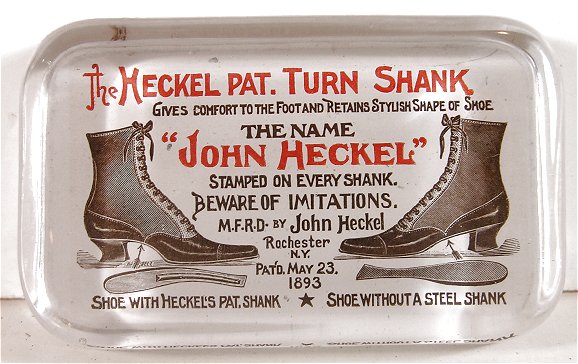
Like Goodger,  the John Heckel Company was a Rochester, New York, manufacturer.  Heckel did not make the shoes, he made the steel shank that underlay the foot.  As he showed in his paperweight,  the steel shank kept the foot well supported while a shoe without his 1893 patented device apparently could lead to fallen arches.   Although this weight is not marked it looks was made by the Abrams Paper Weight Co., of Pittsburgh and other cities.

The Heywood Boot & Shoe Company for many years was one of America’s most successful.  Tracing its origins in Worchester, Massachusetts, back to the Civil War era (e.g. 1964),  the company featured an oxford toe, laced over the ankle man’s shoe,  a type that became popular in the late 1900s.  Among the company slogans was:  “Outside your foot steps in style, inside our footprint in leather.”   Making good shoes and advertising widely,  the Heywood Company survived two World Wars and the Great Depression, going out of business in 1953 due undoubtedly to foreign competition.

A similar shoe, only partly laced, was the product of the Dorsch Shoe Company.  Its paper weight tells us that it was located next the Engine House but neglects to tell us in what city.  In reality it was located in Newark, New Jersey.   Known as the makers of “The Bull Dog” shoe line,  the firm probably issued this weight about 1908.

Information about the origins of the Streng & Thalheimer firm are scanty.  They were a Louisville, Kentucky, outfit who claimed to be both manufacturers and jobbers (e.g. middle men) in the shoe trade.  Two brands are advertised on the weight,  “Squire Carter’s Glace” calf shoe and “Dr. Palmer’s XXXX” calf shoe.

It was rare for a woman’s name to be associated with a manufacturing enterprise in those days, but Mrs. A. R. King is prominently identified with the “The Kant Slip Shoe.”   Assuming she was an actual personage, she made her footwear in Lynn, Massachusetts, specializing in a low woman’s button shoe with a rubber bottom.   Her weight was a marked Abrams product, this one bearing a Mystic, Connecticut, address.

Although the next paper weight mentions a Rochester, New York, distributor, the manufacturer was Goodyear’s Rubber Glove Company, located in Connecticut.  As the story goes, the first vulcanized rubber overshoe was made in a factory in Naugatuck.  The daughter of inventor Charles Goodyear demonstrated the process for a group of highly impressed investors in 1843 and manufacturing began shortly after under a license granted by Mr. Goodyear.

Eventually there were four rubber companies in Naugatuck.  Goodyear himself invested in a company that moved from Litchfield, Connecticut, to Naugatuck and changed its name to the the one shown here.  In addition to the traditional rubber galoshes and boots, this firm manufactured rubber gloves for telegraph linemen.

The most colorful weight has been left for last.  It was issued by the Gray Bros. Manufacturing Company of Syracuse,  New York.  It shows a the white tip of a elegant example of footwear.  It seems far from the ordinary shoe.  My guess is that it was an opera boot, dress pump, or dancing slipper that readily would have been recognized by the women of the era.

There they are, ten glass paperweights, each one providing a glimpse at  what people walked around in a century or more ago.  A hundred years  from now I wonder:  Will future generations be just as astonished about a $600 pair of sneakers in our day as we are that our ancestors could pay as little as $3.50 for a Dorsch shoe?






Saturday, September 15, 2012

Kids Selling Whiskey II

A 21st Century mentality has a hard time grasping the idea that in the 19th and early 20th Century it was perfectly fine to advertise and sell whiskey by using images of children.  I first explored this phenomenon in this blog in March of 2010.   Subsequently a number of other whiskey ads, trade cards and signs featuring youngsters have come to my attention, occasioning this second look at kids selling whiskey.

The youngest child to be present is a photograph of a tot,  presumably a boy,  standing at a table on which sits a jug from the Edgewood Distilling Company of Cincinnati.   Cincinnati directories indicate that the A.G. Diehl Company,  had merged with the Paxton Brothers Co. to create Edgewood Distilling. The business relationships between Diehl and the Paxton Brothers began as early as 1874 when A.G. Diehl & Co.  Wines and Liquors,  occupied a location at 32 East Second Street in the Queen City.   A separate listing for the same address lists Paxton & Diehl,  Distillers.   From 1875 to 1877 the firm name became Diehl & Paxton Brothers,  to be changed to Paxton Bros. & Co., Distillers, from 1878 to 1883.  Finally in 1887 the business became Edgewood Distilling at the same East Second Street address.  The company moved its business office after 1891 to several locations on Main Street and finally in 1906 to its last address at 417-419 Elm Street.   The actual distillery was located in Lincoln County KY.  The firm disappeared from Cincinnati directories after 1918,  an apparent casualty of National Prohibition.

The jug on the table is its own story.  It was manufactured by the Fulper Pottery of Flemington, New Jersey, which sold ceramic whiskey containers as “fancy jugs” and were  used by distillers and dealers nationwide.

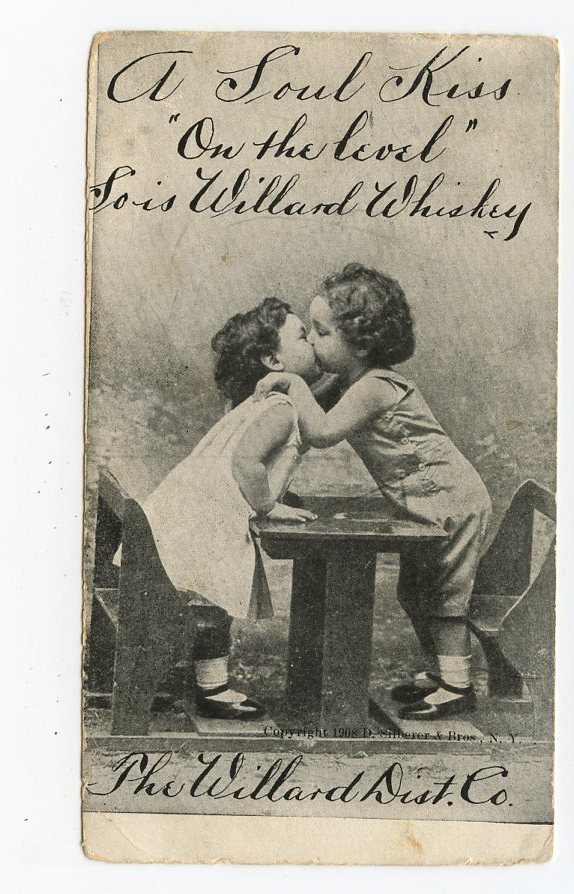
The next tots are almost as young as the first, but not too young to be doing some inter-gender smooching.  The Willard Distilling Company almost certainly were not distillers and probably not “rectifiers,”  (i.e. blenders of whiskey) but more likely wholesale distributors and dealers.  Nonetheless, their amorous kids made a statement with their “soul kiss.”

The “Old Forrester” trade card ushers in a series of whiskey ads featuring children and animals.  The first shows a precious little lass is leading a equally precious little lamb.  What could be more appropriate for selling whiskey?  This was a brand from the Vogt-Applegate Company of Louisville, Kentucky.  The Applegates were a prominent Kentucky family whose leader,  Colonel C. L. Applegate,  would sell you four quarts of his whiskey for $3.00.

The following trade card also features a youngster, well dressed in breeches and a feathered cap,  advertising J.S. Stone Old Bourbon Whiskey which, we are assured, is “chemically pure.”  He is accompanied by two doves, neither of which could have laid the giant egg the boy seems to be rolling.   This whiskey was the product of Holden & Clay, a Boston based liquor store that shows up in city directories in 1891 and not afterward.

Fernberger Bros. at 1230 Market Street in Philadelphia advertised their “pure old rye whisky” with another youth.  In his case, the doves have been replaced by an owl with a knowing look.  Perhaps the look reflects the claim that for $3 one can get a gallon of the Fernberger’s product and, it is claimed, a libation of equal quality would cost at least $4.  As Prohibition closed in, many whiskey outfits claimed that their product was only for “family and medicinal use,”  not to be imbibed in those awful saloons.  The Fernbergers were in business from 1871 until 1902.

Our last child-animal association is considerably less benign than the earlier ones.  Here a youth, whose gun has been laid aside, confronts a bear and seemingly is reduced to prayer as a response to the apparent threat.   This was a trade card for “Golden Horseshoe”  rye whiskey, at $1 a bottle.  It was sold by Max D. Stern at his 49 Whitehall Street address in New York City.  Stern was a whiskey wholesaler with three locations.   He claimed that his booze “aids digestion & strengthens the constitution.”   He does not, however, say how it assists in being eaten by a bear.

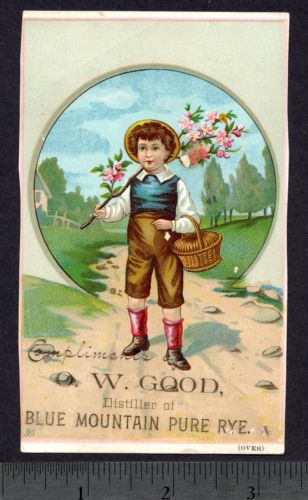
At the age of 28, Oscar Good bought an existing distillery in his native Franklin County.  He improved it to include a three-story stone distillery building with a water tank on an attached frame shed at the side and a tall active smoke stack.  Behind the distillery were the slopes of the Blue Mountains, a beautiful low Appalachian range that extends for more than 100 miles through the southern Pennsylvania countryside, an bucolic area that attracted a modest tourist trade.

Good’s flagship label was “Blue Mountain Rye.” The brand was featured on a colorful trade card of a winsome lad carrying a flowering branch and a basket.  The reverse side declared:  “These whiskies are pure, distilled from clean grain, and soft mountain water, which seems to be the secret of making fine whiskies.  I will give one hundred dollars if any person finds adulterations of any kind in my whiskies from the time I commence mashing the grain until I dispose of them.”    Good also asserted that his whiskeys had no unpleasant aftertaste.  He further suggested it could be served to hired hands at harvest time.

The next trade card features two little girls, one with a doll and the other with a quill pen and a writing desk advertises “Stonewall Whiskey.”   This was a brand from Charles Rebstock & Co. of St. Louis whose whiskey dealership survived from 1871 until 1918.  Rebstock’s flagship label was “Stonewall,” which he registered with the federal government in 1874.  His ads said of this whiskey:  “It makes people happy and wealthy.”  It was also touted as “America’s Finest Whiskey” and “Perfection.

In 1914, after 24 profitable years on Main St. in St. Louis,  Rebstock moved to 200 S. First Street and eventually shut down as Prohibition approached.  Now 74 years old and apparently without immediate heirs,  this wealthy whiskey man began to look for likely place to practice philanthropy.   The Journal of the American Medical Assn. reported in 1922 that Rebstock had purchased the Wintersteiner Collection of 13,000 microscopic preparations of pathologic changes of the eye and contributed them to the St. Louis (Medical) University.  The collection was said to be the most complete in Europe and was to be used for graduate instruction in opthamology.

The calendar depicting two barefoot “Huck Finn” type boys was from the Utah Liquor Company, a  most interesting whiskey dealership.  The company was formed in 1898 Salt Lake City and its  owner, Jake Bergerman, literally sold whiskey in the heart of Mormon Land. Early on, for example, he issued a metal token good for 12&1/2 cents in trade at the Utah Liquor Co. that had an image of the Mormon Tabernacle on the reverse.  His annual calendars could  be found far and wide among the Utah drinking population.

Our last example is from California, a sign promoting the whiskey and wines of the Theodore Gier Company. It depicts four lovely young girls with a dog hauling their wagon. After having been in the U.S. for only a year, Gier set up a grocery store in Oakland that proved successful.  With those profits, he established a retail and wholesale company to sell liquor.  That money he used to begin vineyards and to make prime wines.  When Prohibition arrived, he attempted to continue selling wine, was caught, fined heavily and his property confiscated.  He died broke.

Here we have 10 pre-Prohibition images of children being employed to sell whiskey,  While the notion of such merchandising seems out of bounds today,  at an earlier time it was  common and accepted by the drinking public.  With the coming of National Prohibition in 1920 all such advertising ceased and by 1934 when it resumed the use of children to push whiskey had become anathema. 


Saturday, September 1, 2012

Centennial Post: Odyssey of a Collector

Almost unbelievably, this is my 100th post for the blog I began in 2009, called Bottles, Booze and Back Stories.   Over ensuing months,  I have tried to keep the presentations varied, in accord with the subtext,  “A blog about more things than you can shake a stick at.”  For this centennial post,  I have decided to address my journey through a lifetime of collecting.

Like many youngsters in the 1940s and 1950s,  I started by collecting postage stamps.  President Franklin Roosevelt was a stamp collector and the hobby was highly popular.  For a kid it put you in touch with foreign countries and images that stretched the imagination.  My interest extended into the early 1960s when I worked across the street from a Gimbel’s Department Store in Milwaukee that featured a large stamp department.  My particular interest was in stamps featuring American Presidents,  including FDR and, after his death, John Kennedy.

By the 1970s, my interest in postage stamps had waned and I began selling off the foreign stamps and using the U.S. stamps on mail.  About the same time, my interest soared for collecting first editions of the American author, Sherwood Anderson.   I had done my master’s thesis on Anderson,  was communicating with his widow, and contemplated writing a book about him.  My long-suffering bride endured a New York City honeymoon during which we spent much of our time pawing through the dust of used book stores trolling for Anderson’s works.

In the mid-1990s I drove the Anderson volumes to Milwaukee and donated them to the rare book section of the library at Marquette University, the school where I had first become acquainted with the American author.  The university did me the kindness of issuing a press release about my contribution and, for a while, putting the books on display.  I took a tax deduction.

Meanwhile a new collecting passion had emerged.  While visiting Jakarta Indonesia on a business trip in 1978,  I was taken to Jalan Surabaya,  a street  with a giant open air flea market where artifacts from around the world are sold.  There I found three highly decorated British whiskey jugs, like nothing I had ever seen before.  For US$100 I bought them all and was able to ship them, undamaged, back to my home.

That triggered a passion for whiskey jugs, both American and British, that lasted for some two decades.  During that time I amassed a group of several hundred, large and small.  It also launched my writings on jugs, bottles and other collectibles that now exceed 400 articles in magazines and newsletters in the U.S., Britain, Australia and Canada and include three self-published books.

By the late 1990’s the whiskey jugs seemed to be crowding my wife and me out of the house. Subsequently, in three auctions I sold off, and profitably so, the “high end” British and American jugs.  Other items were sold at bottle shows.  More recently, I contributed  80 less valuable whiskey ceramics to the Getz Whiskey Museum at Bardstown, Kentucky, which has been very gracious about the gift.

As the process of devolving the whiskey jugs was proceeding,  I noted that a great many hillbilly ceramics had been issued as souvenirs during the period 1940-1970.  These artifacts were a product of automobile tourism made possible by the hardening of roadways, capped by the development of the interstate system.   The hillbilly was the last ethnic group that safely could be caricatured but even that era was ending.  As a result, I set out to collect as many ceramic hillbilly souvenirs as possible as expressions of Americana that were not likely to be replicated in the future.  The collection included pottery ashtrays, salt and peppers shakers, coffee mugs, plates, and jugs. Because they were common and inexpensive, I was able to amass some 100 hillbilly ceramics in the space of three years.

From the outset my purpose for this collection was eventually to give it to a museum or library.   Looking around for a suitable place to donate the items in 2005, I came across the Appalachian Life Museum at the University of North Carolina - Boonesboro.   The museum’s curator was fascinated,  drove to my Virginia home, and picked all but a few, and drove them back to North Carolina.  Although the museum later lost its space at the university,  my hillbillies remain in good hands.

After disposing of the whiskeys and the hillbillies I was searching for a new collection.  The objects had to be less space-filling than the whiskey jugs but something that would hold more interest than postage stamps.  They also had to be artifacts that were commonly being sold on internet sites like eBay. After much thought, beginning about  2006 I focussed on glass paperweights.  Because of my interest in the pre-Prohibition American whiskey industry, I largely have concentrated on U.S. weights that advertise liquor.   Right now, that collection numbers approximately 87 items, the majority of them from the pre-Prohibition era.  Because of their  modest size, paperweights can be stored easily.  Much of the present collection is housed in a six-drawer former thread cabinet that sits on the desk in my office.

Residual elements of all my former collections remain with me.  My U.S. Presidents stamps and a few others sit in albums in the basement. About two dozen whiskey jugs, old favorites, still decorate our family room.  Fourteen hillbilly items look down on me as I sit at my computer writing this 100th post.  Several of Sherwood Anderson’s books,  purchased after my gift to Marquette,  repose on a shelf behind me.

With advancing age I am coming to the end of the collecting road.  It has been an odyssey of almost 70 years to accumulate -- and often later to dispose of -- items of interest.  Each collection in its turn has expanded my knowledge and understanding as well provided  material for hundreds of articles.  Most of all, I suppose, my collecting has been a lot of fun.


Saturday, August 18, 2012

A Fig for Your Health!

Around the end of the 19th Century a series of hucksters, promising remedies for various ailments,  centered on the lowly fig as an elixir of great potency and healing.   Ironically, there is an traditional English saying about not giving or caring a fig about something.  The Oxford English Dictionary translates “fig” in that context as something “small, valueless or contemptible.”

Another, even older book, however, carries a different story. In the Old Testament of the Bible King Hezekiah, shown here, was very sick.  Apparently stricken with boils, he seemed near unto death and prayed for deliverance.  The answer came in the shape of the Prophet Isaiah who told Hezekiah to apply a bunch of fresh figs to his sores.  He complied and was completely healed.

That was the fig story captured by the nostrum peddlers.  Their sales pitch had nothing to do with boils,  but largely with constipation and other ills.  Figs are known to have a mild laxative effect and it was that quality that spawned the widespread sale of fig remedies.  Among the most notable was the “Syrup of Figs” produced by the California Fig Syrup Co. of San Francisco.  It came in labeled, embossed bottles that sold in drug stories across America at the not inconsiderable cost of a half dollar.

As shown here, this company advertised widely in national magazines, frequently featuring comely women to illustrate its product.   It claimed offices in Louisville, Kentucky;  New York City, and London, England.  Another advertising method was offering colorful lithographed tin signs to pharmacies stocking the syrup, again featuring a young lovely.  The California Fig Syrup Co. was not without its imitators.   Although figs are not native to Wisconsin, the Andrews Drug and Chemical Co. of Drillion had its own “Syrup of Figs.”  Its product claimed to cure “many ills arising from an weak or inactive condition of the stomach, bowels, kidneys and liver.”

In the wake of the Food and Drugs Act of 1906,  health authorities targeted the fig remedies.  The American Medical Association (AMA) Journal wrote:  “Syrup of Figs is a laxative whose chief advertising asset is its name.” It continued that any purging action was due to the presence in the mix of 25%  senna, a tropical herb with well-recognized laxative effects. The AMA also noted that the syrup was 6% alcohol, about the potency of beer.  Eventually Federal officials forced the fig syrup floggers to list senna and alcohol on the label.  In England, however, the product continued to be sold the old way.  California Fig Syrup Co. simply prepared two different boxes and labels.

None of this meant much to Fridolin Madlener.  He was a Chicago liquor blender and wholesaler.   Seizing on the popularity of fig remedies, he melded fig syrup with the rye whiskey he was mixing up in the back room and, eureka, Fig Rye was born.

Madlener was not content with merchandising Fig Rye as  a laxative.  His advertising touted it  as “an ideal health whiskey.”  Ordinary whiskey, he claimed, was distilled totally from grains and “destroys the lining of the stomach, makes the liver hard as a rock, and causes disease of the kidneys.”   By contrast,  Fig Rye neutralized all those bad effects and was recommended for “the dyspeptic, the consumptive, the debilitated, the weak....”   According to one Madlener ad,  Fig Rye was used in 1,500 hospitals across America and prescribed daily by thousands of doctors.

After Fridolin’s death in 1897, his son Albert continued to promote Fig Rye vigorously. The firm advertised in national magazines and sold it by mail all across America. One Madlener ad claimed that 100,000 bottles were sold annually.  On the strength of its profits Albert commissioned the construction of a grand new house in Chicago’s Gold Coast.  Currently on the National Register of Historic Homes, the mansion can be characterized as “the house Fig Rye built.”

Because whiskey was not subject to the labeling requirements of the Food and Drug Act,  The AMA and the Federal food police could not lay a hand on the Chicago-based company.   The coming of Prohibition, however, did spell a finish to Fig Rye.   Fridolin Madlener,  the man who gave the world Fig Rye, is buried in Chicago’s Graceland Cemetery.  His grave lays beneath a huge monument bearing the family name and ornamentation that looks, at least to me, like hanging bunches of figs.


Friday, August 3, 2012

Vintage Automobiles in a Shoebox

A new technology always spawns multiple businesses, each one seeking to profit by its particular genius.  So it was when the motor car first hit American streets. Whether steam, electric or gasoline fueled, there was a sudden proliferation of makers, brands and models.  Some endured, others did not.  Old enough to remember the days when electric cars and the Ford’s Model T were not totally unusual sights on the streets of my town, I seldom pass up a chance to attend an exhibit of vintage automobiles and often wish I owned one.  Now it is possible to collect antique cars and store them in a shoebox. They just have to be captured on paperweights.

The limousine shown here was produced by the Columbia Automobile Company, created in 1899 as a joint venture of the Pope Manufacturing Co. of Hartford, Connecticut and the Electric Vehicle Company.  The outfit made both gasoline and electric powered vehicles.  Its electric models included taxis and police cars, buses, and limousines.  The Columbia electric runabout was the best sellng car in America in 1900 and the first to exceed 1,000 sales.  The weight can be dated to a reasonably narrow time frame.  The company was acquired by the U.S. Motor Company in 1910.

A nifty weight is from the Burr Co., Coach Builders of New York City. This firm was founded in the 1880s to make luxury horse-drawn carriages.  When the automobile was invented, Burr tried to make the transition from carriages to cars with a factory located at the southern edge of Gotham’s automobile row.   Speculation is that Burr created the bodies to fit on other chassis and never produced a complete vehicle.  In any case along with the buggy whip,  Burr & Co. became extinct about 1915.

The “Silent King” automobile, seen here on a celluloid paperweight issued by a Buffalo auto dealer,  was the brainchild of Charles King, the first person to drive a gasoline powered automobile in Detroit.   In March of 1886, operating a vehicle of his own invention,  King took a history-making ride down Woodward Avenue at a rip-roaring six miles an hour.   History records that Henry Ford followed him on a bicycle.  After working for other early auto manufacturers, Charles opened King Motors in 1910, producing sporty cars like the one shown here.

A cobalt glass weight proclaims Haynes as “America’s First Car”  with dubious validity.  As early as 1894, Elwood Haynes built an vehicle that he called the “Pioneer” and claimed that it was the first American automobile well after it was apparent that there were earlier U.S. models.   The Pioneer had no crank and had to be started by pushing it.  Once the engine caught the car moved at a stately seven to eight miles an hour.  The photo shows Elwood sitting in his invention.   Haynes continued to make cars until 1924 when financial problems caused the company to declare bankruptcy and ultimately cease operations.

The Kissel Motor Car Company was an American automobile manufacturer founded by Louis Kissel and his sons in 1906 in Hartford, Wisconsin.  The company built quality gasoline powered automobiles, hearses, taxis,  fire trucks and utility vehicles.  During World War One Kissel prospered, selling trucks to the military but stiff competition and the Great Depression forced it into bankruptcy in 1930.

About the same time that Kissel was crashing the Locomobile Company of America was going out of business.  Founded in 1899, initially in Watertown and later in Bridgeport, Connecticut,  Locomobile began by manufacturng small steam cars.  In1903 the company switched to making internal combustion-powered luxury automobiles.  Bought in 1922 by Durant Motors, the Locomobile line continued until 1929.

The Hupmobile was the brainchild of Robert C. Hupp who began to build automobiles in a factory in Grand Rapids, Michigan in 1908.  The vehicle was introduced to the public at the Detroit Auto Show in 1909.  A year later his production had soared to more than 5,000 units.  After disagreements with investors,  Hupp sold out about 1910.  The new owners were auto pioneers and among the first to use all-steel bodies.   The company survived the Depression and competition to close in 1940.

Based in Anderson, Indiana, the Lambert Automobile Company was founded in 1905 by another automotive pioneer,  John William Lambert.  His Lambert automobile was one of the most successful on the market, eventually selling 3,000 cars a year.  He also produced trucks, fire engines and farm tractors.  Most of these were chain driven, not powered through a drive shaft. With the outbreak of World War in 1917 Lambert converted his factory for defense work,  making explosive shells, caisson wheels and military fire engines.  Recognizing that automobiles were going to be made only by large manufacturers,  after the war Lambert did not resume automobile production.

The Jordan Motor Car Company was founded in 1916 in Cleveland, Ohio, by Edward S. “Ned” Jordan, a former advertising executive turned entrepreneur.  His factory produced what became known as “assembled cars,” using components from other manufacturers.  Jordan’s vehicles were known for their styling and original advertising, rather than their advanced engineering.  Jordan’s theory was that his competition was too dull and drab.  Since people dressed smartly, he reasoned, they wanted smart looking cars.  He provided them with the Jordan until 1931 when the Depression killed his market.

There they are: Ten classic automobiles and ten stories of automotive pioneers and their now vanished companies. The real vehicles, parked one to another, would fill a sizable barn  and cost millions.  Pictured on vintage paperweights, however, they easily can be housed in that proverbial shoe box.  Moreover, they never need a drop of gasoline.


Saturday, July 7, 2012

Risque Whiskey II: Clothed and Not So


In January 2011,  this bog featured a post dedicated to the various risque advertising and merchandising artifacts that the distilleries, rectifiers (blenders), wholesalers, liquor stores and saloon of the pre-Prohibition era issued to promote themselves and their brands.  In ensuing months I have collected a number of other images from that period that reflect the same “sex sells” attitude.

One thing always to keep in mind about America before 1920 is that women were not allowed in saloons.   That enabled publicans to feature over their bars and at other points within their drinking establishments,  pictures of unclothed or otherwise suggestive images of females, knowing there would be no outrage among their patrons.  For those selling whiskey, therefore, providing a steamy sign that advertised their liquor was a natural.

Five such are shown here.  The first, for Gilt Edge Whiskey, was the flagship brand of Wichman, Lutgen of San Francisco.  The lady, legs akimbo, lies on a red coverlet with a bottle of whiskey next to her.  She seems to be waiting for someone.  Either she or the whiskey is declared “A Treat that Can’t be Beat.”  Perhaps “Guilt Edge” might have been a better name for the booze.  Wichman, Lutgen, founded in 1877,  saw their building destroyed in the great San Francisco earthquake of 1906 and rebuilt, but could not survive Prohibition.

The following bar sign is typical of many in which a demure young lass with flowing hair is shown draped loosely in a blank or shawl of some type with a bit, just a tantalizing bit of a breast showing. It was issued specifically for bars by Auge’s for its G and H brand whiskey. So far my research has not been able to uncover either the brand or the outfit that issued it. 

The sign advertising White Seal Whiskey points up another frequent scheme for showing female nudity:   Place the ladies in a mythical or Oriental scene.  Here a pair of young lovers -- she bare breasted -- are being escorted down their river of love on a flower garlanded boat by no fewer than five totally nude river nereids.  This was a very popular bar sign from the Hulman and Beggs Company of Terre Haute, Indiana.  Herman Hulman, progenitor of the famous Hulman motor racing family,  was in the liquor business for many years but his alliance with John Beggs apparently lasted only from 1894 to 1896.

The fairy atop the Old Maid Whiskey sign clearly has a kinship with Hulman’s sea nymphs  and even more generously proportioned and clearly delineated.  When Orene Parker, a Covington KY rectifier,  took Old Maid as his flagship brand, he initially advertised and labeled the whiskey with a sour faced old maid.   The owner of a vaudeville theater and showman,  it apparently did not take Orene long to decide that a more appealing image might sell better.


Gustav Fleischmann,  part of the well-known Fleischmann yeast and distilling family,  did not take long to decide that a saucy sign might help sell his principal label,  Gold Grain Whiskey.  Gustav, an immigrant from Germany, apparently liked his ladies with amplitude.  Thus the woman on his saloon sign has a particularly robust backside.   Partners in a Buffalo wholesale liquor firm from about 1882, Fleischmann bought out his partner about 1893 and changed its name to the Buffalo Distilling Company.  It survived until 1918.

Another format for risque images were paper items like calendars and trade cards.  These would be given out to customers of all stripes to remind them of the proprietor and his wares.  The first here shows a quintet of comely maidens each dressed from head to toe and hardly scandalous in appearance except for the five cats peeking from their bloomers.  With a calendar attached, this image could be referred to on a daily basis for a year.

The trade cards that follow are from a single whiskey man whose name was Simon Hirsch.
A German immigrant who settled first in Leadville, Colorado, serving whiskey to silver miners, Hirsch moved on to Kansas City where he founded a very successful whiskey business. There his flagship brand was Quaker Maid rye.  Initially his label and advertising showed a modestly clad damsel.  But the racy images of the boomtown obviously prevailed and his ads featured women in various stages of nudity, but,  just as interesting, a male presence to ogle them.  Hirsch founded his business in 1877 and continued selling whiskey until 1918 when he switched to selling an alcohol-laced patent medicine.

Still a third format for using risque images in merchandising liquor was the use of the tip tray.   These were liberally provided to saloons and restaurants for use on the bar or by servers to present a bill, hold the payment, bring the change, and, presumably, find their tip.   The Edwin Schiele Distilling Co. put a bare breasted goddess on their tray advertising Autocrat Whiskey, their flagship label.  She seems to be emerging from a shimmer of silk or maybe soapsuds, but clearly thirsty for a shot of the good stuff.  The company was founded by Edwin Schiele about 1900 and lasted until Missouri went dry in 1918.


Thomas Moore, who billed his whiskey as coming from Possum Hollow, Pennsylvania, similarly found an outdoor setting for his tip tray nude,  reminiscent of the Manet painting “Luncheon on the Grass,”  but a whiskey bottle where a wine bottle would be.  Moore, who was forced by poverty to suspend his schooling at 14,  became very rich working in both the distilling and mining industries.   He died in 1898 but his firm continued until Prohibition.

Our final example is, to my mind the most sensuous of the lot.  It appears on a tip tray issued by the I. (for Isadore) Trager Company of Cincinnati, whose principal brand was “Cream of Kentucky.”  The image is of a red haired, bare-breasted woman with a come-hither look in her eyes.  The tray identifies her as the “Cream of Kentucky”  but clearly not the kind of girl one takes home to Mother.  Trager founded his firm in 1886 and met with financial success until Ohio voted “dry” in 1916.